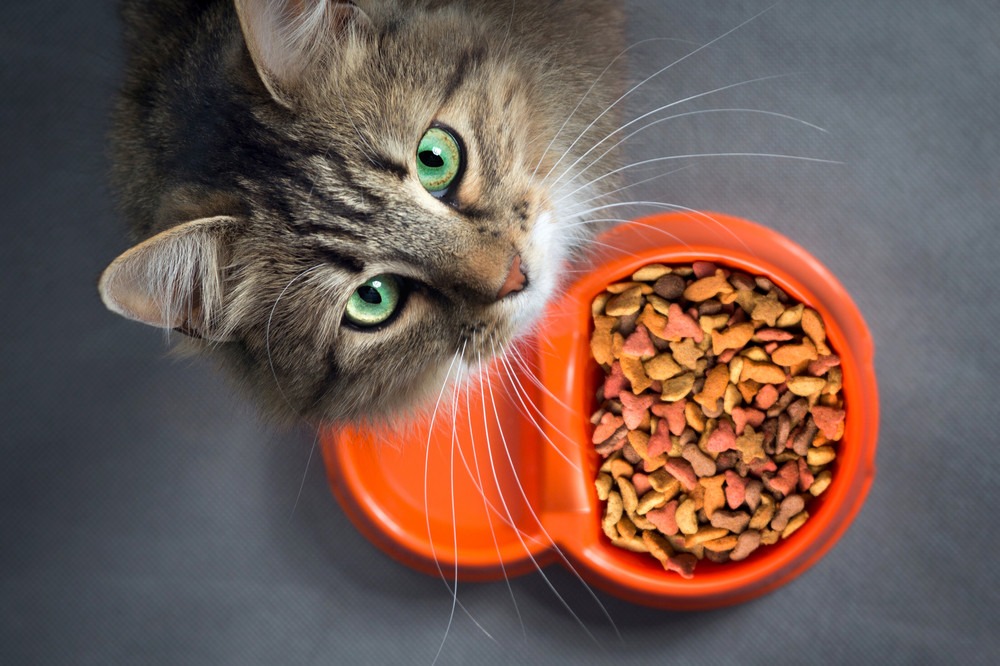
Scientists revealed the main secret: why cats suddenly refuse food. Image source: vprok.ru
Every cat owner has experienced this at least once: the pet enthusiastically starts eating, and a couple of minutes later turns around and walks away, leaving a full bowl. A new study by Japanese scientists explained this feline quirk: it’s not about being full and not about being picky — cats literally lose interest in food when they get used to its smell. This phenomenon is called sensory-specific satiety, and it’s well known to us humans: remember how after a heavy dinner you suddenly “find room” for dessert.
Why Cats Lose Interest in the Same Food
In humans, this mechanism has been studied for a long time. We lose our appetite for a specific dish, but as soon as a new smell or taste appears, the desire to eat returns. That’s exactly why at a restaurant after the main course we easily agree to dessert, even though a minute ago it seemed like we couldn’t eat another bite.
Scientists from Iwate University (Japan) hypothesized that cats have a similar mechanism, only with smell playing the key role. The feline nose produces many oddities: for example, smell may be one of the reasons why cats are afraid of water. As the study authors write, cats often stop eating long before they are full, even after 16 hours of fasting. But if you remove the bowl for ten minutes and return the same food, they start eating again. This clearly doesn’t look like “she ate her fill and left.”
The Food Experiment: Why Cats Ate Less and Less
The study involved 12 healthy domestic cats of mixed breeds. Scientists developed a series of tests to separate the influence of smell from the actual feeling of hunger.
First, the cats were not fed for 16 hours, and then they were offered 20 grams of dry food. You’d think that after such a break, the animals would eat everything. But out of 12 cats, only four ate the entire portion within the allotted 10 minutes. On average, cats ate only about a third of the offered food — even when hungry. At the same time, the opposite can happen with food: some store-bought foods hook pets so strongly that it seems like the food drives the cat crazy.
Then the scientists conducted a series of six cycles: 10 minutes of feeding, 10 minutes of break with an empty bowl. When cats were repeatedly given the same food, they ate less with each cycle — regardless of brand and flavor. But when a new type of food was offered in each cycle, consumption remained stable or even increased.
Why Cats Eat Less Due to the Smell of Familiar Food
The most elegant part of the experiment was the dual-chamber bowl test. Scientists used a special design: the lower compartment contained one food, and its smell rose up to the upper compartment, where the actual food was placed. The food in the upper compartment didn’t change, but when a different food’s aroma came from below, the cats ate noticeably more.
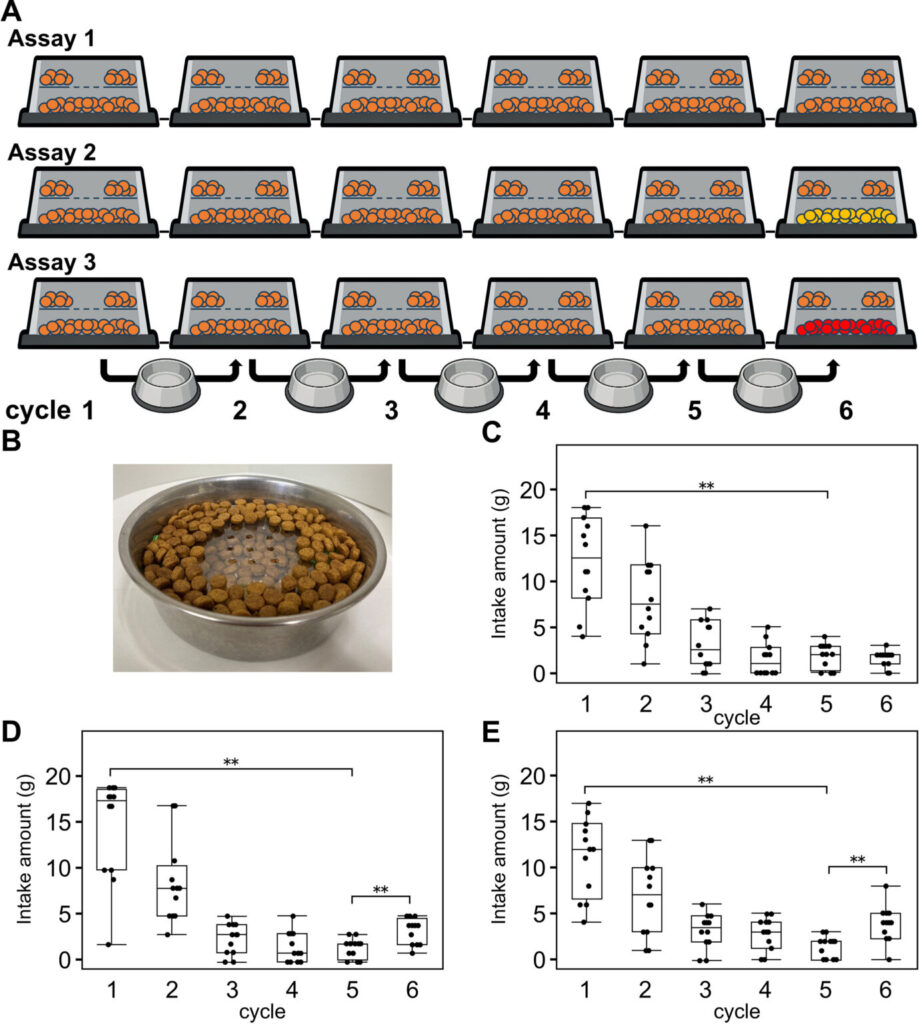
Illustration from the study, showing in detail the experiment with the dual-section bowl. The smell from below affects the cat’s appetite above. Image source: sciencedirect.com
There was also a reverse test: if before feeding a cat was pre-exposed to the smell of the food it would later receive, it ate less. But if it was given a different food to sniff beforehand, the appetite was preserved. Scientists also measured the volatile organic compounds of each food and confirmed that all six types had different “aromatic profiles,” although the degree of “smelliness” did not match the cats’ taste preferences.
“Cats don’t stop eating because they’re full,” explains animal behavior specialist Masao Miyazaki. — Their motivation to eat decreases as they become accustomed to the food’s smell and is restored when a new aroma appears. Sensory novelty, especially olfactory, can reactivate feeding behavior.”
Why Dogs Eat Everything While Cats Are Picky
The difference between cats and dogs in their attitude toward food is not just an everyday observation, but a result of evolution. Dogs descended from pack predators that needed to eat quickly and a lot before their packmates took the prey. Hence the habit of “swallowing without chewing” — sometimes literally to the point of vomiting.
The ancestor of the domestic cat — the African wildcat (Felis lybica) — hunted alone for small prey. It didn’t need to hurry, but it had to hunt many times a day. Hence the strategy of “eating often and little,” where olfactory novelty plays the role of a switch: a new smell signals new prey and restarts the appetite.
Interestingly, according to earlier studies, olfactory habituation in dogs is much less pronounced. Perhaps this is why dogs, not cats, are used to search for explosives and prohibited substances: their nose doesn’t “tire” as quickly from the same smell. In dogs, it works like a separate super-device, and a wet nose helps them better detect scents and air movement.
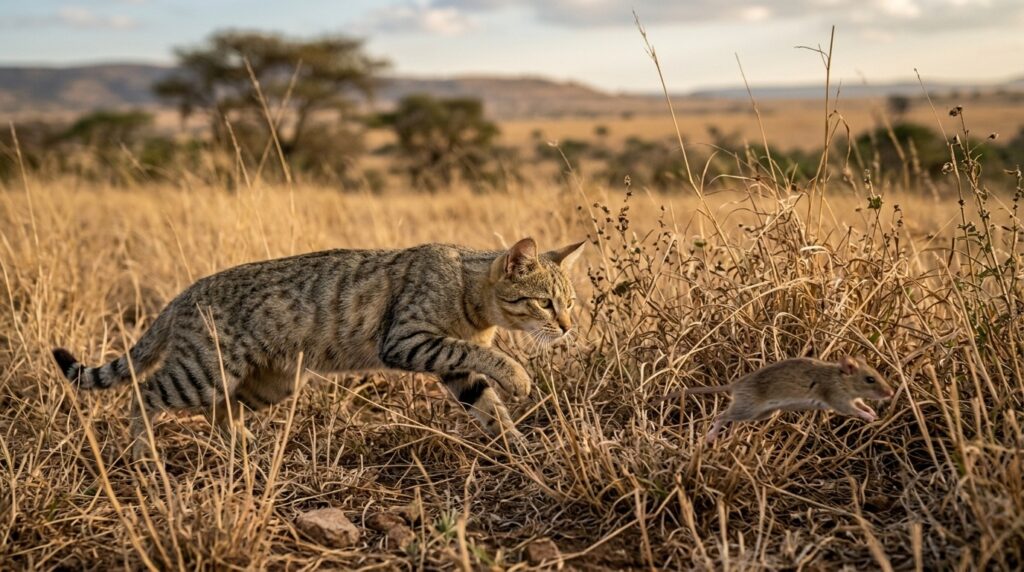
The African wildcat — ancestor of domestic cats — hunted small prey many times a day
How to Help Your Cat Eat Better and Not Refuse Food
The study results were published in the journal Physiology & Behavior and have quite practical significance for cat owners — on both ends of the weight scale.
For overweight cats, the discovery suggests an unexpected strategy: instead of a strict diet, you can try controlling the smells. If olfactory habituation reduces appetite, then limiting the variety of smells can help a cat eat less without strict portion restrictions.
For sick or elderly cats that lose their appetite, the approach is the opposite:
- alternate foods with different aromatic profiles
- slightly warm the food to enhance the release of volatile compounds
- don’t leave a bowl with the same food for a long time — it’s better to remove it and offer again after some time
But if the refusal to eat persists for several days, accompanied by lethargy, thirst, or sudden weight loss, that’s already a reason to check whether the cat is ill.
It’s important to understand that the study was conducted on a small sample (12 cats) and its results should still be viewed as preliminary. Nevertheless, the mechanism of olfactory satiety itself is well studied in humans, and its discovery in cats appears to be a logical continuation of this line of research.
So when your cat demonstratively turns away from the bowl, don’t rush to blame the food or feline temperament. It’s quite possible that she simply needs a new smell — just as we need dessert after the main course. This is not a whim, but an evolutionary nose setting that once helped her ancestors hunt more effectively.