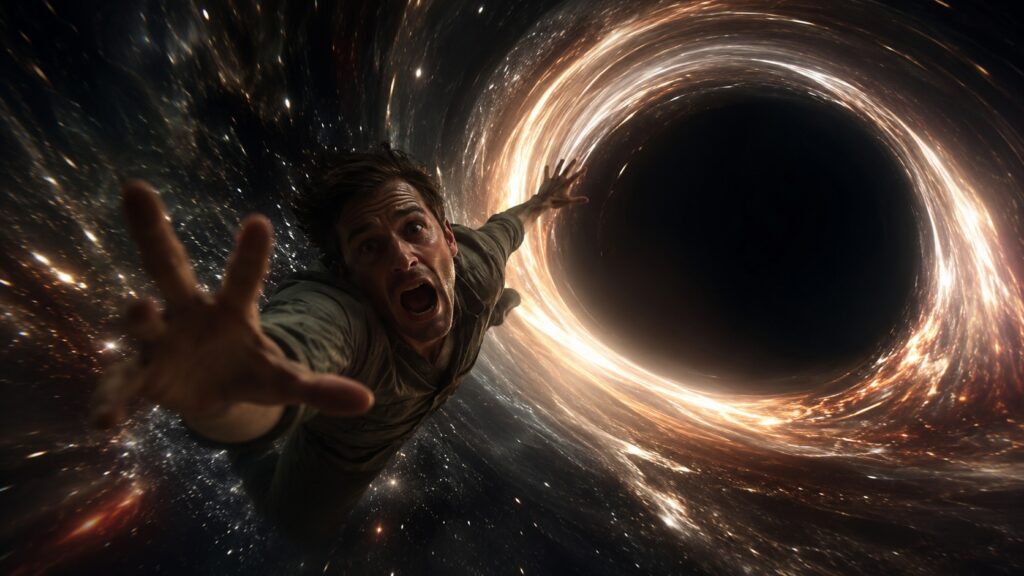
Falling into a black hole is visually incomparable to anything in our world
Surprisingly, scientists already know exactly what a person falling into a black hole would see. These aren’t guesses or science fiction, because the calculations exist and they give a clear answer. But reality differs so much from Hollywood movies like Interstellar that most people would be surprised. So what exactly happens in the final seconds before the inevitable?
What Approaching a Black Hole Looks Like
First, a dark spot will appear ahead, blocking out the stars. A black hole has no solid surface — it’s merely a region of space with incredibly strong gravity. What we see as a black circle is the shadow of the black hole, which appears noticeably larger than the actual point of no return.
The closer you fly, the more the surrounding cosmos becomes distorted. Gravity bends rays of light, so stars will begin stretching into arcs and multiplying. You will literally see the same cosmic object from different sides simultaneously. If there is a glowing gas disk around the hole, you’ll be able to see its far side, hidden behind the dark sphere, because light simply curves around it in an arc.
As you accelerate, the light ahead will begin to change. Due to physical effects excellently demonstrated on the NASA website, the radiation will shift into the blue spectrum. Harmless reddish light will become blindingly white, then blue, and eventually turn into hard X-rays, which is in itself fatally dangerous without reliable shielding.
What Is Spaghettification in Simple Terms
The main danger when falling into a black hole is not a collision, but the colossal difference in gravitational pull. A black hole pulls your feet more strongly than your head, simply because they are a couple of meters closer to its center.
This effect causes spaghettification. The body begins to stretch lengthwise and compress from the sides. Scientists long ago calculated what would happen if you fell into a black hole: a person would be torn apart into atoms while still far from the event horizon.
That is precisely why for our thought experiment we chose a supermassive black hole with a mass equal to millions of Suns. For such giants, the event horizon is so vast that the gravitational gradient remains tolerable. This gives a theoretical chance to cross the fateful boundary alive.
The Event Horizon of a Black Hole and the View from Inside
Crossing the event horizon — that very mathematical boundary from which light cannot escape — will pass completely unnoticed. You won’t collide with a firewall, nor will you break through an invisible membrane. Your wristwatch will continue ticking at its usual pace, and your heart will beat as normal.
Contrary to popular misconceptions, it won’t instantly become absolutely dark inside. The event horizon works like one-way glass: light from inside cannot get out, but from outside it continues to fall inward unimpeded. You will still see outer space, though the image will compress into a bright, monstrously distorted spot above your head.
You often hear the beautiful tale that a falling observer would watch billions of years fly by and witness the death of the Universe. But calculations by Russian physicists, published in the journal “Uspekhi Fizicheskikh Nauk”, prove the opposite. A finite amount of time remains until your demise, and light from the infinite future simply won’t have time to catch up with you.
What Happens at the Center of a Black Hole
After crossing the horizon, any maneuver becomes pointless. Moving toward the center is now as inevitable as moving into tomorrow. Even if you turned your ship around and fired the engines at full power, you would only slightly delay the finale.
At the very center, according to classical general relativity, lies the singularity — a mysterious region where the familiar laws of physics cease to function. Will you see it? Almost certainly not. Tidal forces will tear apart any matter within seconds before you could get close to the center.
But for your friends who stayed at a safe distance, the ending of this story would look entirely different. They will never see you cross the horizon. Due to time distortion, your image will begin to slow down, growing ever dimmer and redder, until it finally freezes near the black shadow and dissolves into darkness.
So it can be said that falling into a black hole is the most incredible optical spectacle in the Universe, one that inevitably ends in total destruction. And although no person could ever send a photograph from there, modern science allows us to imagine this mesmerizing sight in full detail.