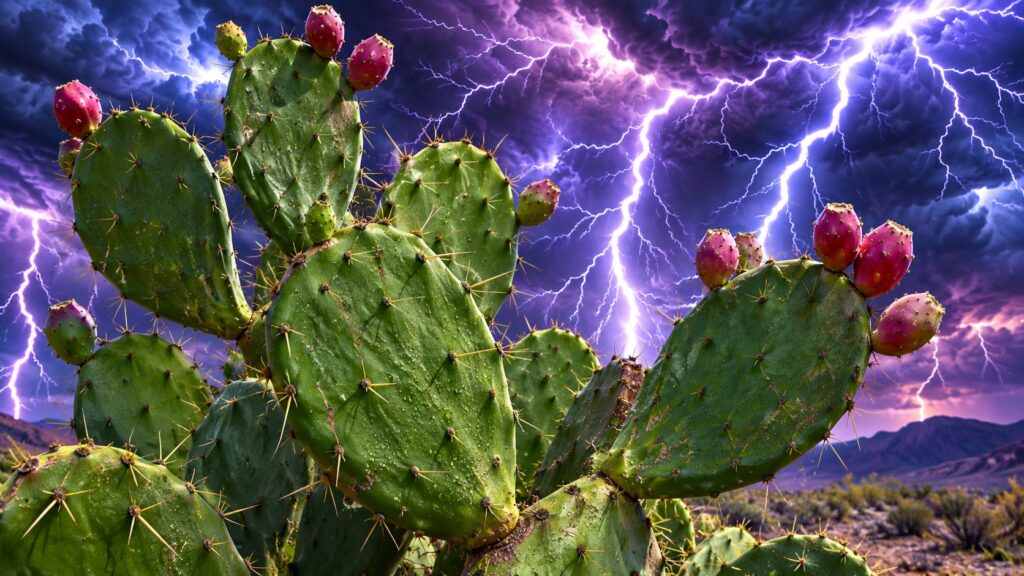
A cactus with lightning discharges
Researchers at the University of California, Santa Cruz have turned prickly pear cacti into a small living power source. By connecting eight plants, they obtained 4.5 volts. The effect comes from a difference in acidity between the sunlit and shaded sides of each cactus. No one is proposing to charge phones or run lamps this way. Instead, the researchers see a possible use in powering small, low-energy sensors on farms. They describe it as an early-stage method that still needs development.
What you need to know
- Eight connected prickly pear cacti produced 4.5 volts, three times the voltage of a standard AA battery.
- The voltage arises because malic acid breaks down only on the sunlit side of the plant, leaving the shaded side more acidic.
- After 15 months without water, the cacti were still photosynthesizing, and sometimes showed higher voltage than regularly watered plants.
- The work was published in Plants, People, Planet on November 19, 2026. The source does not report how much power the plants can sustain over time.
Why cacti are suited to this
Cacti are known for surviving in hot deserts with very little rain. They store water in thick, fleshy stems. Their spines are modified leaves that lose almost no moisture and also protect the plant from animals.
Prickly pears take in air at night to save water
Most plants feed through photosynthesis, using sunlight to turn carbon dioxide and water into sugar. They take in carbon dioxide through tiny pores in their leaves, which stay open during the day. For a desert plant, that is risky: in the heat, too much water would escape through those pores.
Prickly pear, along with aloe, pineapple and agave, uses a different metabolic strategy known as CAM metabolism:
- The plant opens its pores only at night, when it is cool.
- It absorbs carbon dioxide and stores it as malic acid.
- During the day, it uses that acid for photosynthesis in the light.
This schedule lets the plant feed around the clock while losing very little moisture.
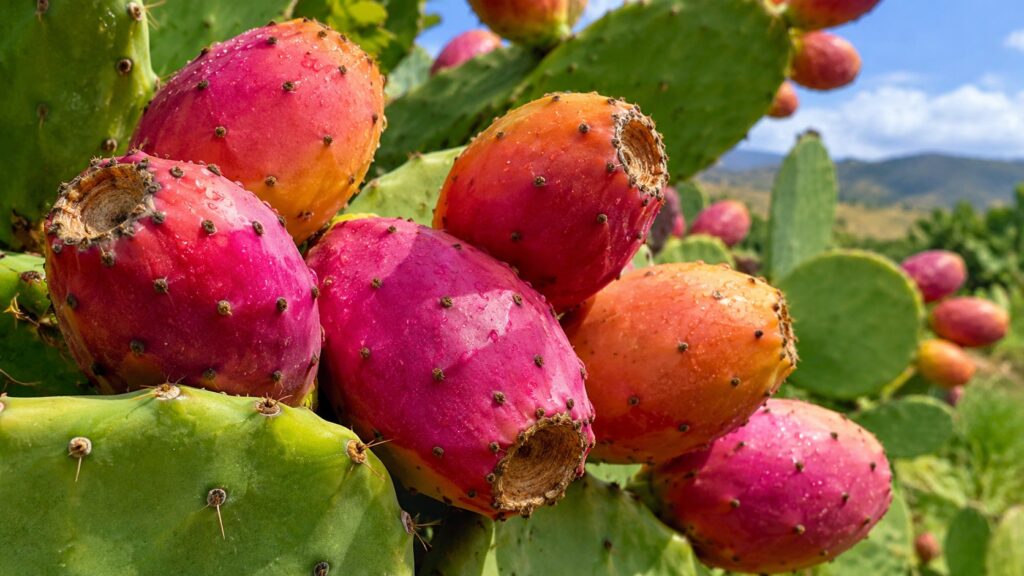
Prickly pear cactus
How sun and shade create a voltage
During the day, malic acid breaks down only on the side of the cactus that faces the sun. The shaded side stays acidic, so a single plant contains two zones with different acidity.
Ordinary batteries rely on a similar principle. When two parts differ in chemical composition, an electrical voltage can be produced. The UC Santa Cruz team used this property to turn prickly pear into what the source calls a green solar panel. They described the system in the journal Plants, People, Planet on November 19, 2026.
According to the source, the original paper does not explain exactly how the wires were attached to the plants. Details of the setup are therefore not yet available.
About ten students from different departments worked on the project. Co-author Charlie Chesney, an environmental specialist, said that this kind of collaborative work is needed to find solutions to climate change.
Eight cacti, 4.5 volts
A single wired prickly pear produces very little electricity. When several plants are connected, however, their voltages add up. Eight cacti together produced 4.5 volts, exactly three times the voltage of a standard AA battery.
That figure needs context. You would not even feel this voltage if you touched the wires, and no one is proposing to charge a phone or run a lamp from cacti. The source also reports only voltage and does not say how much power the plants can deliver over long periods. According to the source, the voltage is enough for small, energy-efficient sensors that farmers place in fields to monitor crop conditions.
Drought did not stop the cacti producing electricity
The researchers also tested the plants in the desert’s main challenge: going without water. Even after 15 months of drought, the prickly pears survived and kept photosynthesizing. At times, they produced higher voltage than cacti that were watered regularly.
Chesney called this a very unexpected result. He said a cactus can keep generating electricity even when it looks almost dead. According to the source, the authors do not explain in the available materials why the drought-stressed plants sometimes produced higher voltage.
Living sensors for farms, and the method’s limits
Ecologist Michael Loik, another co-author, sees a possible role in agriculture. Wired cacti could act as living “sentinels” in a field. They would power their own sensors, monitor field conditions and send data to a farmer’s computer. In that scenario, no batteries would need replacing and no power lines would need to be run to the sensors.
The idea is not limited to prickly pear. The same approach could in principle work with any plant that uses night-time CAM metabolism, such as aloe, pineapple or agave. On farms that already grow these crops, it could become a convenient add-on.
What remains uncertain
This is an early development, not a finished technology. The authors themselves say the method needs further work. Several key questions remain open:
- How much energy can the cacti supply over months?
- How reliable are such systems under real field conditions?
- Would they cost less than conventional solar panels or batteries?