For a typical bathroom, washing a shower curtain about once a month is reasonable, though the right interval depends on how many people shower and how quickly the room dries. The source author reached that conclusion after reviewing scientific data and advice from sanitary physicians. The author rarely takes baths and almost always showers, so the curtain gets wet every day, and had been washing it monthly. After repeatedly seeing claims that curtains carry more germs than toilets, the author looked for evidence. The verdict was that there is no need to panic, but a few small habits are worth adopting.
What you need to know
- A 2004 study of four vinyl shower curtains, each used for more than six months, found 117 unique bacterial DNA sequences. The most common genera were Sphingomonas and Methylobacterium.
- The study did not measure how many bacteria were present per square centimeter, so claims that curtains have “100 times more germs than a toilet” are not supported by it.
- It also did not show that people become infected from shower curtains at home. The source says the risk is low for healthy adults but matters more for people with severely weakened immunity.
- There is no official washing schedule. The source suggests about once a month for an ordinary bathroom and more often in large households or damp rooms.
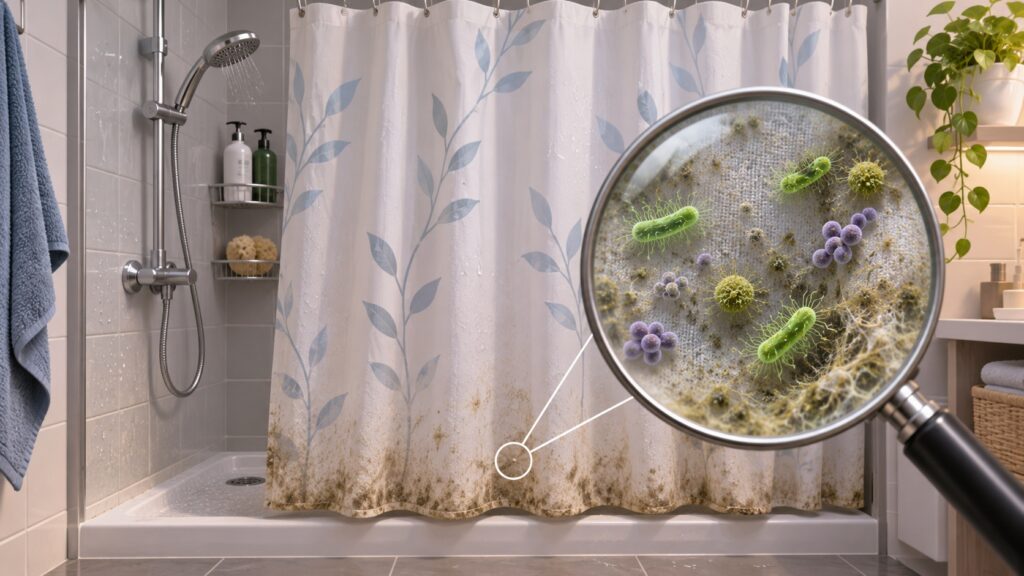
Bacteria on a shower curtain
117 bacterial DNA sequences on four curtains
The main scientific work on the topic was published in 2004 in the journal Applied and Environmental Microbiology. American microbiologists collected four vinyl shower curtains from different homes, each of which had been in use for more than six months. The researchers scraped off the film on the curtains, examined it under a microscope and identified the bacterial DNA it contained.
In total, they found 117 unique sequences of bacterial DNA. That does not mean each curtain hosted exactly 117 species. It means that, taken together, the curtains supported a highly diverse community. Bacteria from two genera turned up most often:
- Sphingomonas. These bacteria usually live in water and soil, and some can cause infections in people with weakened immune systems.
- Methylobacterium. These thrive in damp conditions and can leave a pinkish film. Some species are also opportunistic pathogens, meaning they usually do not harm people with normal immunity.
There is an important caveat. The study was small, and the researchers did not count how many bacteria were present per square centimeter of curtain. As a result, claims such as “100 times more germs than a toilet” are not supported by this research.
Soap scum is sometimes a microbial colony
According to the source, the film that many people assume is dried soap can sometimes be a dense cluster of bacteria known as a biofilm. A biofilm is a layer of microbes bound together by substances the microbes produce themselves. This “glue” holds them on a surface and protects them from the outside environment.
A shower curtain offers almost ideal conditions. After every shower, it holds water droplets, skin particles, sebum, shampoo and shower gel. Bacteria arrive from the water, the air and our bodies. If they manage to attach, they begin to multiply.
The dirtiest areas tend to be the bottom edge, which touches the tub, and the folds, where moisture lingers longest. Pushing the curtain into a bunch after showering is the worst option, because the inside stays wet for a long time. The Moscow Center for Hygiene and Epidemiology also identifies shower curtains as places where bacteria accumulate. It advises regularly rinsing off shower gel and shampoo residue.
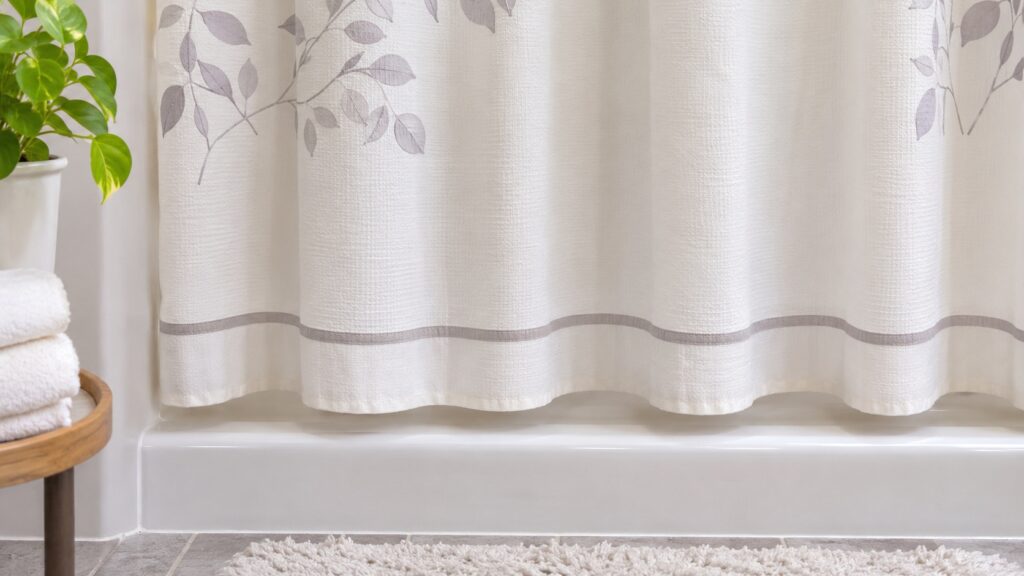
The bottom of a clean shower curtain
A curtain poses little threat to a healthy person
Bacteria are almost everywhere, and their presence alone does not mean danger. People encounter enormous numbers of microbes every day and do not get sick from most of them. The source says an ordinary shower curtain poses no serious danger to a healthy adult.
However, the source identifies situations in which it is better not to let a curtain get dirty:
- Severely weakened immunity, for example after an organ transplant, during chemotherapy or in similar situations. Some of the bacteria found on curtains are related to pathogens that cause infections.
- Cuts and damaged skin. In theory, the risk of infection rises if a dirty curtain repeatedly rubs against them. A single touch does not mean infection is inevitable.
- Mold. Microscopic fungi also grow on curtains that stay damp. In sensitive people, their spores can cause allergies and irritate the airways.
It is important to note that the study found only the DNA of bacteria related to pathogens. It did not prove that people become infected from shower curtains in their homes.
What pink, black and white films can indicate
You do not need a microscope to tell when a curtain needs washing. A pink or orange film is often a bacterial biofilm. In the 2004 study, the pink color was linked specifically to Methylobacterium. However, a bacterium cannot be reliably identified by color alone.
Black or dark green spots usually indicate mold, especially if they spread and smell musty. A white or gray film most often consists of mineral deposits and soap, although microbes can be present there too. The source also lists warning signs: a slimy surface, an unpleasant smell and dirt that quickly returns after washing.
How often to wash a shower curtain
There is no official standard for how long a shower curtain can go without washing. For an ordinary home, the source considers washing it about once a month reasonable, so the author’s existing habit turned out to be adequate. The right frequency depends on how many people shower and how quickly the bathroom dries.
| Conditions | How often to clean |
|---|---|
| Daily showers, bathroom is reasonably well ventilated | Once a month |
| Large household, several showers a day | Every 2–3 weeks |
| Bathroom is constantly damp, film returns quickly | Every 1–2 weeks, while also tackling the dampness |
| Slime, dirt or mold has appeared | Immediately |
The source notes that these intervals come from practical experience rather than scientific experiments. Following a strict calendar is not essential. What matters most is not letting dirt build up.
Fabric goes in the washing machine, plastic gets a sponge
The cleaning method depends on the material. According to the source, fabric and polyester curtains can usually be machine-washed on a delicate cycle at 30–40°C (86–104°F) with a small amount of ordinary detergent powder or gel. Check the care label first, because some fabrics have restrictions.
Vinyl and plastic curtains are easier to clean with warm water, a soft sponge and detergent. Some can be machine-washed at a low temperature, but not all. Hot water can deform plastic, and the source advises against drying such curtains on a hot radiator or in a tumble dryer.
Pay particular attention to the bottom edge, seams and folds, where film builds up fastest. After washing, rinse the curtain thoroughly, spread it out and let it dry completely. The source advises avoiding chlorine bleach unless necessary and making sure any mold remover is suitable for the material. Chlorine-based products must not be mixed with vinegar, acidic cleaners or ammonia.
When to replace a curtain instead
There is no expiration date after which every shower curtain becomes dangerous. According to the source, a good fabric curtain will last a long time with proper care. However, it is worth replacing one if mold has become ingrained in the material, stains will not wash out, the smell does not go away or the surface has started to break down. The source advises extra vigilance if someone with severely weakened immunity lives in the home.
Spreading the curtain out after a shower slows buildup
The most useful habit takes only a few seconds. After showering, spread the curtain out to its full width so the folds can dry, and rinse off any foam if possible. The bottom edge should not sit in water all the time, but the curtain should still be long enough to keep water off the floor.

A bathroom with a shower curtain and an exhaust fan on the wall
Running the exhaust fan or airing out the bathroom is just as important. If dampness lingers for hours, even a freshly washed curtain will quickly develop a film again. A clean appearance also does not mean there are no bacteria, so the source recommends washing the curtain even when it looks fine.
The bottom line
The source author plans to keep washing the curtain monthly, which suits an ordinary bathroom. The author will also spread the curtain out after every shower, ventilate the bathroom and wash the curtain as soon as a film appears rather than waiting for the end of the month. In the author’s view, these habits do more good than constantly treating the bathroom with harsh household chemicals.