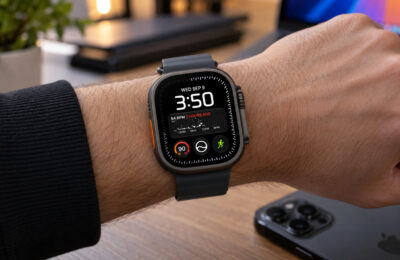
How many times a day do you look at your Apple Watch? One day I decided to count and got about 40. And most of those glances weren’t about “what time is it” but about “what notification just came in now.” For a year and a half I lived like that with the Apple Watch Series 10, until one day a Whoop copy popped up for 2,900 rubles: the same screenless band that Cristiano Ronaldo and half the world’s marathon runners wear, only not for 35 thousand, but 10 times cheaper and without a subscription. I got one to try — and since then my watch has just been sitting in a drawer. In this article I honestly break down what this screenless fitness band can actually do, where it falls short of the real Whoop, and whether it can really replace an Apple Watch.
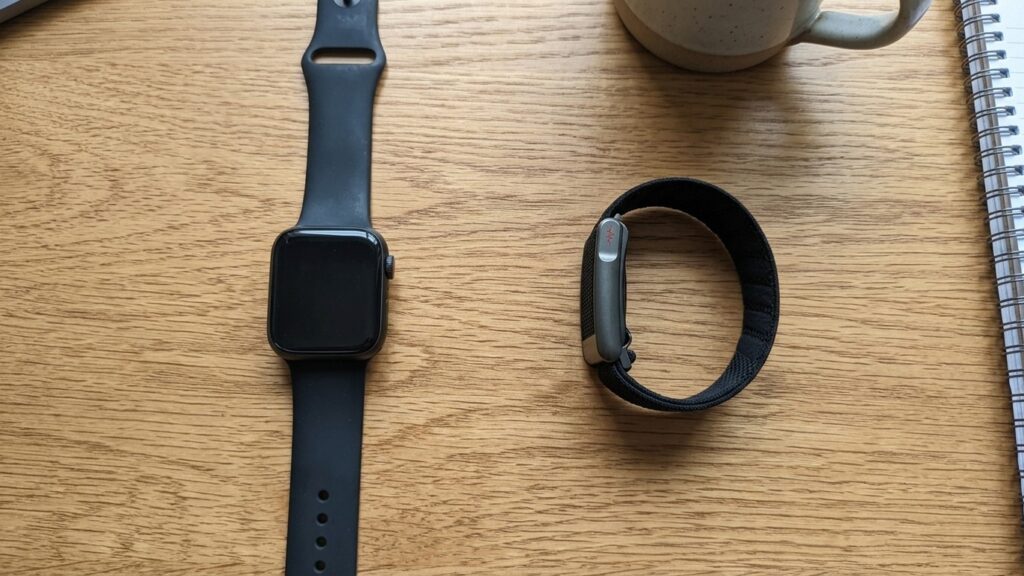
Left — Apple Watch for 40 thousand, right — what I actually wear every day.
What’s Wrong with Apple Watch in 2026: Notifications, Charging, and Price
The truth is, the watch had been driving me crazy with notifications for quite a while. Because it duplicates absolutely everything that comes to the iPhone — chats, reminders, emails, and even a message saying the watch is fully charged. In theory it seems convenient, but in practice it’s really exhausting. Even though half of those push notifications are completely unnecessary.
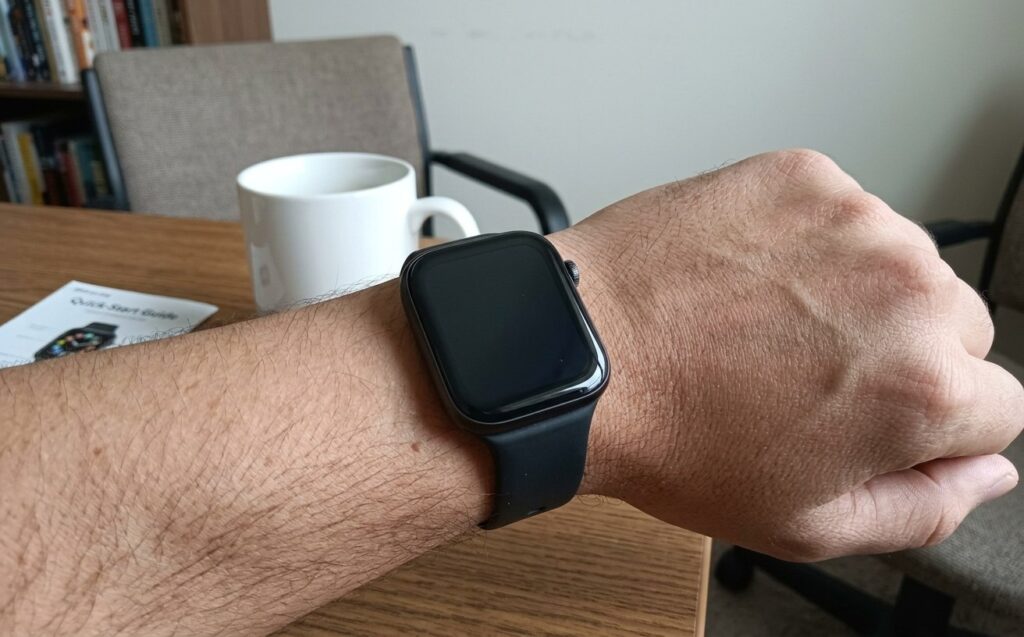
If Apple Watch had no screen and no notifications, they’d be the perfect smartwatch
But I couldn’t give up Apple Watch. First, because they track heart rate, and second, because they let me monitor my sleep, which most fitness bands can’t do. So switching from proper smartwatches to something like a Mi Band wasn’t appealing. After all, it’s both a noticeable drop in status and the same notifications that would keep driving me crazy.
You might say, just turn off notifications and live peacefully with Apple Watch. But Apple’s watch has another problem that nobody has solved yet. I’m talking, of course, about battery life, which Apple Watch simply can’t hold. Especially if you want to track sleep like I do — you’ll have to take the watch off and put it on the charger literally every day. And that’s inconvenient.
And lastly — the price itself, for which you endure all of this. The current Apple Watch model now costs around 40 thousand rubles, and the Ultra 2 is even more expensive. So lately I kept catching myself thinking: what exactly am I paying for? For calls from my wrist that I never use? For notifications I want to turn off anyway?
What Is Whoop and Is It Worth Buying in Russia
Whoop is a fitness band that simply has no screen. Basically, it’s a regular braided nylon strap with a metal sensor module that measures heart rate, SpO2, heart rate variability, and skin temperature 24/7, and all the data goes to a smartphone app.
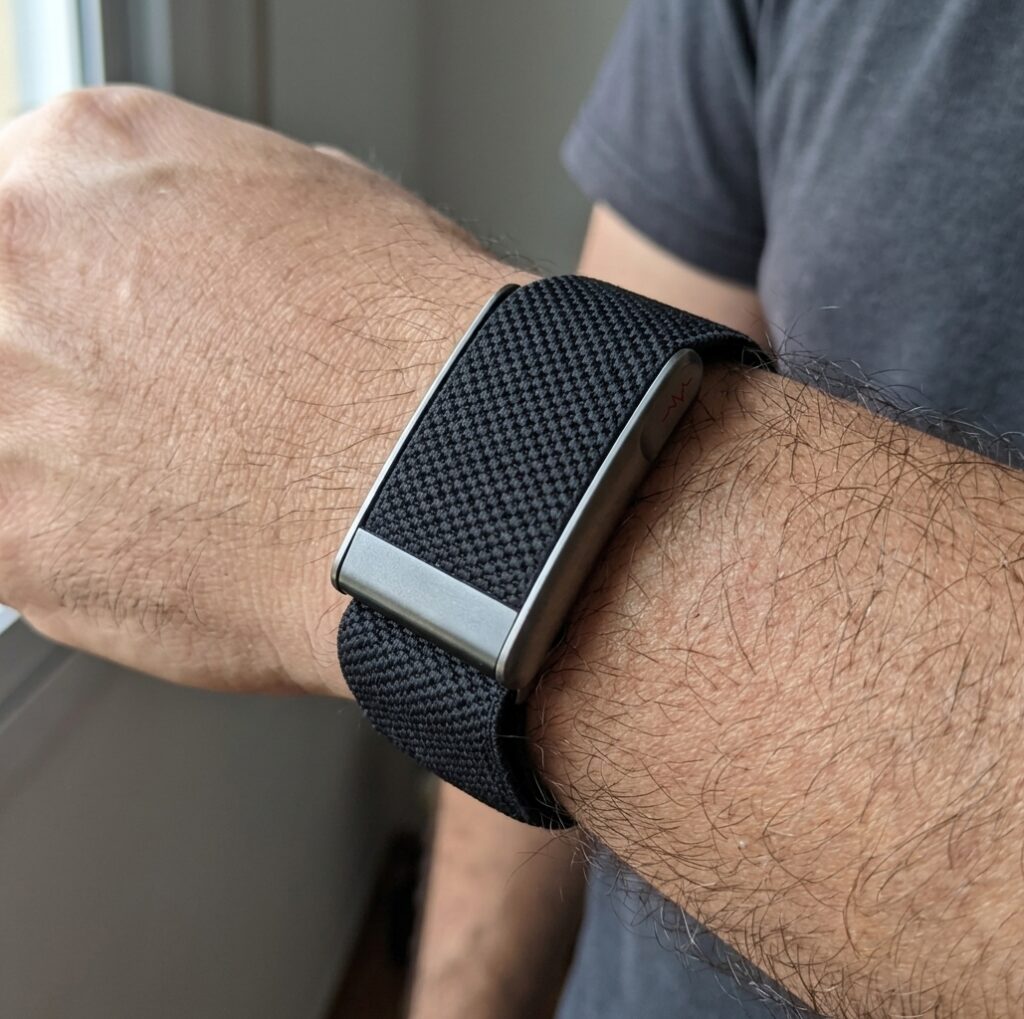
The braided strap sits over the sensor module — fabric is visible on both sides.
Nothing on the wrist blinks or beeps — no notifications distract you, and you focus only on your body. It’s precisely this minimalism that got Cristiano Ronaldo, LeBron James, and half the world’s marathon runners hooked on Whoop. After all, when you’re running thirty kilometers, the last thing you need is an extra screen on your arm.
The problem with Whoop 5.0 PEAK is just one thing — price and subscription. The band itself costs from 25 thousand rubles in Russian stores. But that’s not all, because then there’s the app subscription — $199 per year, which is another roughly 15 thousand rubles. And without it, the band simply stops working: the app won’t even launch.
Moreover, paying for the subscription from Russia isn’t that easy: our cards don’t work abroad, and you’ll either have to find intermediaries with a commission or ask someone overseas. In short, Whoop is worn in Russia by those who were ready to spend the same amount on a premium Apple Watch — they just chose different metrics. And for someone (like me, for example) who wants to measure heart rate and sleep without monthly payment hassles, it’s simply expensive and tedious.
Whoop Copy from AliExpress for 2,900 Rubles: What a Screenless Fitness Band Can Do
That band appeared under the name “Whoop copy.” And in terms of form, it really is identical: a braided black nylon strap with a small sensor module and a flat metal clip instead of a clasp. No display, no buttons. You can wear it on your wrist or on your bicep, because the package includes two straps of different lengths. This is actually a familiar thing for athletes — during a workout the band often moves to the bicep so it doesn’t interfere with bending your arm.
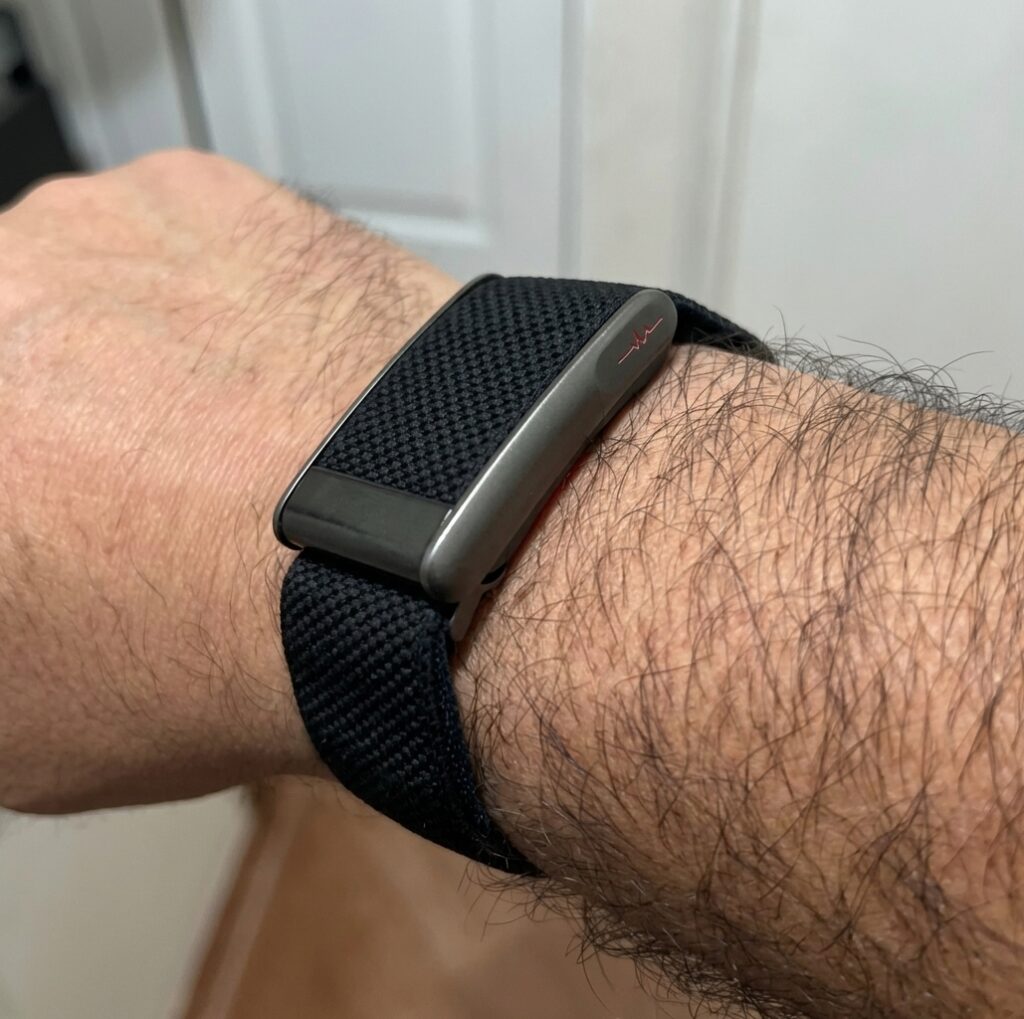
In profile you can see the module is really flat — it doesn’t bother you on the wrist at all.
In terms of sensors, it can do practically everything the original does:
- Heart rate and heart rate variability — optical PPG sensor, 24/7 measurement.
- Blood oxygen (SpO2) — nighttime and on demand.
- ECG — yes, a separate electrode that takes a 30-second electrocardiogram.
- Skin temperature — daily trend, helps catch a cold before symptoms appear.
- Sleep — phases, duration, micro-awakenings.
- Activity and calories — based on movement and heart rate.
It has 5 ATM water resistance, so you can swim without worry and don’t need to take it off in the shower. It syncs with your smartphone via Bluetooth, the app is free and works on both iPhone and Android. And no subscriptions — you don’t have to pay anything every month.
The Whoop Copy App: What Metrics It Shows You in the Morning
The app has three main screens: Recovery (how ready you are for exertion), Strain (how much strain you’ve accumulated during the day), and Sleep (how you slept). The logic is the same as the real Whoop, just with a simpler interface and without the trendy design.
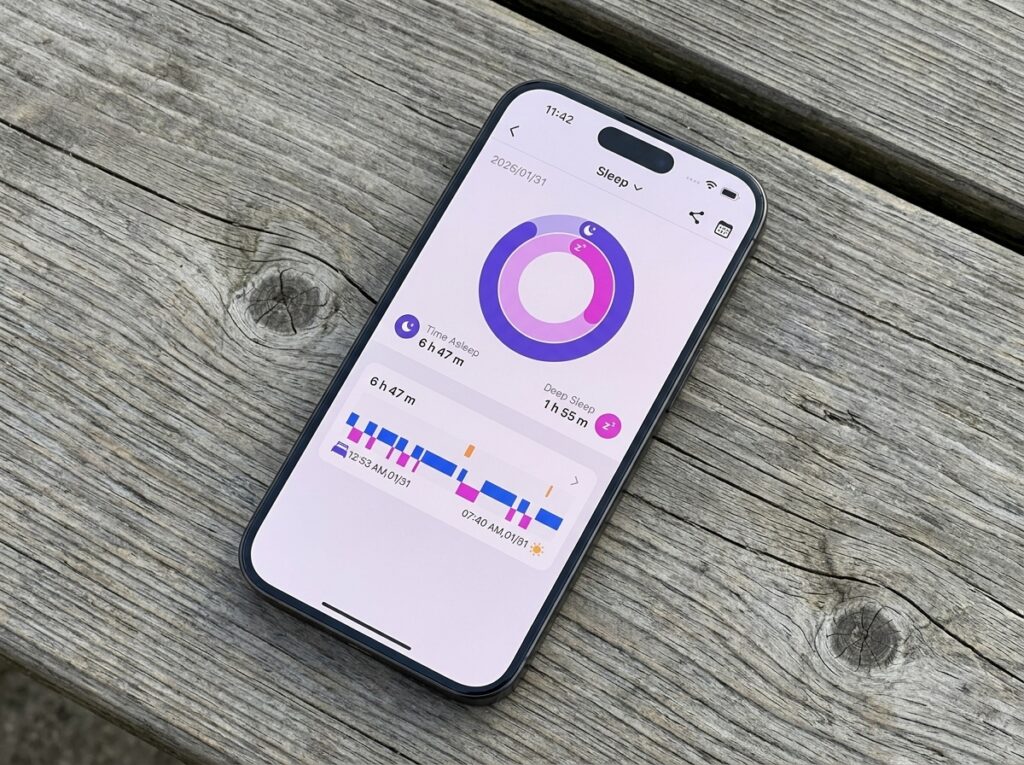
Nobody translated the app into Russian, of course
Recovery is calculated based on heart rate variability (HRV)