
One sleepless night rewires the brain: unexpected consequences for your health
We spend roughly a third of our lives sleeping, and for a long time scientists debated why we even need it. Now science has obtained important evidence: just one sleepless night noticeably changes the connections between neurons in the living human brain. A study from Germany’s Jülich Research Centre demonstrated this effect directly for the first time — not in animals, but in people.
The Synaptic Homeostasis Hypothesis: Why the Brain Needs a “Cleanup” During Sleep
One of the leading ideas about the benefits of sleep goes like this: while we are awake and interacting with the world, the connections between brain cells (synapses) are constantly strengthened. This is necessary for learning and memorizing, but it comes at a cost: the process devours energy and leaves behind metabolic “waste.”
To restore order and conserve resources, the brain needs to prune excess connections. But this can only be done when we are not building new ones — that is, during sleep. This idea is called the synaptic homeostasis hypothesis — essentially, at night the brain works like a gardener trimming the neural connection “bushes” that have overgrown during the day. Until recently, this was primarily supported by experiments on animals.
How Scientists First Observed Synapse Changes in Living Humans
To test the hypothesis in humans, researchers used PET — positron emission tomography. They radioactively labeled a special protein called SV2A, which is found in vesicles at the synapses themselves — the contact points between neurons. This essentially allowed them to “illuminate” and measure the density of connections in the living brain.
The logic is simple: the more of this protein there is, the more synapses exist in a given area. Previously, it was impossible to directly measure such subtle changes in humans, which is why this work became an important step. The results were published in the journal PLOS Biology.
What the Experiment with 40 Volunteers Showed
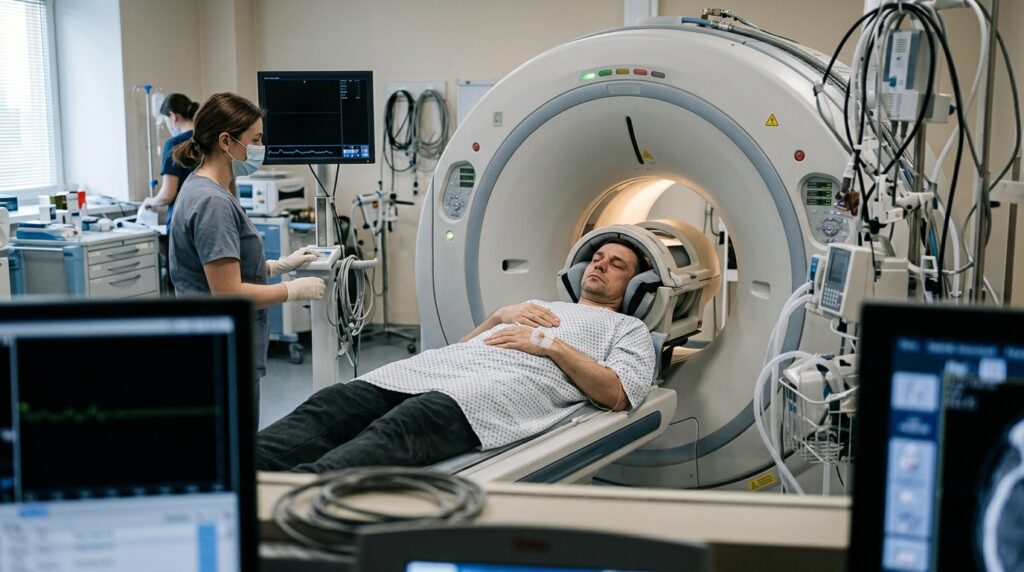
After 28 hours without sleep, volunteers had their brains scanned using PET
The study involved 40 people. Half of them were asked to stay awake for one night. After 28 hours of wakefulness, their brains were scanned and compared with those who had slept normally.
The difference was notable. In sleep-deprived individuals, synapse density differed primarily in areas responsible for:
- memory (the hippocampal region)
- processing and integrating information from the senses (the parietal lobe)
- transmitting signals through the central nervous system (the thalamus)
This is direct evidence that sleep deprivation doesn’t just cause fatigue — it physically affects the structure of brain connections — at least in regions critical for thinking and memory.
Why a Brain with More Synapses Sleeps More Deeply
Sleep-deprived participants were allowed to nap for two hours, and their brain activity was recorded during that time. It turned out that people with higher concentrations of SV2A protein more often entered slow-wave sleep — the deepest, most restorative phase.
In other words, the denser the “thicket” of synapses that had accumulated during the day, the more strongly the brain tried to plunge into deep sleep. It appears that high synapse density serves as a trigger for deep sleep phases, during which excess connections are pruned down to the level needed for the next day. The scans themselves don’t show what exactly happens during sleep, but the picture that emerges is logically consistent.
What a Sleepless Night and Synapse Status Mean for Dementia Risk
It’s important not to overinterpret the findings: the study does not claim that sleep has only one function or that we sleep solely for the purpose of “weeding” neurons. Sleep performs many tasks. But now there is solid evidence that our energy-hungry brain needs nighttime sleep to function at full capacity.
It becomes especially concerning when you recall the already-known consequences of sleep deprivation: chronic lack of sleep increases the risk of neurodegenerative diseases — for example, loss of deep sleep and dementia go hand in hand. Therefore, going to bed on time and sleeping soundly is probably one of the best things you can do to preserve mental clarity for a long time.