
We thought hair grows because cells at the roots divide and push it upward, like toothpaste from a tube. But that’s not the case. Image source: zmescience.com
For decades, biology textbooks explained hair growth simply: cells divide at the root and push the hair upward, like toothpaste from a tube. But a new study published in the journal Nature Communications has shown that this explanation isn’t entirely correct. In reality, hair isn’t pushed out — it’s pulled upward by a coordinated force inside the follicle, which works almost like a tiny biological motor. It turns out that the problem of hair loss has always been approached incorrectly.
How Hair Growth and the Hair Follicle Work
Before getting to the discovery, it’s worth recalling how the hair follicle works — a tiny factory hidden in the skin. At the bottom of the follicle is the so-called bulb, where cells actively divide. For a long time, it was believed that this division is what pushes the hair upward — somewhat like a conveyor belt, where new cells push old ones from below.
Around the hair shaft itself is a protective sheath — the outer root sheath. Previously, its role was considered purely passive: something like a sleeve that simply surrounds the growing hair. But it is precisely this structure, as it turned out, that plays a key role in growth.
A team of scientists from L’Oréal Research & Innovation and Queen Mary University of London were the first to observe living human follicles in real time, using 3D time-lapse microscopy. Before this, researchers had to work with static sections — essentially frozen “photographs” from which it was impossible to see the dynamics of the process.
Why Hair Doesn’t Grow Due to Cell Division
When scientists began tracking the movement of individual cells inside living follicles, they saw an unexpected picture. Cells of the outer root sheath moved downward along a spiral trajectory — that is, in the direction opposite to hair growth.
At first glance, this seems paradoxical: how can downward movement push hair upward? But the physics of the process turned out to be straightforward. Imagine grabbing a rope and pulling it downward, hand over hand. The rope itself slides upward. The follicle works in roughly the same way: the coordinated spiral movement of cells around the shaft creates traction that pulls the hair out of the skin.
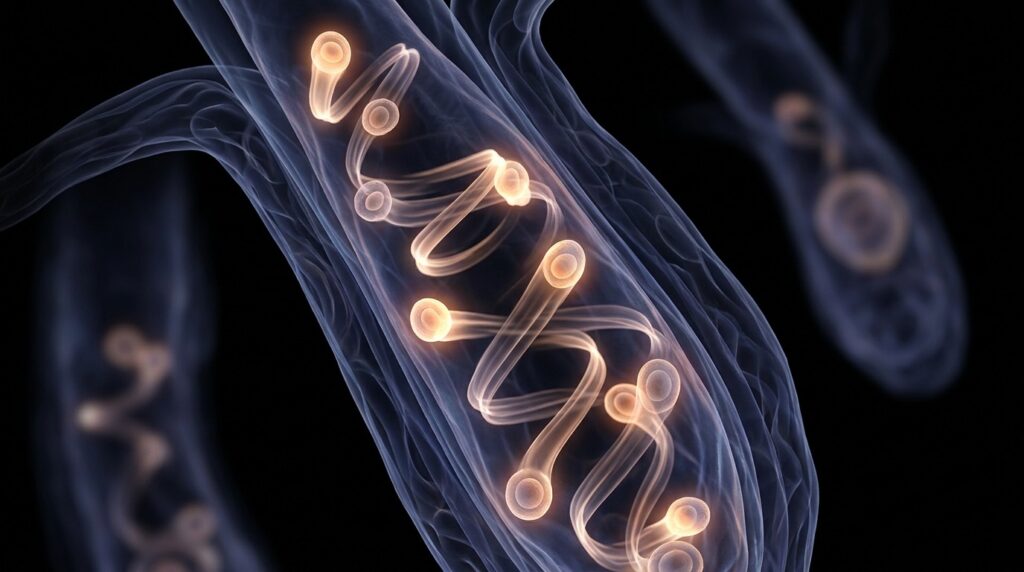
3D visualization of cell movement inside the hair follicle
Professor Inês Sequeira, one of the study’s authors, called what happens inside the follicle a “fascinating choreography” and compared its function to a “tiny motor.” This is not just a metaphor: it refers to a real mechanical force created by cells acting in concert.
What Scientists Proved About the Mechanism of Hair Growth
A beautiful hypothesis required rigorous testing. And the researchers conducted two key experiments.
First, they blocked cell division in the follicle. If the old “pushing” model were correct, the hair should have stopped growing. But that didn’t happen — growth continued at nearly the same speed.
Then the scientists suppressed the activity of actin — a protein that allows cells to contract and move. Actin is essentially the “muscle” of every cell: it forms the internal scaffold that enables cells to change shape and move. When actin function was disrupted, hair growth speed dropped by more than 80%.
This became the decisive proof: it is the mechanical movement of cells, not simply their division, that is the main driver of hair growth. Computer models confirmed the conclusion — the calculated traction force created by the coordinated cell movement precisely matched the actual growth rate.
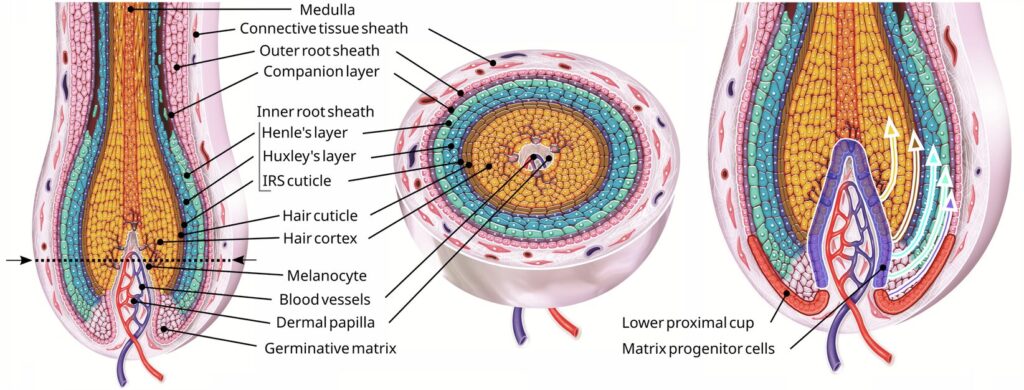
Structure of the hair follicle. 1. Hair follicle bulb containing concentric layers of different cell types. The layers are divided into several compartments: the hair shaft, consisting of the medulla, cortex, and cuticle; the inner root sheath, consisting of the cuticle, Huxley’s layer, and Henle’s layer; the companion layer and the outer root sheath. The dashed line marks the cross-section area. 2. Modern model based on cell lineage tracking linking locally differing matrix progenitor cells with the growing layers of the hair follicle. Image source: nature.com
How the Discovery of the Hair Growth Mechanism Will Change Baldness Treatment
Today, most hair loss treatments work with biochemistry: they stimulate cell division, affect hormones, and improve blood supply to follicles. This is the basis of how minoxidil and finasteride work — the two most popular drugs. But if the main driving force of growth is not cell division but mechanical movement, then existing approaches are only addressing part of the picture.
The new understanding opens an entirely different direction: creating drugs that restore or enhance the physical dynamics inside the follicle. This involves how cells move, how they create traction, and how follicle tissues maintain their structure.
Moreover, the developed 3D visualization methodology allows testing drugs directly on living human follicles — observing not only cell division but also cell movement in real time. This is fundamentally important because until now, most knowledge about hair growth was obtained from rodents, and human follicles are structured differently.
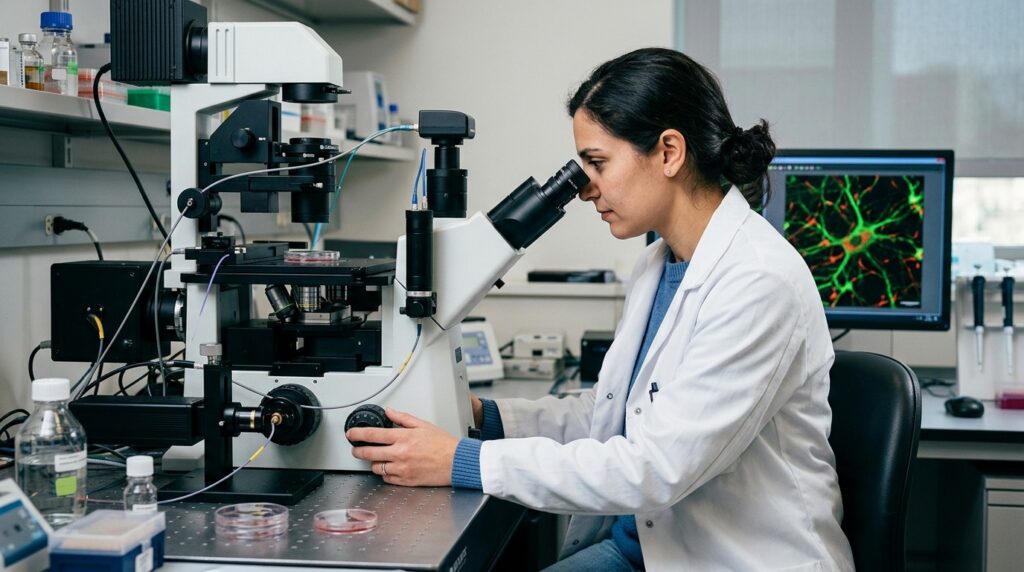
Researcher working with a multiphoton microscope to observe living follicles
What Affects Hair Growth and Why It Changes
The average speed of hair growth on the head is about 1–1.5 cm per month, or approximately 12–15 cm per year. Women’s hair typically grows slightly faster than men’s, and the most active growth occurs between ages 15 and 30. Growth speed is influenced by genetics, hormonal levels, nutrition, stress, overall health, and even the external environment.
But all these factors have until now been viewed exclusively through the lens of biochemistry — hormones, vitamins, blood supply. The new study adds another, previously unknown parameter to this list: the mechanical activity of follicle cells. It’s possible that for some people, problems with hair growth or baldness are linked not only to nutritional deficiencies or hormonal imbalances but also to disruption of this “internal motor.”
However, the boundaries of the discovery should be honestly noted. The experiments were conducted on follicles grown in laboratory conditions, not in living skin. Scientists still need to confirm that the same pulling mechanism works in a complete organism — with its blood flow, hormones, and immune system. It also remains unclear whether this mechanism is the same for different types of hair and areas of the body.