How astronauts do laundry in space without water
On Earth, you can simply toss a dirty T-shirt into a washing machine. In space, that’s not an option: water is scarce, it has to be reused, and wasting it on laundry is an unaffordable luxury. So astronauts wear the same clothes until they’re completely soiled and then simply throw them away. Scientists have proposed a solution — laundry without a single drop of water using cold plasma.
Why You Can’t Do Laundry in Space Like on Earth
Water in space is worth its weight in gold. Every liter must either be transported from Earth or produced on-site, and nobody is going to allocate it for laundry. That’s why clothes are never washed on the International Space Station.
Instead, garments are cleaned with a dry vacuum and wiped down with chemical wipes. It works poorly: neither of these methods effectively kills bacteria. As a result, astronauts wear the same clothes for weeks until they become completely dirty, then dispose of them along with other trash. For short flights this is tolerable, but for long future expeditions to the Moon or Mars, where resupply ships will be rare, this approach won’t work.
How Cold Plasma Kills Bacteria Without Water
A team of scientists from the University of Alabama in Huntsville, together with a NASA microbiologist, built a compact device that emits a jet of cold plasma roughly the thickness of a pencil.
The principle is as follows: high voltage ionizes a mixture of helium, air, and water vapor. When this jet is directed at fabric, reactive oxygen species are formed — for example, ozone. They penetrate between the fibers and destroy microbes through oxidative stress. Simply put, they burn them chemically, without heat or fire.
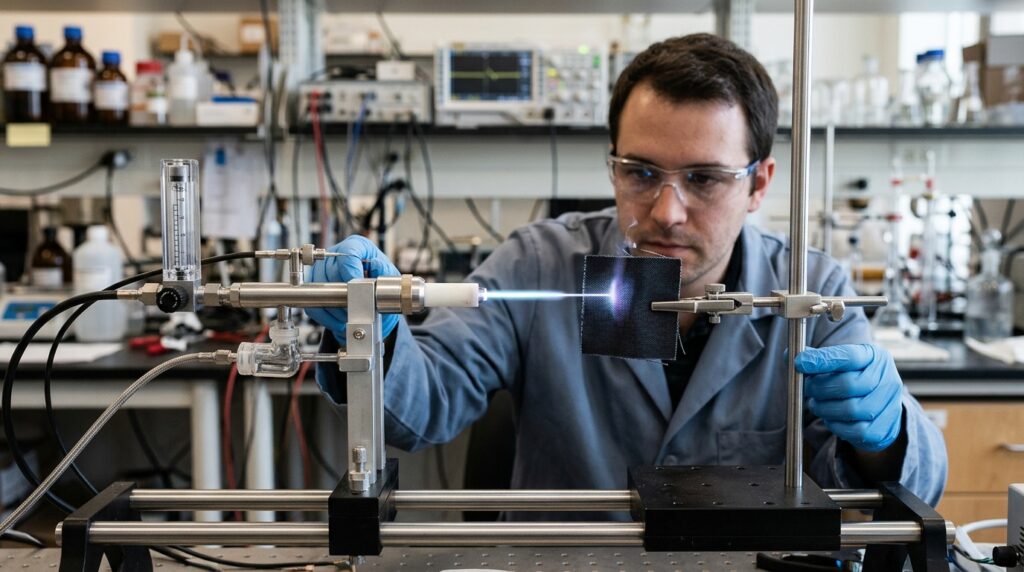
A thin jet of cold plasma kills bacteria right within the fabric fibers
It may sound intimidating, but this is neither welding nor a soldering iron. Cold plasma operates at room temperature and harms neither fabric nor human skin. One of the authors explained it simply: some microbes are resistant to ultraviolet light, but no microbe is resistant to oxidative stress.
What Laboratory Tests of Cold Plasma Laundry Showed
The scientists took samples of the bacterium Staphylococcus caprae — a microbe from human skin that has previously been found on the ISS. They contaminated pieces of cotton fabric and treated them with plasma.
The result was significant: the number of bacterial colonies dropped from roughly 250,000 to 60,000 per milliliter. That means plasma dealt with microbes better than the current cleaning methods on the station. However, there is a caveat: it doesn’t remove stains. But it does kill exactly the bacteria that could make astronauts sick. So it’s not so much laundry in the traditional sense as deep disinfection.
Why This Matters for Future Bases on the Moon and Mars
For now, this is just a working prototype that cleans a tiny patch of fabric at a time. But the team has big plans. They want to create:
- a plasma chamber resembling a washing machine
- a combined “plasma jet plus vacuum” system for surfaces
- devices for decontaminating spacesuits, tools, and soft upholstery in habitation modules

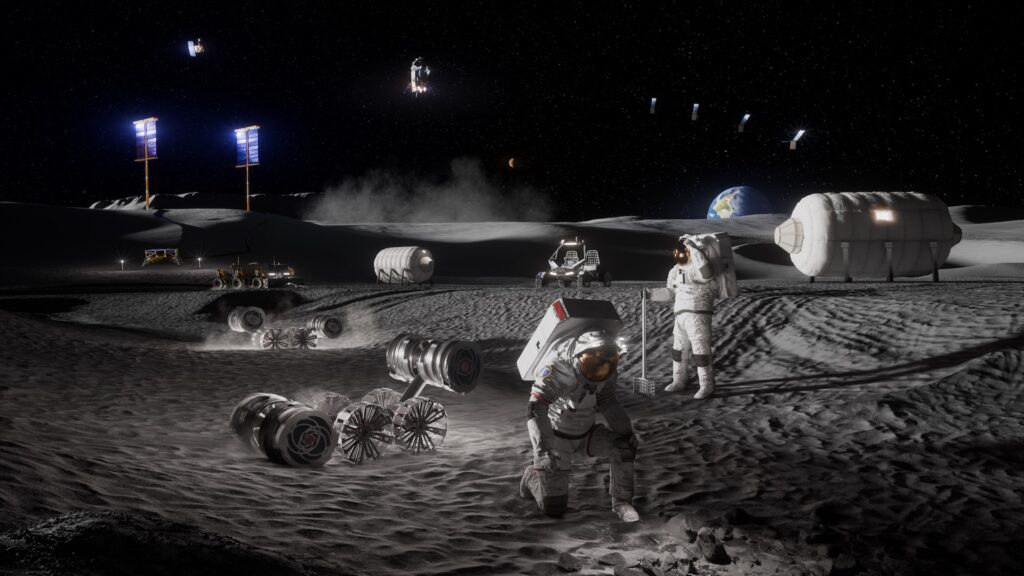
On lunar and Martian bases, controlling bacteria will become a matter of crew health
For future long-duration expeditions, this is critically important. A small group of people locked in a cramped module for months is especially vulnerable to bacteria and disease. A vacuum cleaner can collect dust, but it can’t handle biological contamination. Plasma, however, is designed for exactly that.
But it’s too early to celebrate, because the technology still needs to be tested on a wide range of microbes and researchers need to understand how plasma affects fabric over prolonged use — whether the clothes will start falling apart. So a real plasma-powered space washing machine is still a long way off. If everything works out, plasma cleaning will help astronauts live far from Earth for months, saving water and reducing the risk of infection.