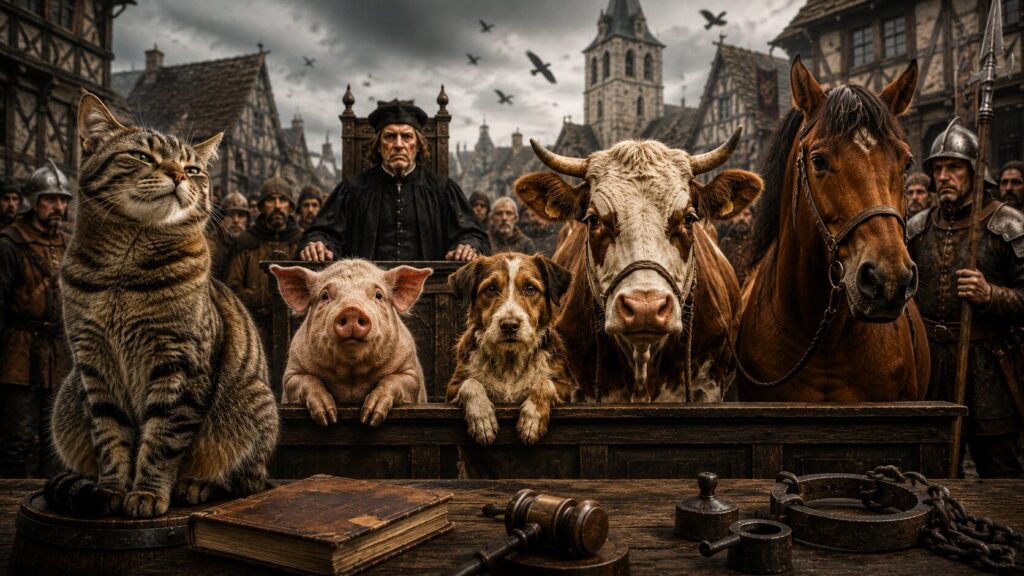
Animals were imprisoned in jails where humans were incarcerated: bizarre trials of the late Middle Ages and the surprising absence of criminal cats.
From the late Middle Ages until nearly the end of the 18th century, animals were genuinely put on trial in Europe — complete with charges, lawyers, and sentences, just like humans. Pigs, cows, birds, rats, and even locusts were sentenced to punishments up to and including execution. But among hundreds of defendants, there were almost no cats, which is very strange for that era. And although today we know that animals are smarter than we thought, the idea of putting them on trial still seems absurd.
How Medieval Europe Put Animals on Trial Under Human Laws
Think it’s fiction? This is a documented practice: animal trials took place in many European countries — most often in France, as well as in Switzerland, Germany, the Netherlands, and occasionally in Britain, Spain, and Italy. Isolated cases later occurred even in Russia, Brazil, the USA, and Canada.
People of that era genuinely believed that an animal was responsible for its actions just like a human, as if it had intention, will, and moral responsibility. And if so, then it could be tried and punished.
People of that era genuinely believed that an animal was responsible for its actions just like a human, as if it had intention, will, and moral responsibility. And if so, then it could be tried and punished (today the question is sometimes posed in reverse).
These proceedings were virtually indistinguishable from regular ones. The case was presided over by a real judge, prosecution and defense were represented by lawyers, and charges were based on existing laws. It’s just that sitting in the dock was not a person, but a cow, horse, or pig — and sometimes an entire herd or swarm.
What Animals Were Sentenced to Execution and Prison For
The most frequent defendants were pigs. They were kept right in courtyards and homes, and they sometimes attacked infants and small children — for which they were charged with murder. Large animals like cows and horses also ended up in court if they trampled a person to death.
The punishments were exactly the same as for humans:
- guilty animals were placed in the same prisons where human inmates were held
- they were executed by the same professional executioners who dealt with human criminals
- if a fine was imposed, the owner had to pay
A well-known case from 1457, for example: a sow was found guilty of causing a child’s death, while her piglets were acquitted — it was determined they had nothing to do with it.
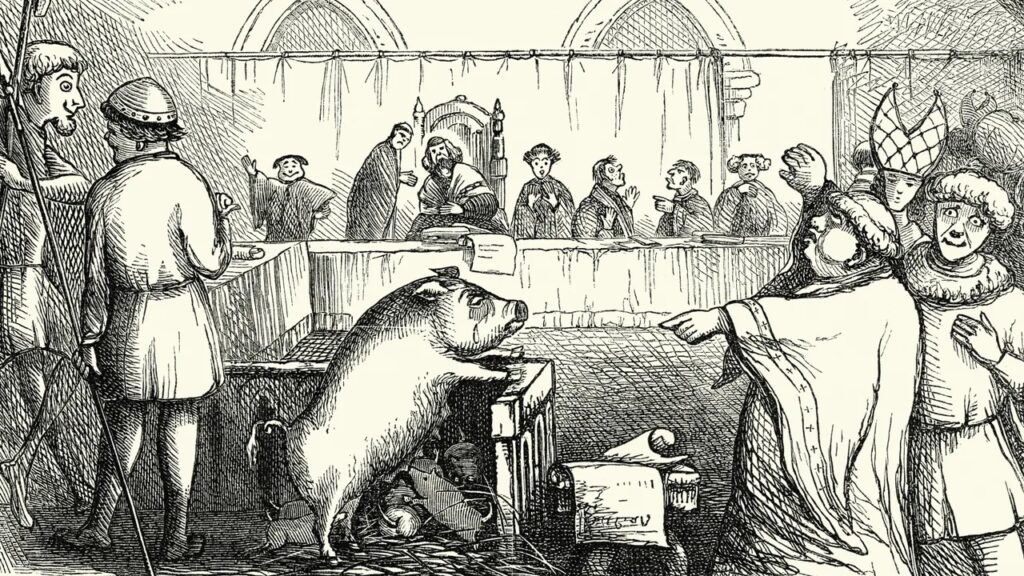
An illustration depicting the trial of a sow and piglets for the murder of a child. The trial allegedly took place in 1457. The sow was found guilty, while the piglets were acquitted.
A separate story involves church trials against pests. Locusts, rats, mice, and leeches were tried for destroying crops. The sentence here was special: the guilty were not executed but excommunicated from the church and ordered to go somewhere they could do no harm.
Why People Believed Animals Could Understand Punishment
The belief in animal “reason” manifested not only in courts. For centuries, there was a custom of hanging killed or maimed animals on branches (rabbits, weasels) to frighten away their kin — a kind of warning for the rest.
This was a direct analogy to how humans were treated at the time: criminals were executed publicly, and severed heads were placed on stakes in plain view of passersby. The logic was the same — let others see and draw conclusions.
Whether this worked with animals, we cannot know. But the very fact that people expected animals to understand such a “lesson” says a lot about their ideas regarding animal intelligence and morality. Today we know for certain that some animals are indeed capable of remembering wrongs and changing their behavior after unpleasant experiences.

A so-called “gamekeeper’s gibbet” — killed animals were hung up to scare off the rest.
Why Cats Almost Never Ended Up in the Dock
And here’s the most interesting part. In one compilation of animal trial cases from the 9th to the 19th century, nearly 200 cases are collected — featuring dogs, wolves, grasshoppers, snails, goats, pigs, and horses. But among the accused there is not a single cat.
Even dogs, which were considered the most loyal creatures, regularly ended up in court — most often for biting. Incidentally, there is a medieval story about the opposite: a faithful dog allegedly brought its master’s killer to court, and the man was convicted and executed.
But cats — no. The explanation turns out to be simple and almost mundane: cats simply didn’t commit serious enough crimes. They:
- didn’t eat children, like pigs
- didn’t seriously bite people, like dogs
- didn’t trample anyone to death, like bulls
- didn’t destroy crops, like locusts
For their size and habits, cats turned out to be surprisingly law-abiding. Not because they were kinder, but simply because they had neither the strength nor the appetite to commit the kinds of acts for which others were dragged to court.
Cats in Medieval Animal Trials: Witnesses, Not Defendants
Sometimes cats did make an appearance in these proceedings — but in a different role. In the early 16th century, in the diocese of Autun in Burgundy, rats were summoned to court, accused of eating barley. The rats, naturally, did not appear.
Their lawyer handled the case cleverly. He secured a postponement, arguing that cats lay in ambush along the road, making the journey dangerous — and one cannot demand attendance from those who cannot reach the court safely. Whether the rats ever made it to the courtroom, history does not tell.
The fact that cats stayed on the sidelines is perhaps the best compliment to their ability to mind their own business. But it should be honestly said: the absence of cats from the courtroom doesn’t mean they lived peacefully. They were tormented and killed, but these were extrajudicial acts. And sometimes a cat was declared an assistant to a witch or the devil, but that is an entirely different, dark story.