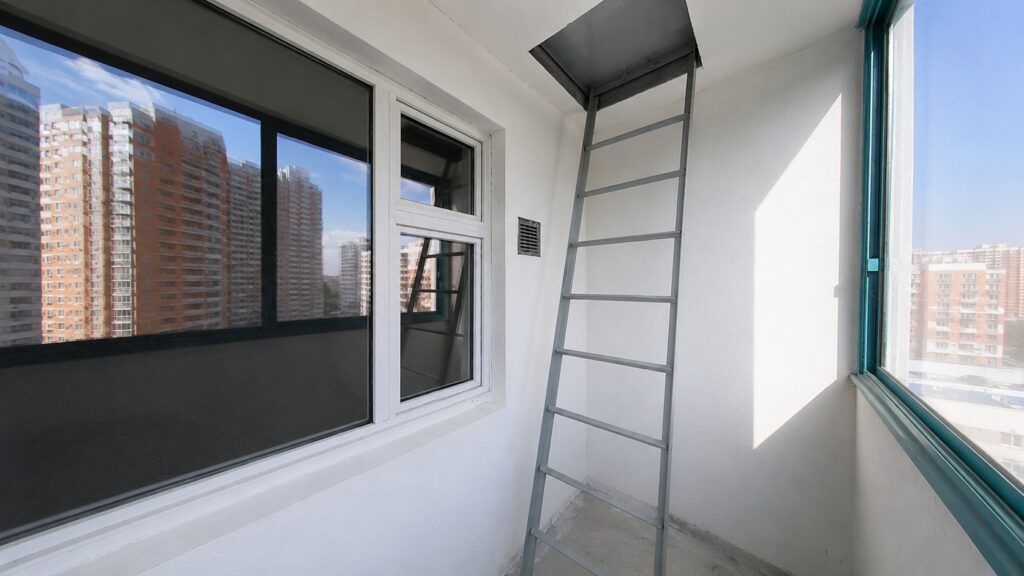
You cannot block the balcony hatch — you can be fined for it
If you’ve ever lived in a high-rise building, you’ve probably noticed a strange metal cover in the floor of your balcony or loggia. Many people consider it a meaningless Soviet-era relic and, at the first opportunity during renovation, weld it shut, tile over it, or place a cabinet full of jars on top. In reality, it’s a passageway that can save lives. And if you block it, you can be fined.
What Is the Hatch on the Balcony or Loggia For
The hatch in the floor and ceiling of a balcony is an emergency fire exit. If the regular exit from the apartment or the stairwell is blocked by fire, smoke, or structural collapse, a person must have an alternative escape route. The balcony hatch is exactly that alternative route, leading downward.
Imagine the situation. There’s a fire in the apartment or on the staircase landing, and you can no longer open the door because there’s fire and smoke behind it. The person goes out to the balcony, opens the hatch in the balcony floor, and climbs down the metal ladder to the balcony one floor below. From there, they descend even further, and so on until they reach a safe floor — to neighbors, to firefighters, or to a point where they can be rescued.
Yes, it’s uncomfortable and potentially dangerous. But in a fire, even a narrow vertical ladder is better than staying in a corridor filling with smoke. Fire victims most often die from combustion products rather than from flames, so the ability to go down literally means the difference between life and death.
How to Escape a Fire When Exits Are Blocked
This isn’t something builders came up with on their own — it’s a solution prescribed by regulations. The current building code SP 1.13130.2020 explicitly lists among emergency exit options an exit to a balcony or loggia at least 0.6 meters wide, equipped with a ladder that connects balconies floor by floor, and a hatch in the floor measuring at least 0.6 × 0.8 meters to provide access to the balcony below.
It’s important to understand that such a hatch is specifically an emergency exit, not a primary evacuation route. The same document states that such exits are not counted when planning regular evacuation routes. In plain language, normal evacuation should go through the corridor, staircase, and exit to the outside. The loggia hatch is merely Plan B for when the usual evacuation route is blocked.
Why Hatches Are Most Commonly Found in Tall Buildings
Balcony hatches are most commonly found in high-rise buildings — they don’t exist in Khrushchyovkas (Soviet-era low-rise apartment blocks). The reason is that the higher an apartment is located, the harder it is to simply rescue a person from outside using a regular fire truck aerial ladder. It doesn’t reach every floor. The average length of a fire truck ladder is about 20 meters.
According to regulations, if there is only one evacuation exit per floor, every apartment above 15 meters must also have an emergency exit. A balcony with a hatch and ladder is exactly one of such solutions.
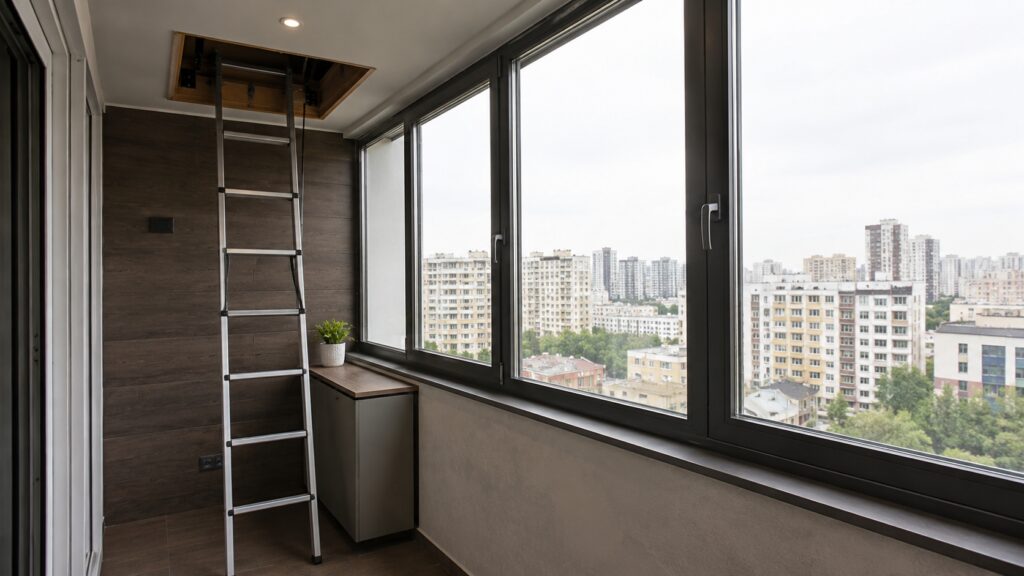
Balcony hatches are only found in high-rise buildings
There is no specific inventor of the balcony hatch — it’s not like Edison’s light bulb or the iPhone, where you can name a hero. The idea grew out of general fire safety logic. In Soviet and post-Soviet buildings, it was implemented cheaply and simply: vertical ladders on loggias plus hatches between floors. Not particularly attractive, but it works.
Why There’s a Hatch Between Balconies of Adjacent Floors
Many people are confused by the second hatch on the balcony ceiling. In reality, it’s needed so that the neighbor above can climb down to your balcony, while your floor hatch allows you to descend further below.
This is precisely why when one neighbor blocks or even decides to weld the balcony hatch shut, they compromise not only their own safety but the entire route for their neighbors. One welded hatch turns a functioning system into a dead end for an entire column of apartments.
Can You Weld the Balcony Hatch Shut
Welding the balcony hatch shut and placing a cabinet on top of it is strictly prohibited. The Fire Safety Rules of the Russian Federation explicitly prohibit placing furniture and objects near emergency exits, dismantling ladders between balconies, and blocking hatches.
Here is a full list of what you cannot do on the balcony:
- cut or dismantle the ladder;
- weld the hatch shut or bolt it permanently;
- tile over it or pour a concrete screed on top;
- place a heavy cabinet on top;
- cover it with a non-removable platform;
- turn it into a potato cellar.
The hatch must open, the ladder must remain accessible, and the path to them must be clear.
Fine for a Welded Balcony Hatch
Such violations are penalized under Article 20.4 of the Administrative Code of the Russian Federation on violation of fire safety requirements. Under the current version as of 2026, the basic penalties are as follows:
- for individuals — a warning or a fine from 5,000 to 15,000 rubles;
- for officials — from 20,000 to 30,000 rubles;
- for legal entities — from 300,000 to 400,000 rubles.
If the violation is repeated or has already led to a fire and damages, the amounts will be significantly higher. So a welded balcony hatch is both a risk to life and a quite tangible hit to the wallet.
Can Thieves Get In Through the Balcony Hatch
Yes, theoretically, a neighbor, a worker, or a particularly athletic thief could make their way through the column of balconies. This is exactly the fear that drives people to weld the hatch cover shut.
But this is a very bad decision. Think about it — what’s scarier: having a TV stolen or burning alive? It’s roughly like removing the brakes to make a car harder to steal.
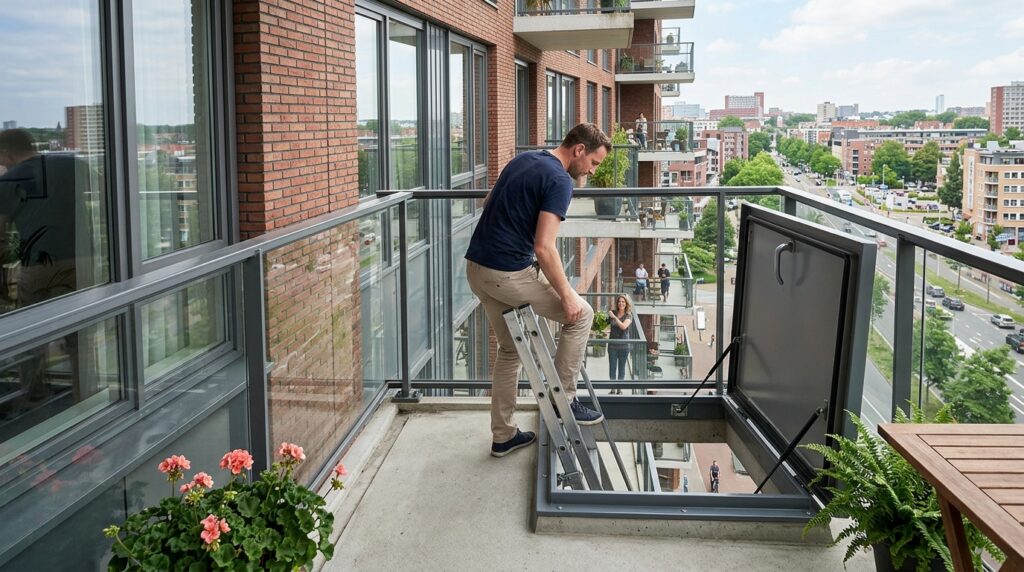
Cases of burglars entering a home through the balcony hatch are very rare
Smart people who worry about thieves install a lock that opens from the inside without a key or tools. But it’s better not to reinvent the wheel based on internet videos — instead, check the building’s design documentation and the requirements of the management company and fire inspection.
What to Do If the Balcony Hatch Won’t Open
In some buildings, the emergency exit on the balcony has long since rotted. The cover is loose, the metal has rusted through, the ladder is falling apart, and the edges of the concrete slab are crumbling. This is a good reason to contact the management company.
The thing is, balcony slabs usually belong to the common property of the building as load-bearing enclosing structures, rather than being a personal “piece of outdoors” owned by the resident. This means that not only the resident but also the management company is responsible for their condition. If the hatch or ladder has deteriorated, you need to file a complaint with the management company rather than silently accepting a non-functional emergency exit.
So, the balcony hatch is needed for emergency rescue during a fire. It wasn’t designed for aesthetics, ventilation, or storing potatoes — it’s part of an emergency route between floors. Welding the hatch shut and cutting the ladder is prohibited; it can only be closed in a way that allows it to be quickly opened at any moment. And if it has rusted away or been blocked by neighbors — that’s no longer just a building quirk but a fire safety violation that should be fixed before it’s truly needed.