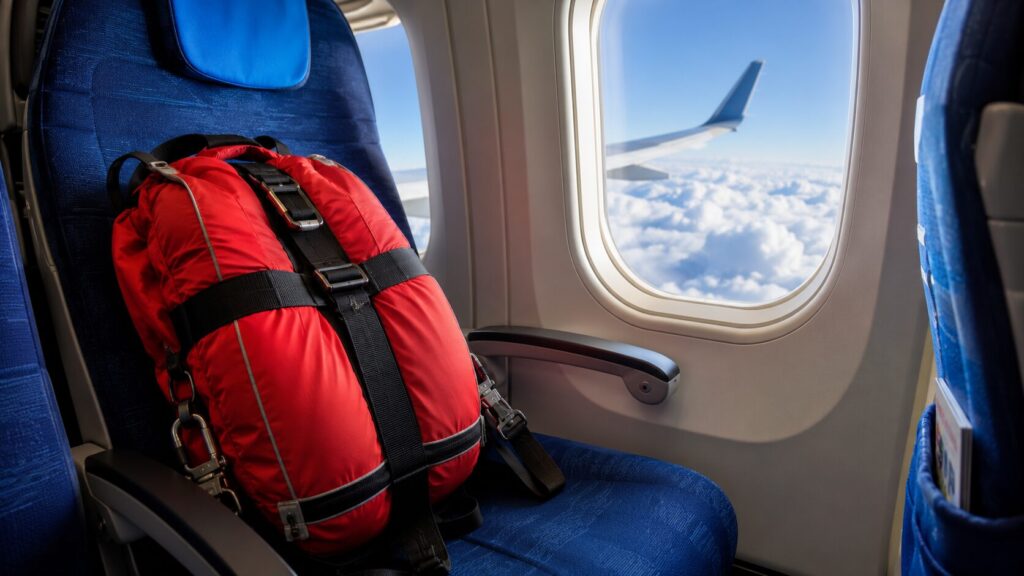
Why parachutes are almost never used on airplanes
Under the passenger’s seat lies a life vest, an oxygen mask hides above the head, but there’s no parachute even in expensive first class. At first glance, it seems like airlines forgot the most obvious way to save lives. People debate which seat on the plane is safer, but rarely ask why you can’t just open the door and jump out. In movies, it takes a few seconds: put on the backpack, step into the void — and you’re already gliding under a canopy. On a real airliner, such a plan would fall apart for several reasons at once. And the cost of a parachute is far from the main one.
Most aviation disasters happen too low for a jump
A parachute is only useful when there is enough free space below the person. For a passenger aircraft, it’s usually during those moments at sufficient altitude that everything is fine.
According to recent statistics from Boeing for 2016–2025, cruise flight accounts for about 57% of time in the air, but only 10% of fatal aviation incidents. Meanwhile, takeoff and initial climb account for 22%, while final approach and landing add another 48%.
It turns out that seven out of ten fatal accidents occur at the beginning or end of the flight. The aircraft at that moment is over the runway or very close to the ground. Even if a passenger somehow managed to get outside, the canopy simply wouldn’t deploy before impact.
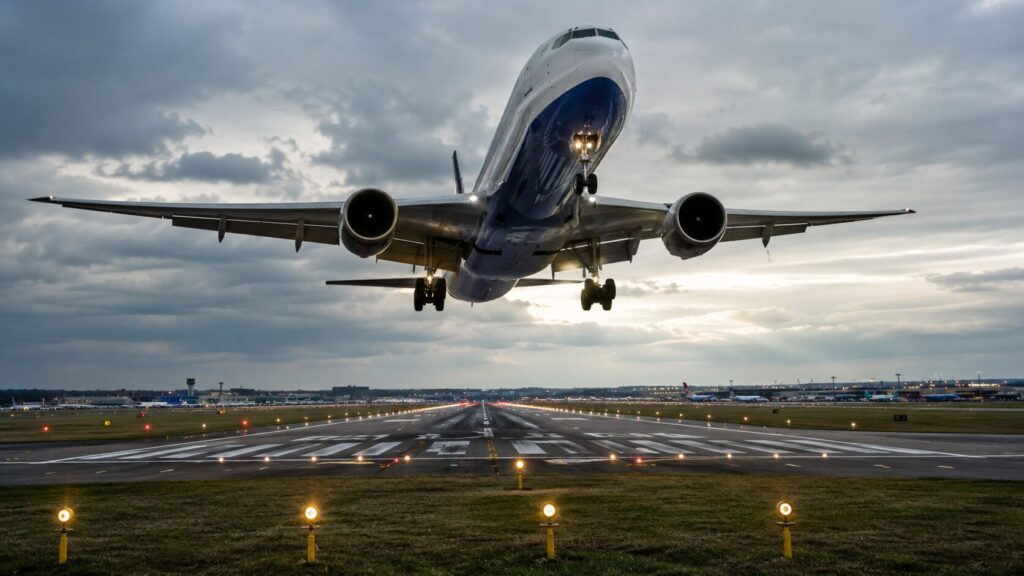
Disasters most often occur at altitudes insufficient for a parachute jump.
Interestingly, thunderstorms are also most dangerous near the ground, not at high altitude. The crew has less time and space to correct the situation.
Opening an airplane door at altitude is nearly impossible
During a normal flight, the pressure inside the cabin is significantly higher than outside. Many passenger doors are designed so that they must first be pulled slightly inward to open. The pressure differential presses such a door against the frame with enormous force, while mechanical locks prevent it from opening accidentally.
Let’s say the aircraft is already depressurized and the pressure has equalized. That doesn’t make things better. An airliner flies at about 800–900 km/h, so beyond the door there isn’t calm air but a powerful airflow. During a jump, it could slam a person against the fuselage, wing, or tail assembly. Engines may also be nearby.
Aircraft for skydivers reduce speed before the drop, follow a designated course, and use a specially prepared door. A passenger airliner isn’t designed for such a maneuver. Its emergency exits were designed for evacuation on the ground, not for a line of people at an altitude of ten kilometers.
Without oxygen, a person won’t have time to put on a parachute
The typical cruising altitude of a passenger aircraft is approximately 9–12 kilometers. As long as the cabin is sealed, passengers breathe air pressurized to correspond to a much lower altitude. But during depressurization, the countdown quickly shifts to seconds.
According to FAA data, at an altitude of 35,000 feet, or approximately 10.7 kilometers, after sudden depressurization a person has only 15–30 seconds during which they can still act consciously. You won’t necessarily lose consciousness immediately, but coordination, attention, and the ability to make correct decisions will rapidly deteriorate — everything without which it’s impossible to properly prepare for a jump.
In those seconds, a passenger would need to find and put on a parachute, properly secure the straps, reach the exit, and not lose their oxygen mask. And outside, thin air and freezing temperatures of dozens of degrees below zero await.
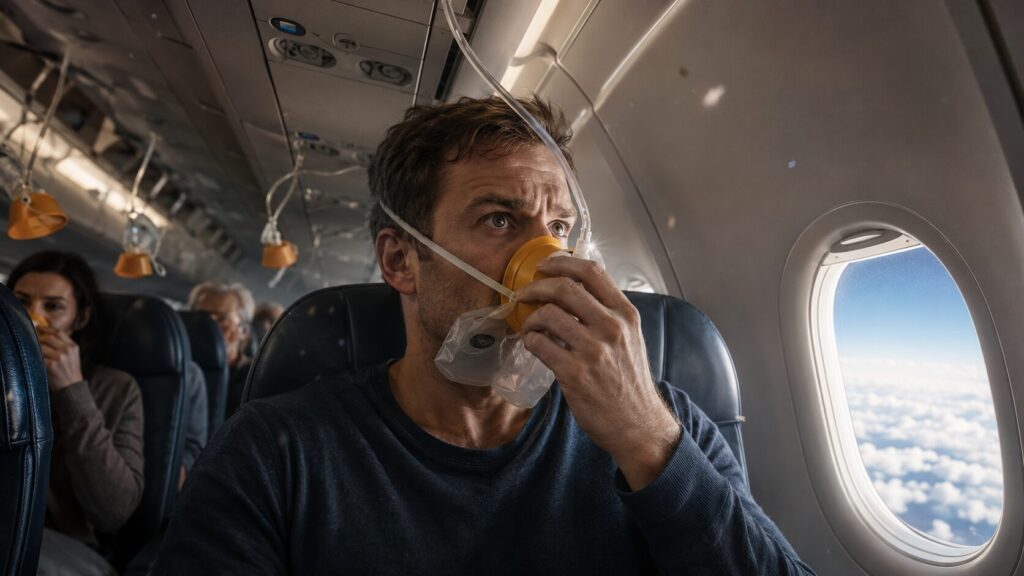
The oxygen mask provides oxygen supply in an emergency situation when cabin pressure drops sharply (for example, during depressurization).
That’s precisely why oxygen masks on airplanes aren’t designed for preparing to jump. They give the crew time to quickly descend to where people can breathe normally again.
You need to know how to use a parachute
A parachute only looks simple when folded. The first solo jump begins with ground training. The training program includes proper exit from the aircraft, body position, altitude awareness, deploying the main and reserve canopies, malfunction procedures, parachute control, and landing. Before each jump, equipment is checked multiple times.
Now imagine the same process in a cabin with hundreds of untrained people. Some won’t be able to fasten the harness system, some will freeze at the door, and some will deploy the canopy too early. Releasing everyone simultaneously is also impossible: people could collide in the air, and lines and canopies could become tangled.
That’s why parachutes are used on aircraft where jumping is planned in advance: in airborne military aviation, skydiving planes, some gliders, and aerobatic aircraft. There are few people on board, they’ve been trained and know what to do, and the aircraft’s design allows for safely exiting the cockpit.
Hundreds of parachutes would create new dangers
A passenger needs more than just a main canopy. A complete system includes a harness, container, reserve parachute, and often an automatic activation device. For a high-altitude jump, oxygen equipment, face protection, and warm clothing would also be needed. All of this takes up space and increases the aircraft’s weight.
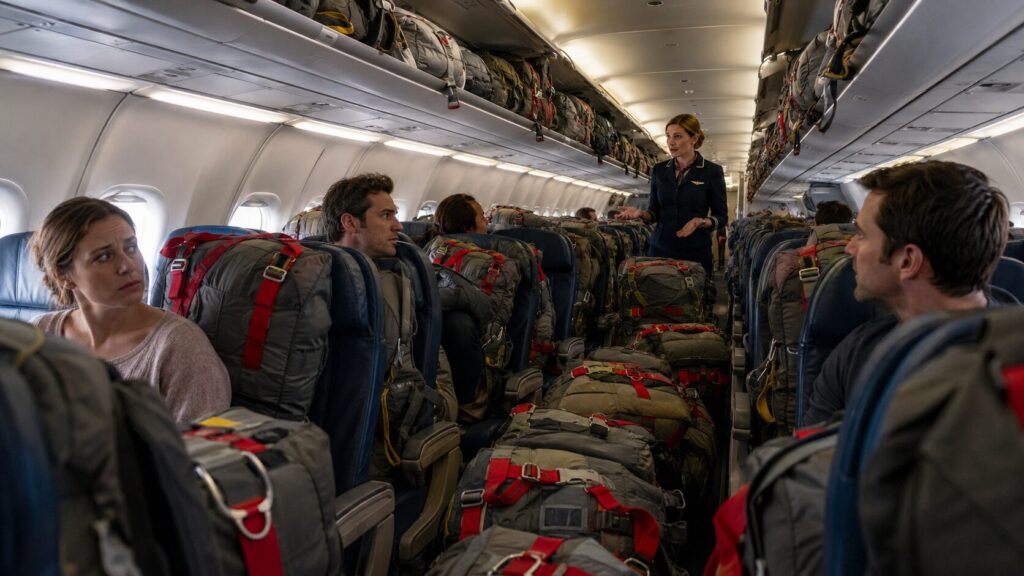
An exaggeration, of course, but the point is clear.
Additionally, parachutes would need to be fitted for passengers of different heights and weights, and regularly inspected and maintained. For example, under American regulations, a reserve parachute made from modern materials must be repacked by a certified specialist no less than once every 180 days.
There’s also a less obvious risk. An accidentally deployed canopy inside an airplane could block the aisle, injure people, and create a dangerous situation. Thus, on a passenger flight, additional rescue equipment itself could become a source of problems.
Why a parachute saves a small Cirrus but not an Airbus
Aircraft with parachutes do exist, however. The company Cirrus installs the CAPS system, which in an emergency deploys a large canopy and lowers the entire aircraft to the ground along with the people inside. According to the manufacturer, such systems have helped save more than 250 lives.
But size decides almost everything here. The maximum mass of the small SR22T, which can be equipped with a parachute system, is about 1.6 tons. Meanwhile, the maximum takeoff weight of a large airliner is incomparably greater.