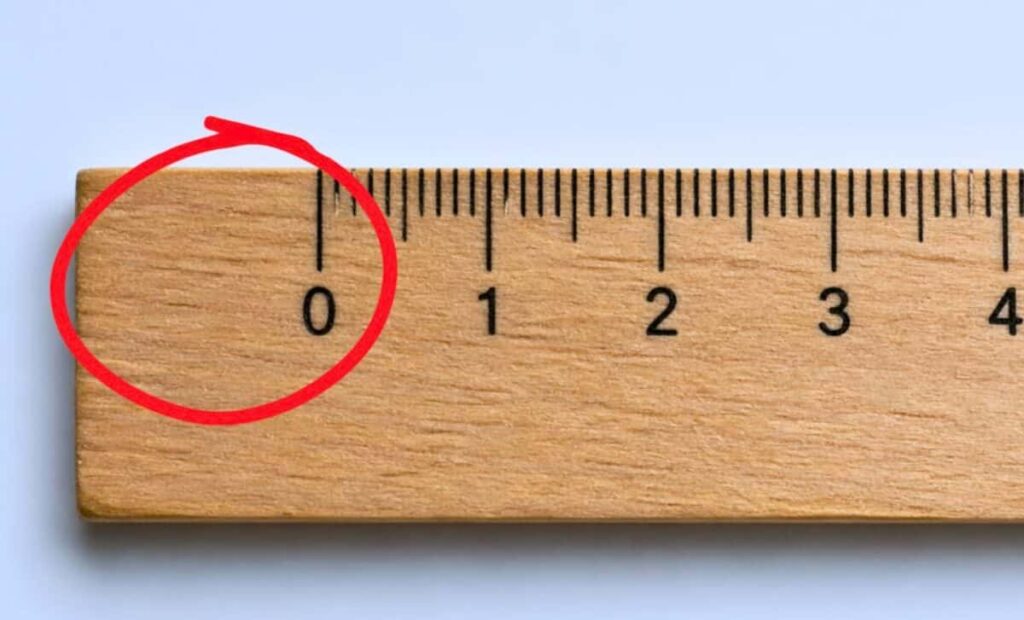
The empty space before zero on a ruler solves at least two serious problems
Pick up a ruler and look at it closely. Before the numbered markings begin, there is a small empty gap — roughly a centimeter of plastic or wood. And it doesn’t look like a manufacturing defect. This inconspicuous gap is one of the most clever engineering solutions among everyday objects. And it has at least three reasons to exist.
The Gap Before Zero on a Ruler
The real explanation is simpler than any guess: edges wear out. The corners of a ruler are constantly subjected to impacts — they scrape against pencil cases, fall on hard floors, and bang against desk edges. If the zero mark were placed right at the vulnerable edge, every chip and scratch would shift the starting point of all subsequent measurements. Half a millimeter of material lost at the edge means half a millimeter of error in every measurement.
By shifting the zero mark inward, manufacturers create a sort of “sacrificial zone.” This empty section absorbs all the damage, while the reference point for measurements remains untouched. The ruler maintains its accuracy even when its corners have long since become rounded and cracked. This is exactly why instructions for precise measurements always recommend counting from the printed zero line, not from the physical edge of the instrument.
Manufacturing Tolerance When Cutting Rulers
There is also a second, less obvious reason. The gap helps during manufacturing. When a factory cuts blanks for rulers, achieving a perfectly precise alignment of the edge with the printed scale at high production speeds is extremely difficult. The gap provides a margin for small deviations during cutting, so the blade doesn’t nick the zero line.
Imagine you need to trim thousands of plastic strips exactly along a drawn line, and do it quickly. Any vibration of the machine, the slightest shift — and the line is cut off. The gap before zero acts as a buffer zone between the blade and the scale. It’s a practical concession to the reality of mass production.
How Calipers and Tape Measures Solve the Same Problem
This principle is not limited to school supplies. Machinists and milling operators work with calipers — metal instruments far more precise than any ruler — and on these, the zero mark also doesn’t coincide with the tips.
Tape measures solve the same problem in a different way. The metal hook at the end has a slight play — it shifts to compensate for its own thickness when you measure from inside a frame or from an outside edge. This movement is not accidental — it is precisely calibrated so that the shift equals the thickness of the hook itself, usually about 1 mm. For external measurements, such as measuring the length of a board, the hook pulls outward when the tape is tensioned. For internal measurements, it pushes back in. In both cases, the readings remain accurate without manual corrections.
All these examples rely on the same idea: keep the reference point separate from the part of the tool that is subjected to physical impact.
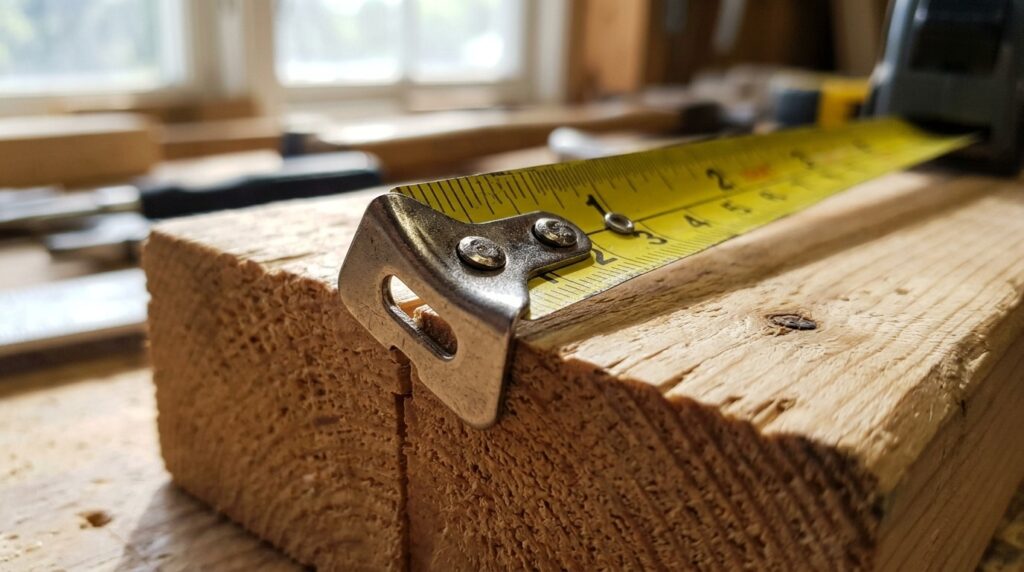
The metal hook of a tape measure shifts by the thickness of its own metal — this is not a defect but a design feature
Why Carpenters and Tailors Knew the Answer Immediately
Among the avalanche of confused comments on social media when people discussed this topic, there was a small group who answered instantly and correctly. Carpenters, tailors, machinists, and engineers recognized the logic right away because they live with its consequences every day. Anyone who cuts wood or fabric professionally quickly understands: a worn tool edge introduces an error that accumulates with every new piece.
This professional instinct points to something broader. The gap exists because the people who designed rulers understood that most users would never think about edge wear until it ruined a project. The solution is built into the design, working quietly and invisibly, performing its function regardless of whether anyone notices it.
The Ruler Gap as an Educational Element for Children
This design also has an educational side that is rarely discussed. For a child who is just learning to measure, the gap makes a visual statement: measurement begins at the zero line, not at the edge of the stick. For an adult, this is obvious, but for a child picking up a ruler for the first time, it is not. The empty space reinforces the correct technique without a single word of explanation.
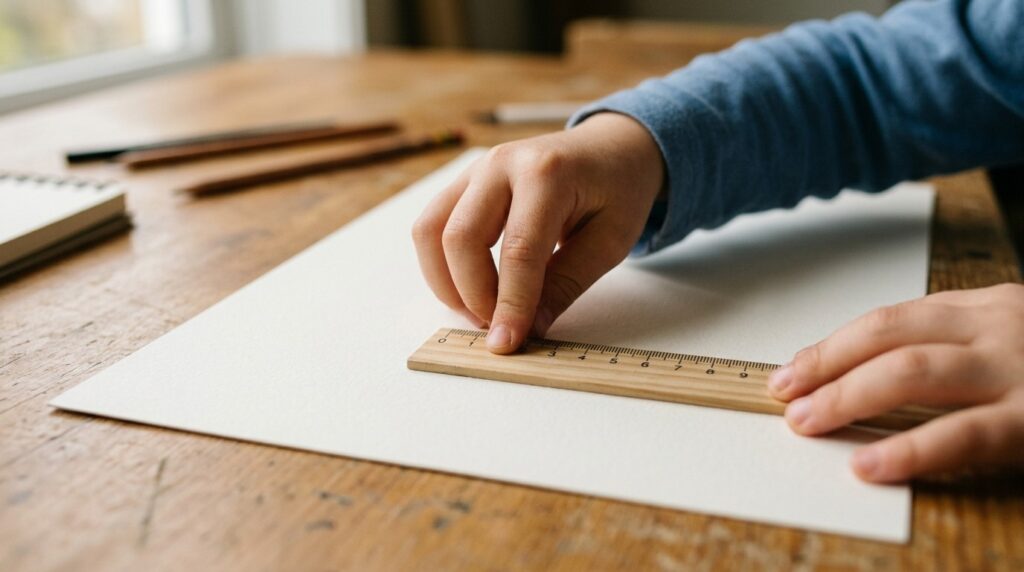
A child learns to align an object with the zero mark, not with the edge of the ruler
This technique has existed for so long that tracing its exact origin is difficult, although drafting manuals from the early 1900s already described this practice. The gap has survived the transition from wood to plastic, from purely inch scales to dual markings, and from expensive drafting instruments to cheap rulers from school supply sets. Such persistence in engineering design usually means the problem it solves is real and universal.