There is no secret metro under Moscow, but there are many other interesting objects
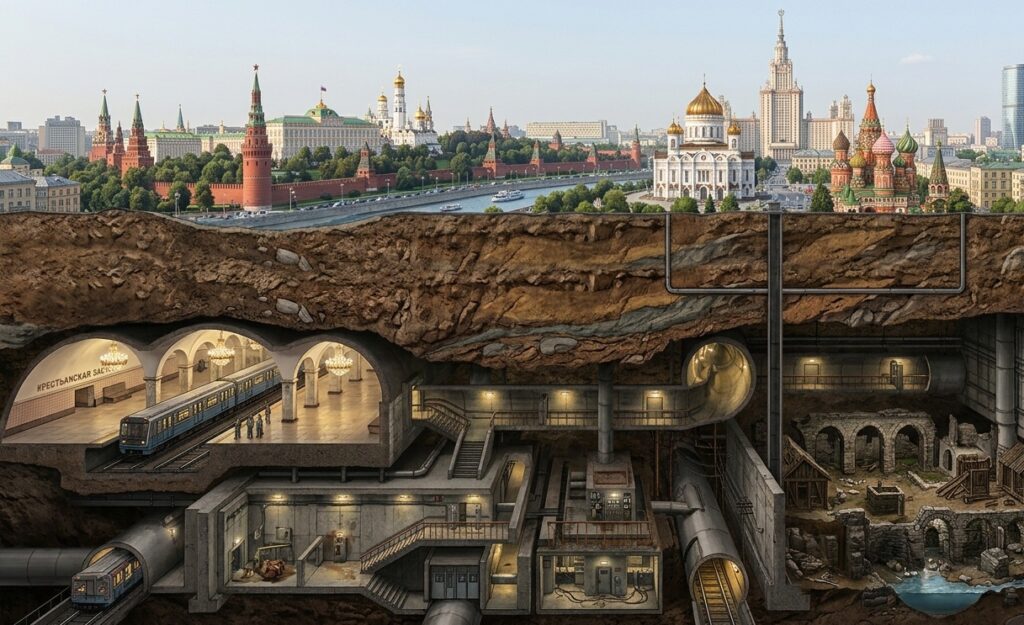
Moscow residents walk on asphalt every day, ride the metro, and descend into underground passages without ever thinking about what lies just a few meters below. Officially, tunnels, underground collectors, and metro lines run beneath the city — everyone knows that. But there are also things that appear on no map and are mentioned in no public sources. Of course, there is no underground city beneath the capital, but this space holds objects whose purpose historians and engineers still debate. What is hidden under Moscow and why are these secrets in no hurry to be revealed?
What Rivers Flow Under Moscow
Many people think that mysterious rivers flow beneath the capital, forming fairytale caves. In reality, these are ordinary urban streams that have been forcibly enclosed in underground collectors to prevent flooding and pollution. According to Mosvodostock, the city currently has 180 small rivers, and more than 70% of them flow through concrete or brick pipes underground.
The most well-known example is the Neglinnaya River. Two centuries ago, it flowed openly through the entire city center, but it became heavily polluted and interfered with construction. Eventually, the river was enclosed in a collector back in the early 19th century. Today it is part of a vast stormwater drainage system that collects rainwater.
During heavy rain, the calm stream instantly transforms into a raging torrent that fills the pipe almost to the brim. It was precisely because of this sudden rise in water that in 2023, a group of eight people perished while on an illegal tour of the Neglinka collector.
Besides the Neglinka, dozens of other watercourses are hidden beneath the asphalt. Likhoborka, Filka, Presnya, Khodynka — all of these are part of the city’s real historical water map. For example, the length of the Likhoborka exceeds 30 kilometers, and more than half of that distance the water traverses in complete darkness.
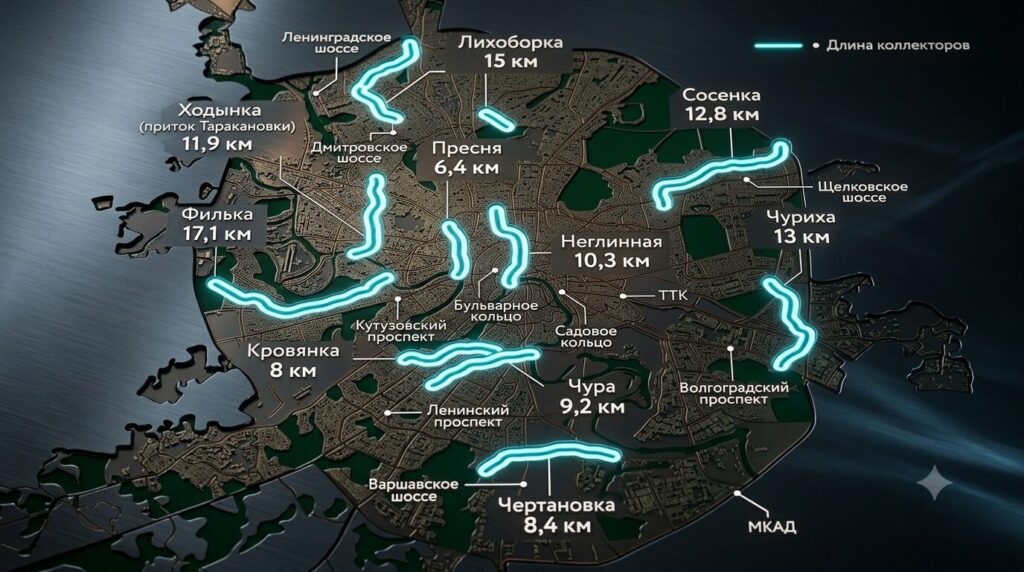
Map of the largest rivers under Moscow
The Hidden Part of the Moscow Metro
While drainage tunnels carry away water, utility collectors sustain the life of the megacity itself. These are multi-kilometer corridors housing the most critical engineering networks — heating pipes, power cables, water supply, and communication systems. The total length of such technical tunnels exceeds 825 kilometers. Without them, repairing wires would require constantly digging up the streets.
However, the most prominent and large-scale part of the underground world remains the Moscow Metro. The total track length of the Moscow metro exceeds 560 kilometers, but an ordinary passenger sees only a small fraction of this enormous system.
The metro’s hidden infrastructure includes service connecting branches needed to transfer trains between different lines. Here you can also find powerful ventilation shafts up to 70 meters deep, crossover chambers, and emergency exits. Additionally, trains regularly cross water obstacles. During the construction of the Rublevo-Arkhangelskaya line, the tunnel boring machine had to dig a tunnel under the Moscow River bed for almost two kilometers.
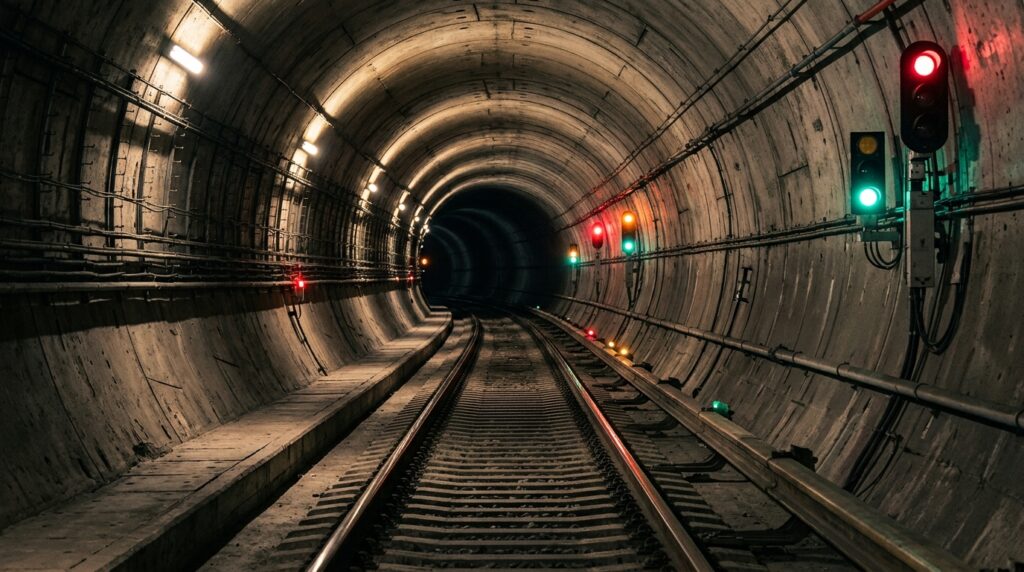
Service tunnel of the Moscow metro
Secret Bunkers Under Moscow
The topic of government shelters is traditionally shrouded in secrecy. Former secret facilities do indeed survive beneath the capital, most of which were built in case of a nuclear war threat. Today, some of them have been declassified and turned into popular museums.
A striking example is Bunker-42 on Taganka, descending 65 meters underground, or Bunker-703 near Paveletskaya, which previously housed a protected document storage facility of the USSR Ministry of Foreign Affairs. It is important to distinguish such deep special facilities from ordinary basements and civil defense shelters, which are designed for the temporary protection of people during chemical or radiation accidents.
As for the legendary “Metro-2” — it is largely an inflated myth. People believe in the existence of a gigantic network connecting the Kremlin with all government buildings. In reality, trying to find an exact map of this labyrinth is impossible, but public and official information about this project simply does not exist. Researchers confirm the presence of individual departmental special tunnels, but there is no unified second metro with stations under every ministry.
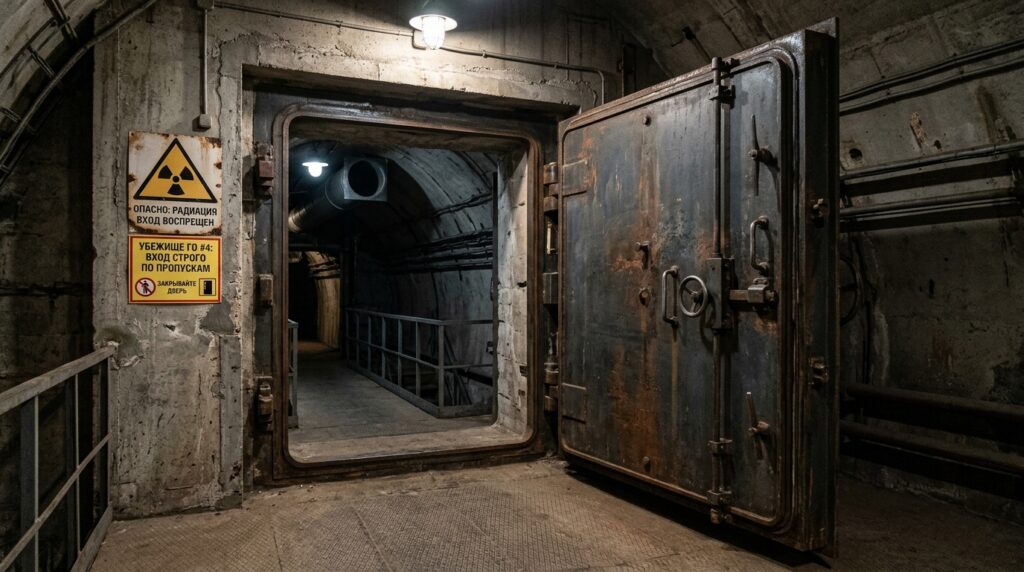
Protective blast door in a declassified bunker
Remnants of Old Moscow Underground
Over the centuries, Moscow grew not only outward but also upward. Old ravines were filled in, riverbeds were hidden, streets were leveled, and as a result, ancient foundations ended up underground. These are not secret escape tunnels but genuine archaeological layers, preserved by time.
To see how the medieval city sank underground, you only need to visit the Archaeology Museum at Manezhnaya Square. There you can find the stone abutments of the 17th-century Voskresensky Bridge, which once connected the banks of the open Neglinka. In Zaryadye Park, an entire Underground Museum was created around the base of the white-stone Kitay-gorod wall.
Another famous location is the cellars of the Solyanoy Fish Yard on Solyanka Street. In the 17th century, fish, salt, and potash were stored here, and later residential buildings were erected on the site of the old yard. Beneath them, an extensive system of historical cellars has survived, which urban legends erroneously associate with secret passages leading straight to the city center.
What Actually Lies Under Moscow
There is no fairytale dungeon from novels under Moscow. In reality, everything is much more mundane, though not without surprises.
Here is what Moscow’s underground world consists of:
- Beds of small rivers and large-scale stormwater drainage systems;
- Concrete utility collectors for communications, heating, and water;
- Metro infrastructure invisible to passengers and depots;
- Declassified bunkers and civil defense protective structures;
- Preserved historical cellars, wall foundations, and ancient bridges.
Hidden pipes save streets from flooding, cables provide homes with heat and light, and ancient vaults serve as reminders of what the city looked like hundreds of years ago. Exploring this hidden world safely is possible only through official museums, since behind every street manhole cover lie the harsh laws of urban infrastructure that do not forgive mistakes.