There are almost no maria on the far side of the Moon. But why?
When the Artemis II crew flew around the Moon, astronaut Jeremy Hansen described the difference between the two sides as striking: the dark patches known as maria, so familiar to us from Earth, are virtually absent on the far side. More than 30 percent of the Moon’s visible hemisphere is covered by these dark plains, while on the far side they make up only about 1 percent. This lunar mystery is one of the most intriguing in planetary science.
What Are Lunar Maria and What Are They Made Of
Even through a small telescope, vast dark areas are visible on the Moon. As early as the 17th century, astronomers called them “seas” (in Latin — mare), although they already suspected there was no water in them. The Apollo missions settled the matter: the first two landings specifically chose “maria” because their flat surfaces were safer for landing. The returned samples showed that these plains consist of basalt — solidified volcanic lava similar to rocks formed on Earth during massive eruptions.
The mountainous regions of the Moon (called terrae or highlands) turned out to be quite different: they are dominated by igneous rocks that solidified deep in the crust rather than on the surface. In other words, the difference between “maria” and “highlands” is the difference between areas where lava poured onto the surface and those where it did not.
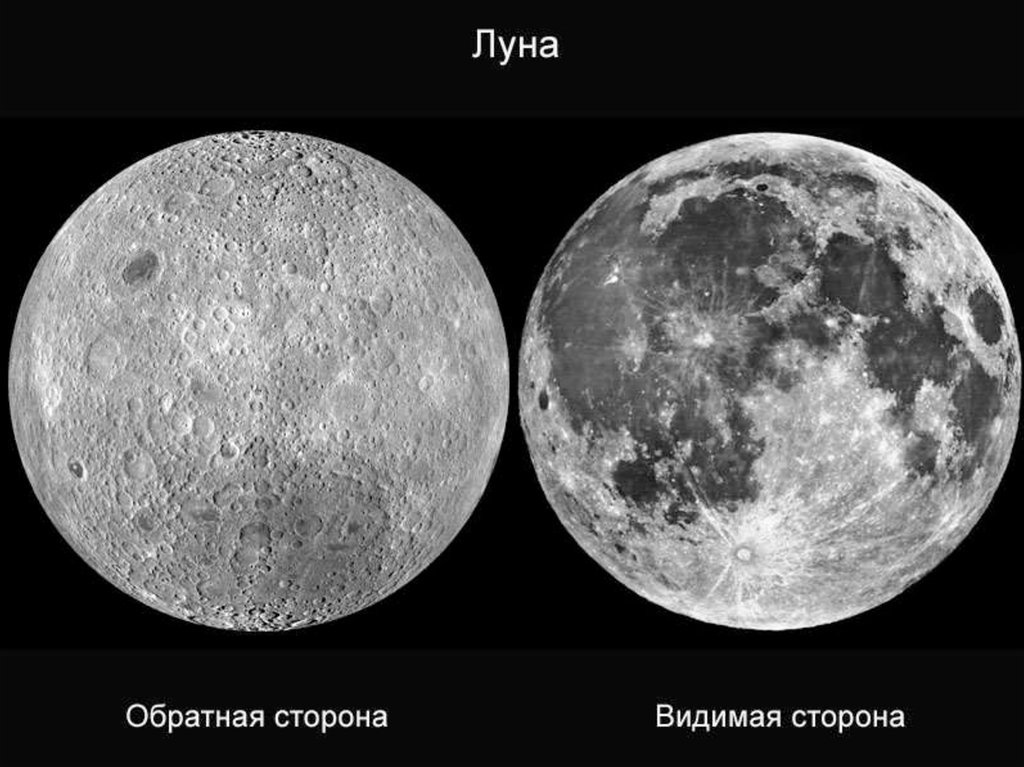
The near and far sides of the Moon. Image source: en.ppt-online.org
When spacecraft first flew around the Moon and photographed the far side, scientists were in for a surprise: there were almost no “maria” there. Instead of smooth basaltic plains — endless craters and mountains. The two hemispheres of the same body looked as though they belonged to different worlds.
Why the Near Side of the Moon Is Warmer Than the Far Side
A recent NASA study using the GRAIL (Gravity Recovery and Interior Laboratory) gravimetric laboratory showed that the differences between the hemispheres extend far below the surface. The lead researcher, Dr. Ryan Park of the Jet Propulsion Laboratory (JPL), explained: “Our study shows that the Moon’s interior is heterogeneous: the side facing Earth is warmer deep inside and more geologically active than the far side. This is linked to the Moon’s volcanic history and explains why the two sides look so different.”
According to Dr. Park’s team’s calculations, the mantle on the near side is 2–3 percent softer than on the far side. To explain this, one must assume either a radical difference in composition or a temperature difference of 100–200 °C. Earthshine on the surface cannot produce such heating — we are talking about processes deep inside.
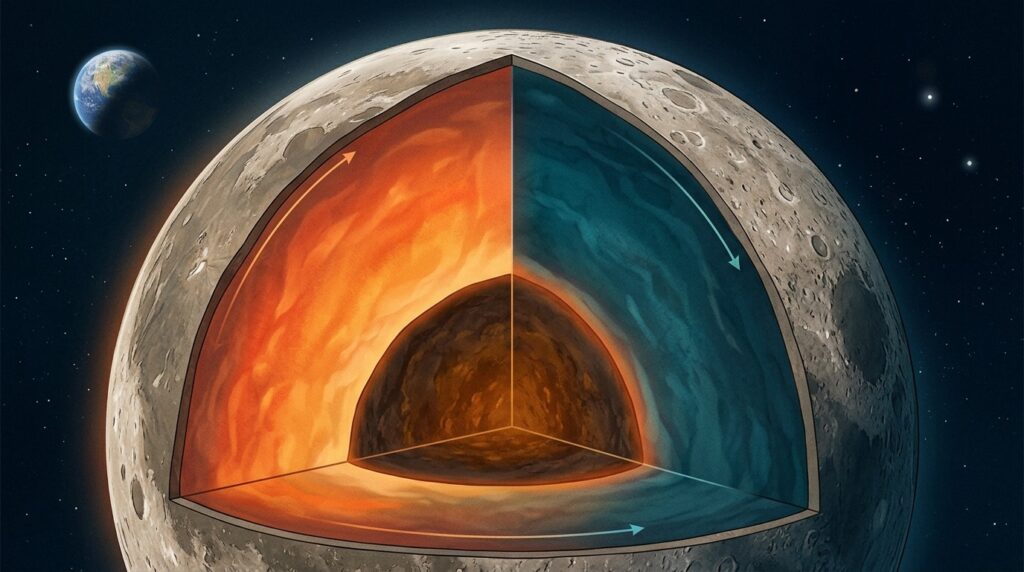
Schematic cross-section of the Moon: the Earth-facing side of the mantle is warmer than the far side
The key role, according to the authors, is played by thorium and titanium: the crust of the near hemisphere contains noticeably more of them. If this imbalance extends to depth, the radioactive decay of thorium could have been heating the near-side mantle for billions of years. Even before this work, models existed suggesting that 3–4 billion years ago the Moon’s mantle was partially molten, and the stronger gravitational field from Earth’s direction caused heavy elements, including thorium, to migrate toward the near hemisphere.
How Earth’s Gravity Affects Lunar Volcanism
This is essentially the version astronaut Hansen articulated when he said that “Earth’s gravitational pull had a profound effect on the near side of the Moon.” The logic is as follows: the additional heat from radioactive thorium sustained volcanic activity on the near side significantly longer than on the far side.
This was critically important in terms of chronology. The early Solar System experienced a period known as the Late Heavy Bombardment — an intense asteroid barrage. Any basaltic plains formed during that period would have been shattered by impacts. But if volcanism on the near side continued after the bombardment subsided, fresh lava flows could have flooded craters and formed the smooth “maria” that survive to this day. On the far side, where volcanism died out earlier, traces of ancient activity were simply erased by asteroid impacts.
Dr. Park’s team even suggests that magma may still be forming beneath the near hemisphere today — at a depth of 800–1,250 km. This could explain the recently discovered young volcanic beads in lunar samples, as well as some of the gravitational anomalies.
Other Hypotheses for Why the Moon’s Two Sides Are So Different
However, not all scientists agree that proximity to Earth is what made the near side so special. There are competing hypotheses — and some of them are quite radical.
- The “head-on collision” hypothesis. The Moon may once have been rotated 90 degrees, with the current far side being the leading hemisphere in orbit. It would have collided with asteroids head-on at higher speeds, which would explain the abundance of craters. However, this idea created more problems than it solved, and it was ultimately abandoned.
- The two-moons hypothesis. The Moon may have formed from the merger of two proto-moons. The collision of two bodies with different compositions could have left behind an asymmetrical object.
- A dwarf planet impact. A catastrophic collision with a large body could have redistributed material so that one side became fundamentally different from the other.
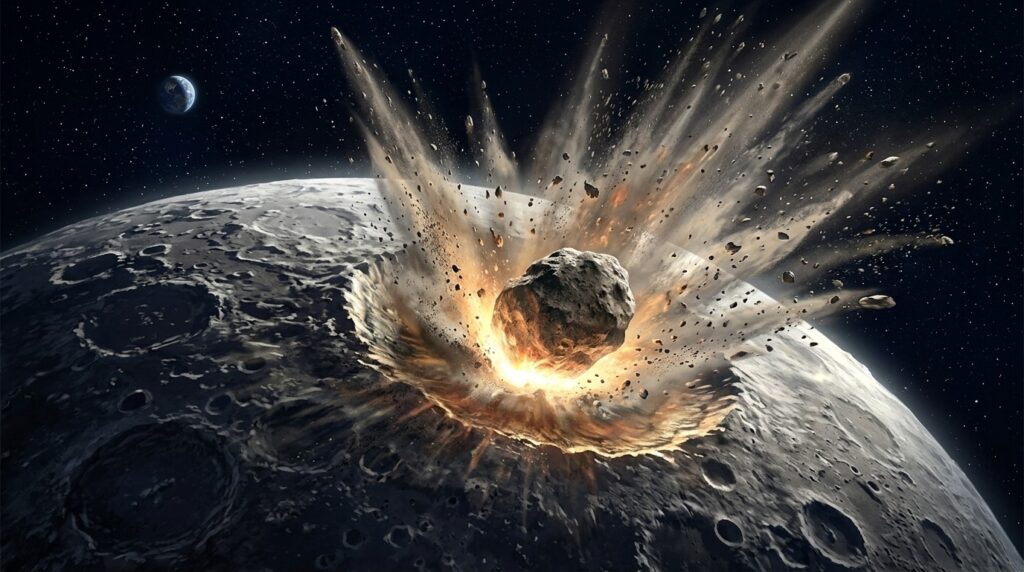
Artistic reconstruction of the giant impact that formed the South Pole–Aitken basin
How the South Pole–Aitken Crater Changed the Moon
A fresh analysis of soil from the far side of the Moon, delivered by the Chinese Chang’e-6 mission (these are the first and so far only rocks from there — just 1.9 kg), supports yet another version. The researchers link the differences between the hemispheres to the impact that formed the South Pole–Aitken basin — one of the largest craters in the Solar System, nearly 2,500 km in diameter.
Despite its name, this basin is not located strictly at the pole: the pole lies at its edge, and the crater itself stretches far across the far side. An impact of such power could have heated the interior and redistributed material within the Moon, triggering a chain of processes that ultimately led to differences in volcanic activity and crustal thickness.
“The dichotomy between the near and far sides, including volcanism and crustal thickness, is likely related to the impact that formed the South Pole–Aitken basin,” the study authors write.
This very basin is the reason space agencies are striving to reach the Moon’s south pole: its depressions may have preserved water ice from cometary impacts that has never seen sunlight.
Why Scientists Cannot Yet Explain the Differences Between the Moon’s Two Sides
The main difficulty is that direct data about the far side of the Moon is still critically scarce. Six Apollo landings and three Soviet robotic missions provided a rich set of samples — but all of them are from the near side. The far side is represented by just 1.9 kg of rock from Chang’e-6, and their analysis is far from complete. Everything else we know has been obtained remotely — through spectroscopy, gravimetry, and magnetic field measurements from orbit.
The results from Dr. Ryan Park’s team are impressive, but it is too early to declare the mystery solved.