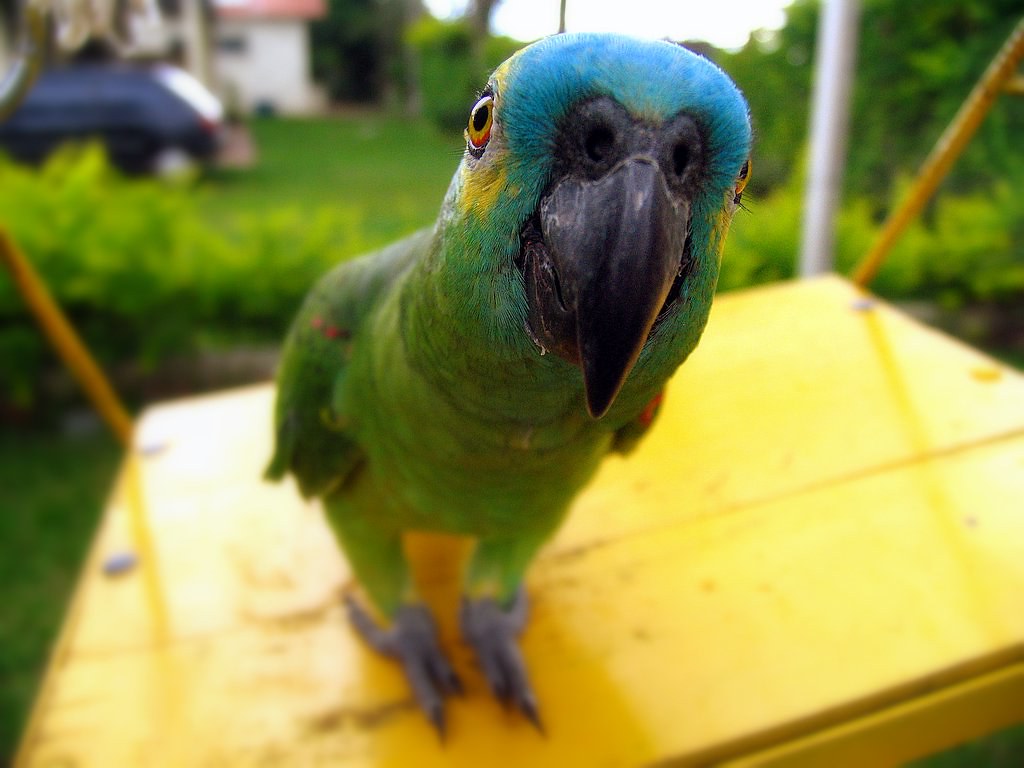
Birds masturbate far more often than we thought, and scientists say it’s completely normal.
Every parrot owner has caught their bird doing something odd at least once: the bird rubs against a perch or toy in a way that leaves no doubt — the behavior is clearly sexual. The first thought is usually anxious: “Is something wrong with it?” But scientists have for the first time conducted a broad study and concluded: there’s nothing abnormal about it. Researchers compiled the largest database to date on masturbation in birds and found that this behavior occurs across a wide variety of species — in both males and females. And, perhaps most surprisingly, it happens even more often in the wild than in captive birds. Apparently, just like in humans, a sedentary lifestyle affects libido.
Why masturbation in birds went unstudied for so long
Animal masturbation has long sat in an uncomfortable corner of science. It’s not a topic for polite conversation, and there were never many people willing to study it seriously. Although the behavior itself, if you look closely, occurs surprisingly often.
It has been observed in primates, dolphins, squirrels, horses, marine iguanas, and penguins. And surely in many other animals that researchers simply haven’t gotten around to yet. In animals, it serves more than just release: masturbation can improve sperm quality, influence readiness for mating, or increase the chances of fertilization.
But birds always received less attention. There were scattered reports about parrots and penguins, but no one had assembled a complete picture. Part of the reason is anatomy: most birds lack external genitalia like mammals have. They mate through the cloaca — an opening involved in reproduction, urination, and defecation. That’s why masturbation in birds usually looks different from what we see in mammals: most often it involves rubbing the cloaca against a perch, branch, or toy, sometimes accompanied by characteristic wing movements or sounds.
How scientists compiled the largest database on bird masturbation
To finally get to the bottom of things, researchers gave the behavior a clear definition: sexual stimulation of the genitals, including with the use of objects, but excluding normal preening and scratching. This is important — otherwise anything could be classified as “masturbation.”
Next, they combined three sources of information:
- peer-reviewed scientific articles
- surveys of bird specialists and zoo staff
- reports and videos from bird-keeping communities and social media
For each case, they recorded the bird species, sex, age, origin (wild or captive), mating system type, and the conditions in which the bird was raised. Patterns began to emerge from this dataset.
Why masturbation in birds is rooted in evolution
The main finding: many bird species masturbate, and the behavior is not randomly distributed. Closely related species resemble each other — some have this habit, others don’t, and it clusters along family lines.
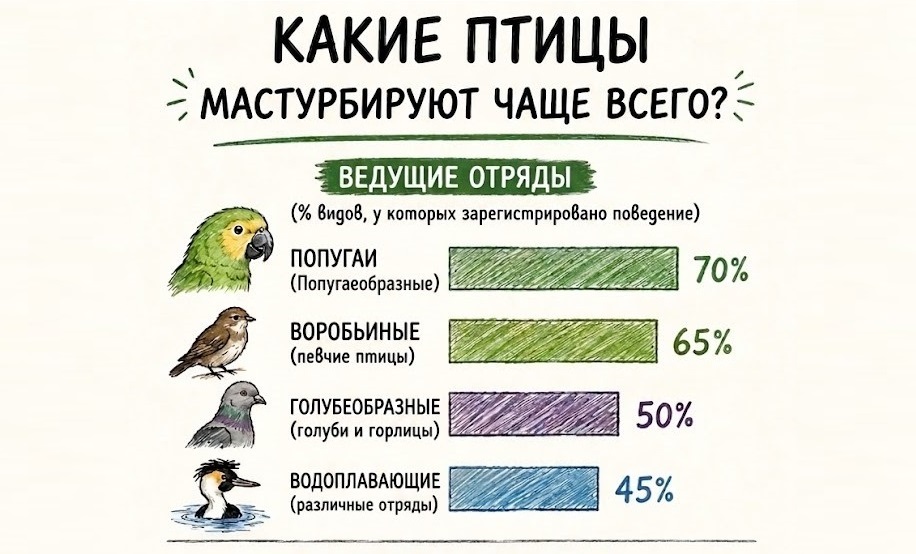
Which birds masturbate most often.
According to the researchers, the common ancestor of all birds most likely did not masturbate, but this behavior independently appeared and disappeared several times throughout evolutionary history. The sex-based numbers are also interesting: among reliable records, masturbation was observed in males in 55% of cases and in females in 36%. There is a difference, but it shows that this is by no means an exclusively “male” activity.
Another important detail: no significant difference was found between young and adult birds. This undermines the popular idea that masturbation is “practice” for adult life.
Why birds masturbate: scientists’ hypotheses
There’s no definitive answer yet, but researchers have a couple of working hypotheses. And they’re related to how birds’ intimate lives are structured.
Many species are socially monogamous — they form pairs, build nests together, and raise chicks. But even so, extra-pair mating in birds occurs frequently. And here’s what the study showed: in monogamous species with long-lasting pairs, masturbation was less common, while in species with more open mating systems, it was more frequent.
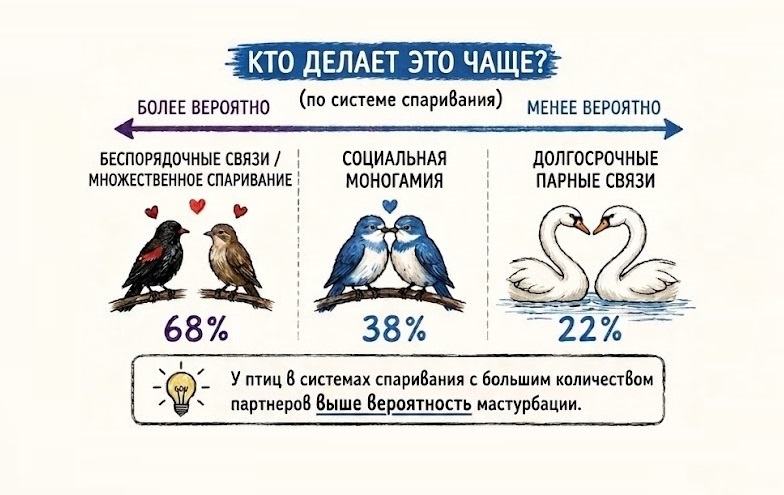
Who does it more often (depending on mating system).
This pattern supports two explanations at once:
- The release hypothesis. In species with frequent mating opportunities and high arousal, masturbation serves as an outlet for that arousal.
- The reproductive advantage hypothesis. The behavior may increase the chances of success after mating or in preparation for it — for example, by improving sperm quality in males.
It’s quite possible that both versions are partially correct. And there may be other mechanisms that science hasn’t yet uncovered.
What bird masturbation means for their owners
A great many people keep birds at home — the number of owners is in the millions. Roughly a fifth of owners are Gen Z, meaning the trend for feathered pets seems to be growing.
For a long time, masturbation in pet birds was considered a problem: supposedly a sign of boredom, frustration, or lack of a mate, and owners were advised to remove toys and “break” the bird of the habit. But the study fundamentally changes the picture: wild birds were caught doing this more often than domestic ones, which means blaming it all on “loneliness in a cage” doesn’t hold up. For many species, this is most likely simply normal.
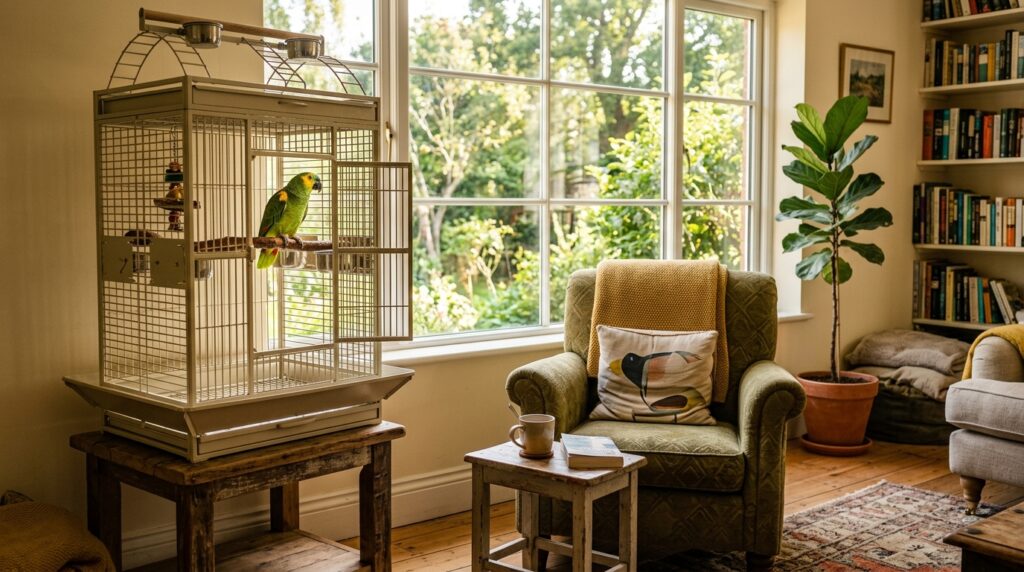
Millions of families keep pet birds, and the question of their behavior concerns many.
That said, the study doesn’t suggest that every such case can simply be ignored. If the behavior becomes obsessive, or if injuries, cloaca irritation, damaged feathers, or obvious stress appear — it’s best to take the bird to a veterinarian. But overall, there’s no reason to panic about it.
How much can we trust the findings of the bird masturbation study
Honestly, the science here is still young. The database largely relies on reports from people who noticed the behavior and decided to share it, and there are still few serious studies on the topic. This means some biases in the data are quite possible.
Still, the pattern emerged clearly enough to warrant rethinking the conventional view. If parrot masturbation was previously automatically classified as a “problem,” veterinarians now have grounds to give owners more accurate and reassuring advice.
The key takeaway: strange behavior in a pet is most often not a problem but part of its nature. Understanding this is useful if only to worry less unnecessarily and to notice genuinely alarming signals in time, when they do occur.