
Rating of the happiest cities in the world in 2026. Should we move?
A new ranking of happy cities for 2026 has been released. And it has a notable feature: 21 out of 25 of the happiest cities are in Europe, while all of North America along with Oceania ended up among the unhappiest regions on the planet. Let’s figure out why happiness so stubbornly concentrates in northern Europe and what these rankings actually measure, since a happy life doesn’t always come down to money, weather, and beautiful streets.
How the Ranking of the Happiest Cities in the World Is Compiled
The main question: can you even measure the happiness of an entire city? The authors of the Happy City Index decided that yes — if you look not at people’s mood in the moment, but at the conditions in which they live.
The ranking is built on six major categories: health, ecology, the residents themselves, quality of governance, transport accessibility (mobility), and economy. Within them lie more than 60 individual indicators — from air quality and green spaces to how convenient it is to get around the city without a car.
So “happiness” here is more about convenience and quality of life: how easy it is to move around the city, how clean the air is, whether healthcare is accessible, whether there are jobs and a park nearby, and whether rent eats up half your salary. When a city accumulates many such positives, it climbs up the list.
2026 Ranking: Why Scandinavian Cities Lead in Happiness Levels
Europe doesn’t just lead in this ranking — it dominates. But even within Europe, there’s a clear champion: six of the ten happiest cities are in the north of the continent, the Scandinavian region. Denmark, Sweden, and Switzerland each took two spots in the top ten. And this is already a pattern: these countries regularly end up at the top when it comes to the happiest countries in Europe.
The secret isn’t in some special northern character, but in down-to-earth things: a high standard of living and strong social support. When people’s basic anxieties — about health, work, and old age — are addressed, they have more energy left for happiness.
A good example is Copenhagen, which is designed for cyclists and pedestrians. The city is set up so that you barely need a car, and for this it receives high scores in mobility. On top of that, a city’s layout also affects people’s health and daily habits.
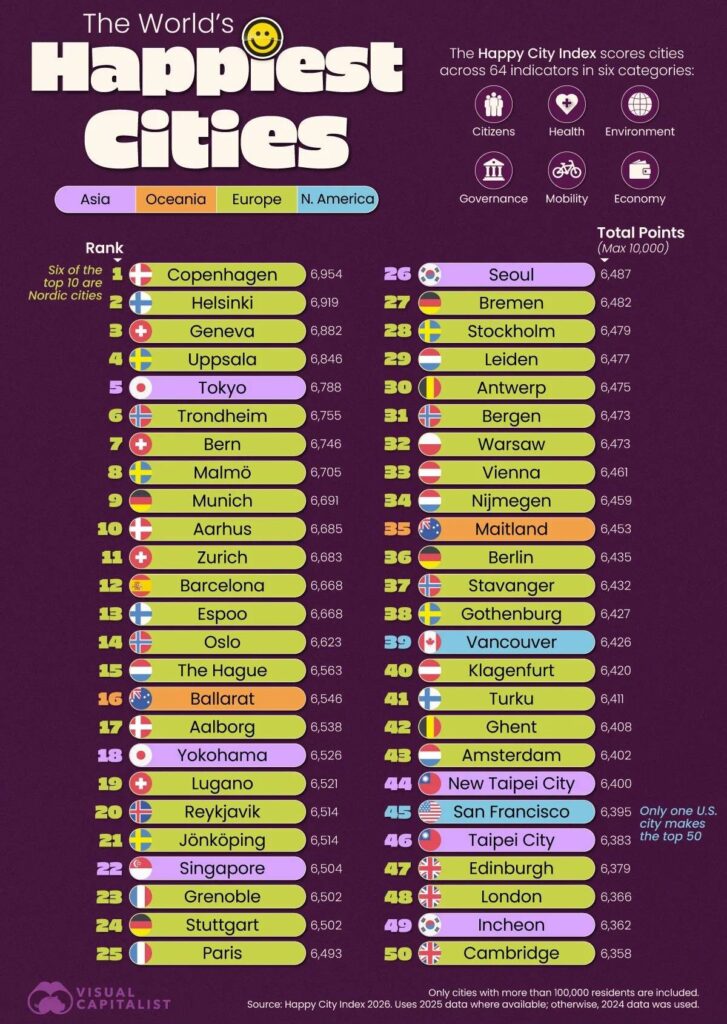
Rating of the happiest cities in the world.
Finland’s capital Helsinki excels in a different way — with a balance between city life and nature, which is literally within arm’s reach. And this is no small thing: green spaces near home are linked not only to mood but also to health.
Switzerland, with its Bern and Geneva in the top 10, adds beautiful landscapes and excellent transport that connects cities into a unified network. It turns out that in the ranking, happiness is assembled from convenience, nature, and peace of mind about tomorrow.
What Prevented North America from Making the Top of the Ranking
Only two North American cities made the top 50, and because of this, the entire continent ended up in the same company as Oceania among the unhappiest regions in the world.
The best in North America was the Canadian city of Vancouver at 39th place. It was pulled up by its connection to nature, green spaces, good ecology, and the Canadian healthcare system. In other words, once again — those same basic things that make life calmer.
As for the USA, it is represented in the top 50 by just one city — San Francisco at 45th place. And it got there for a reason: good healthcare, developed public transport, and an economy fueled by the energy of Silicon Valley and local tech companies.
But there was also an anchor dragging San Francisco down — sky-high housing costs: the average home price there is around $854,000. When a roof over your head costs a small fortune, there’s no question of relaxed happiness: money does affect happiness, but only if it doesn’t disappear entirely into a mortgage or rent. It was precisely the high cost of housing that prevented the city from climbing higher. This is perhaps the main lesson of the entire ranking. You can have a strong economy and plenty of jobs, but if people are suffocating from housing prices, the city still drops in the rankings.
Are There Any Russian Cities in the Ranking of the Happiest Cities in the World
There are no Russian cities in this top list, although they are often searched for in queries about the happiest cities. But if you look at the full ranking of 251 cities, Chelyabinsk can be found at 218th place, and slightly higher up is Tashkent (Uzbekistan) at 186th place.
We’re not encouraging anyone to move tomorrow, especially not to Copenhagen — the ranking is merely food for thought, not a call to action. After all, everyone measures happiness differently: some need mountains and bike paths, while others need loved ones nearby and a familiar neighborhood. What makes you happy?
What is truly useful to take away from this ranking is an understanding of what actually makes up a happy and comfortable city: clean air, convenient transport, greenery, the ability to walk to a park, trust in healthcare, not fearing old age, and not giving away half your income for rent. In this sense, the ranking is useful not as a travel guide, but as a checklist: what to look at when evaluating the place where you live or where you plan to move.