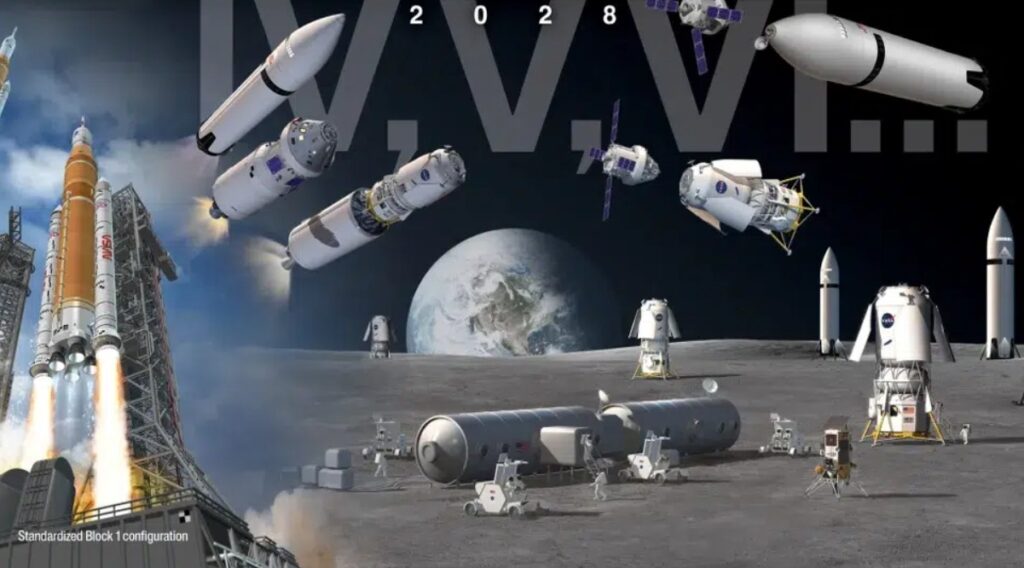
NASA still doesn’t know exactly when humans will return to the Moon
Less than a month ago, the Artemis-2 crew safely returned to Earth, marking the first crewed flight toward the Moon in half a century. It seemed like the lunar surface was within arm’s reach. But Artemis-3, originally conceived as a landing mission, has turned into something entirely different — a test flight in low Earth orbit. And the timeline has slipped again.
Why the Artemis-3 Moon Mission Is Delayed
According to Space News, NASA’s original plan was ambitious: Artemis-3 was supposed to deliver a crew to the Moon’s south pole, where astronauts would spend about a week on the surface. The total mission duration was approximately 30 days. But in February 2026, the agency radically revised the concept.
Instead of flying to the Moon, the Orion spacecraft will now rendezvous in low Earth orbit with lunar landing modules from SpaceX and Blue Origin. The goal is to practice docking, verify the compatibility of life support and communication systems. Essentially, it’s a dress rehearsal before the actual landing, not the landing itself.
The reason is simple and not particularly romantic: neither of the two lunar landing modules is ready for a crewed flight yet. SpaceX is still refining its Starship V3 version, which serves as the basis for the lunar variant. Blue Origin has completed ground testing of the Blue Moon Mark-1 module, but the crewed Mark-2 version will require even more time.
Why NASA Is Repeating “Apollo 9” Instead of a Direct Flight
NASA compares the updated Artemis-3 to the Apollo 9 mission of 1969. Back then, the crew didn’t go to the Moon either — the astronauts tested the lunar module in Earth orbit for the first time: docking, undocking, maneuvers, working in spacesuits. The flight lasted ten days and became the very rehearsal without which Apollo 11 would never have happened.
The analogy is not only elegant but strategically precise. Before sending people to the Moon in entirely new spacecraft, it makes sense to verify that all systems work together — at least close to Earth, where the crew can quickly return in case of problems. The complication is that Artemis-3 must synchronize the launch of multiple rockets from different companies and bring all vehicles to a common orbit within a single launch window. Each additional participant adds logistical complexity.
There’s another fundamental difference from the Apollo era. Back then, NASA controlled the entire production cycle. Now, key elements — landing modules and spacesuits — are being developed by private contractors, and the pace of their work directly affects the agency’s schedule.
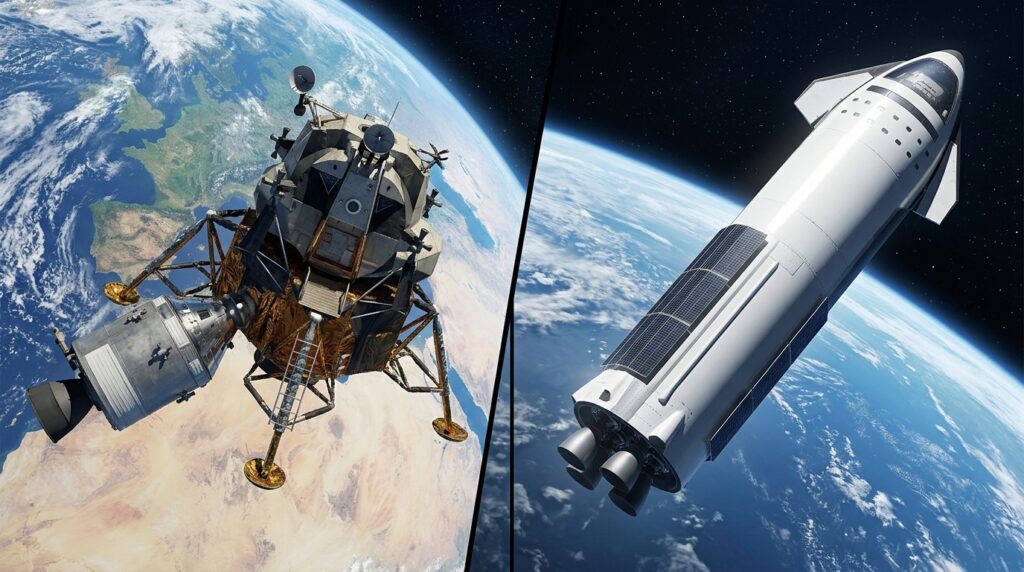
Left — the Apollo 9 lunar module in Earth orbit (1969). Right — the Starship HLS lunar module concept for the Artemis program
The Lunar Mission Plan Remains Undefined
The paradox of Artemis-3 is that the hardware is progressing faster than the mission plan itself. The SLS core stage has already been delivered to Kennedy Space Center in Florida. Solid rocket booster segments are arriving on schedule. Mating of the Orion command and service modules is planned for summer 2026.
Yet key mission parameters remain undefined: at what altitude the docking will take place, how long the flight will last, and exactly what operations the crew will perform. The orbit, scenario, and sequence of actions are all still under discussion. There’s even discussion about launching SLS without its upper stage to preserve that component for future missions. Such decisions show that engineering compromises are directly shaping the mission architecture right now.
A separate story involves the next-generation AxEMU spacesuits being developed by Axiom Space. It’s still unclear whether they will be tested specifically on Artemis-3 or on the International Space Station. An Axiom representative confirmed that the company has proposed several testing options to NASA, but specific details have not yet been agreed upon.
New Artemis-3 Timeline and the Cascading Effect of Delays
In February 2026, NASA indicated a target of “mid-2027.” A program representative specified: “no earlier than March, no later than June.” But by the end of April, NASA Administrator Jared Isaacman outlined a more realistic horizon — the end of 2027.
At a Congressional hearing on April 27, he stated that he had received confirmation from both contractors — SpaceX and Blue Origin — of their readiness to provide docking and compatibility testing by the end of 2027, with a Moon landing attempt planned for 2028.
And then comes the domino effect. NASA plans to launch missions at roughly ten-month intervals. If Artemis-3 slips past April 2027, two crewed landings in 2028 — Artemis-4 and Artemis-5 — no longer fit into the schedule. And that was precisely the stated goal.
The mission crew has also not yet been announced. Isaacman mentioned in an interview on April 30 that the announcement is “not far off” and that with just over a year until launch, it’s time to begin training. But the very absence of a crew is a marker of how unstable the schedule remains.
Why NASA Chose the Path of Caution
One could criticize NASA for the delays, but it’s worth looking at the bigger picture. The Artemis program uses a fundamentally new architecture where commercial partners are responsible for critical components. Neither cryogenic refueling in space (required for Starship) nor high-precision autonomous lunar landing have been demonstrated in real conditions yet.
Abandoning a direct landing in favor of a test flight is a deliberate choice in favor of safety. NASA is essentially saying: we will not send people to the Moon in spacecraft that have never docked with each other in space.
The successful Artemis-2 flight confirmed that the SLS + Orion combination works. The capsule splashed down just a few kilometers from the planned point, and the heat shield loss issue — the same one that surfaced during the uncrewed Artemis-1 — was significantly mitigated. Now it’s up to the landing modules: they are the ones setting the pace for the entire program.
There are three events that will indicate how realistic the 2028 landing plan is:
- The first orbital flight of Starship V3 and a demonstration of in-space refueling — without this, the SpaceX HLS architecture doesn’t work;
- An uncrewed Blue Moon Mark-1 landing on the Moon — the first real flight data for Blue Origin;
- Confirmation that NASA can maintain a ten-month interval between missions after Artemis-3.
Artemis-3 has a strange dual role: on one hand, it’s a mandatory stepping stone to a lunar landing; on the other, it’s a potential bottleneck for the entire project. If the test flight goes well, the path to the Moon will truly open up. If it slips again, it will drag everything else with it. NASA is currently following the principle of “make haste slowly,” and after a half-century hiatus in flights to the Moon, that is arguably wiser than chasing impressive dates.