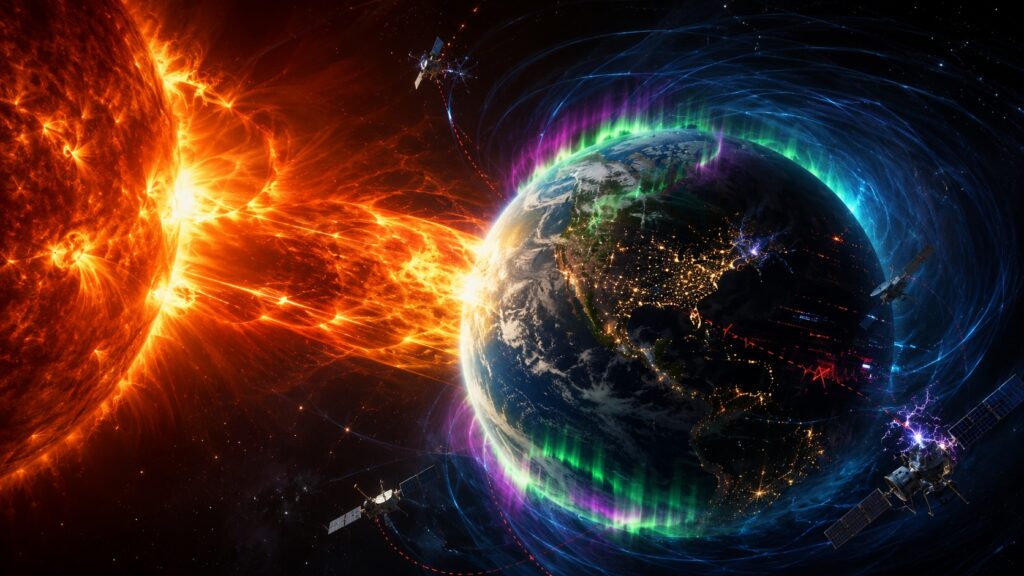
A powerful geomagnetic storm will definitely happen, but we don’t know exactly when
A strong geomagnetic storm can knock out technology and the internet worldwide. It’s hard to believe, but according to experts, it’s only a matter of time. The most powerful solar storms in history occur on average once every 500 years, and our civilization is, for the first time in history, entirely dependent on electricity and communications.
How Geomagnetic Storms Arise from Plasma Ejections on the Sun
A geomagnetic storm, also known as a solar storm, begins on the Sun. Sometimes a huge bubble of superheated gas, or plasma, is ejected from its surface. This phenomenon is called a coronal mass ejection. Essentially, it is a cloud of protons and electrons — electrically charged particles hurtling toward Earth.
When these particles reach our planet, they interact with its magnetic field. The field becomes distorted and weakened, which is why we see auroras and also notice disruptions in technology. In normal doses, this solar wind is harmless and even beautiful. The problem begins when the Sun ejects too many particles.
A good example is the geomagnetic storm of May 2024, which received the highest G5 rating on the geomagnetic storm scale. It disrupted GPS operations so severely that it threw off course automated tractors that require centimeter-level precision. All of this was reported by the authors at ZME Science.
The Most Powerful Geomagnetic Storms in History
The strongest geomagnetic storm occurred on September 1 and 2, 1859. Telegraph systems failed worldwide — and that was one of humanity’s first electronic technologies. Operators received electric shocks, telegraph paper caught fire, and equipment could be used even with batteries disconnected — that’s how strong the induced current was. The aurora borealis on those nights was visible as far as Colombia, even though it’s normally only seen near the poles.
This event went down in history as the Carrington Event.
But even that, as it turned out, was not the limit. Antarctic ice samples revealed traces of an even more massive storm around 774 AD. It is called the Miyake Event. That flare caused the sharpest spike in carbon-14 ever recorded — a radioactive isotope that forms in the upper atmosphere under the influence of cosmic rays. The stronger the storm, the more carbon-14 is produced, which is then found in tree rings.
The Miyake Event produced a 12% increase in carbon-14, whereas the Carrington Event produced less than 1%. In other words, the Miyake Event was many times more powerful. Analysis of ice cores has shown that storms on the scale of the Carrington and Miyake Events occur on average once every 500 years.
The Danger of Geomagnetic Storms to Technology
If a Carrington-level storm were to strike today, it wouldn’t be telegraph wires that suffer, but everything around us. Given our dependence on electricity, the consequences could amount to trillions in losses and pose a threat to the lives of people who depend on these systems.
The thing is, a geomagnetic storm generates induced currents in wires that flow through the power grid. These currents can exceed 100 amperes — roughly as much as an entire residential house consumes. Such current surges into transformers, relays, and sensors, damaging them from within and causing massive outages.
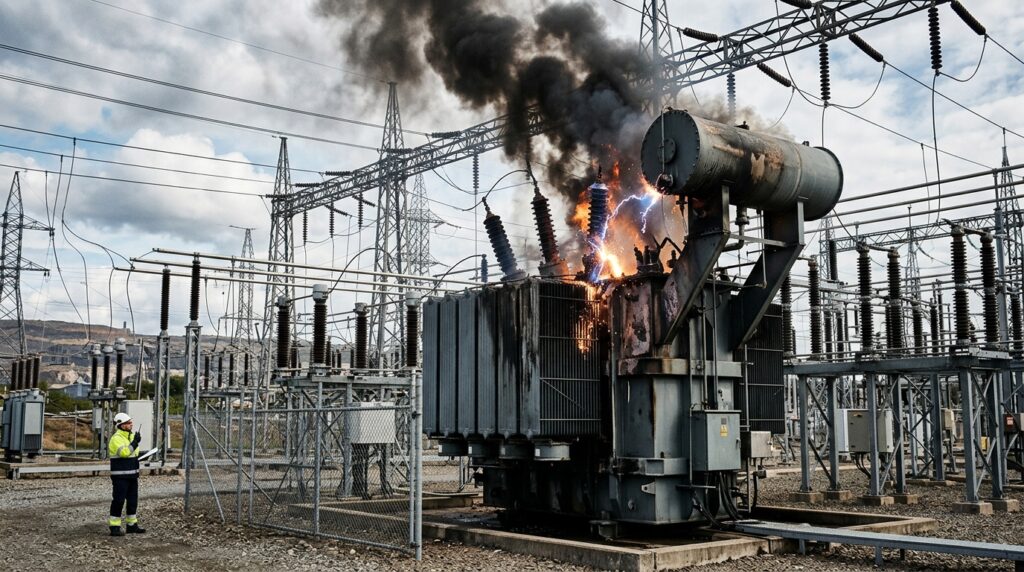
Induced currents can damage transformers and bring down the power grid
This is not theory. In March 1989, a storm three times weaker than the Carrington Event was enough to bring down the Hydro-Quebec power grid. Induced currents damaged a transformer in New Jersey and tripped circuit breakers. As a result, five million people were left without electricity for nine hours. And that storm was relatively weak.
How a Solar Storm Would Affect the Internet
The damage wouldn’t be limited to power outages. In a Carrington-scale storm, communications would be severed on a global scale. Internet service providers would be hit, followed by all systems that need to exchange data.
Here’s what would be at risk:
- High-frequency radio communications: ground-based, shortwave, air-to-ground, and ship-to-shore;
- Satellites, whose circuit boards could simply be fried by induced currents;
- Satellite phones, internet, radio, and television;
- GPS navigation in cars, aircraft, smartphones, and smartwatches;
- Military systems: over-the-horizon radar and submarine detection.
There’s also a less obvious threat. When a storm heats the upper layers of the atmosphere, it expands outward and becomes denser where satellites orbit. The increased atmospheric drag slows satellites down, and if they aren’t boosted to a higher orbit in time, they begin falling back toward Earth.
When Will a Powerful Solar Storm Occur
It’s impossible to prepare for the next powerful geomagnetic storm. Even with NOAA’s space weather service monitoring solar flares, the world would have only a few minutes to a few hours of warning.
A Carrington-scale storm would inflict severe damage to power grids and communications worldwide, and disruptions could last for weeks. If a Miyake-scale storm were to strike, the consequences would be catastrophic, and power outages could stretch on for months.

A powerful geomagnetic storm could leave entire regions without power for weeks
It’s impossible to completely prevent a storm, but the impact can be mitigated. Experts name two approaches:
- Installing devices that protect vulnerable equipment such as transformers;
- Developing technologies to reduce the load on grids when a storm is already approaching.
In short, the most powerful geomagnetic storm will definitely happen in the future, but we don’t know when. The history of ice cores shows that such events are inevitable, and our dependence on electronics makes us more vulnerable than our ancestors. That’s why work on protecting our grids needs to start now, before the Sun reminds us of its power once again.