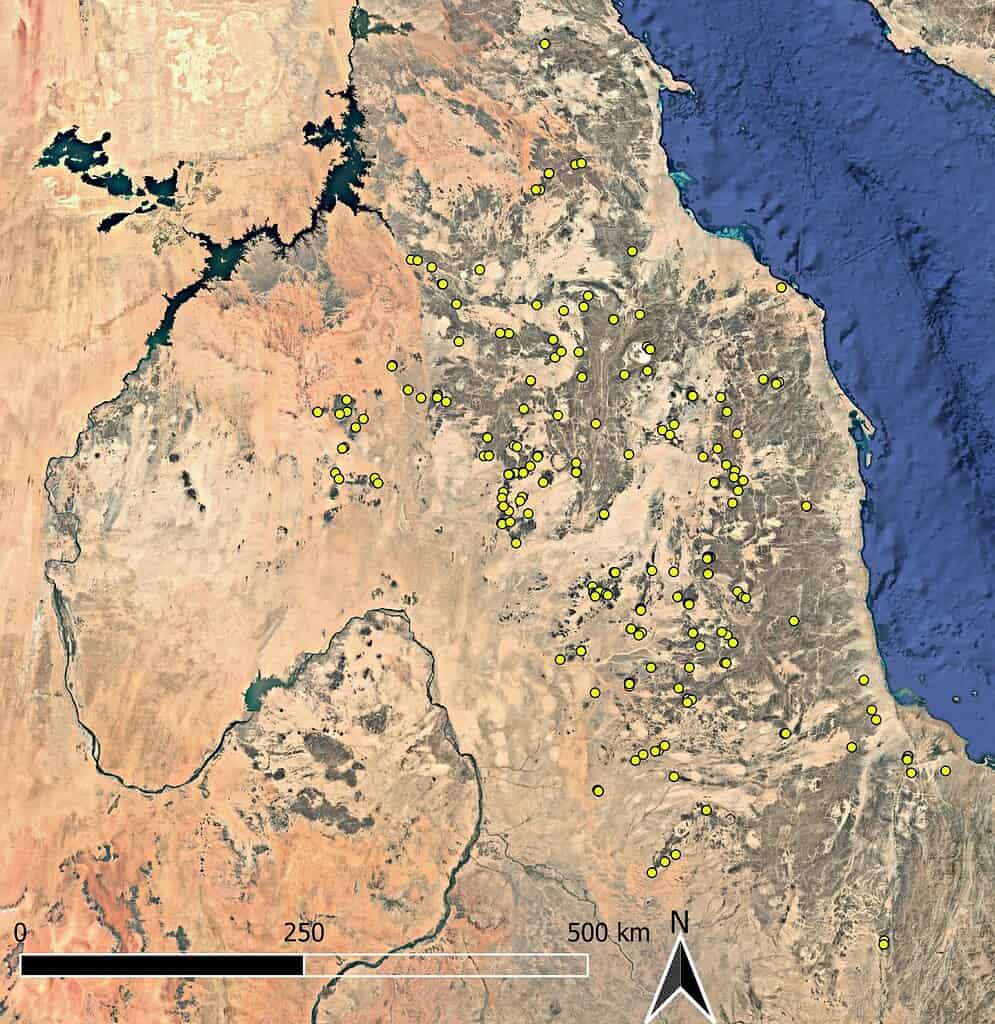
Satellites revealed 260 secret mass graves in the Sahara
An international team of archaeologists has found 260 massive circular burials in the desert of Eastern Sudan that no one previously knew about. Inside are bones of humans and animals, arranged around a central figure. These burials are approximately 5,000–6,000 years old, and behind them lies the story of a forgotten nomadic culture that lived here even before the pharaohs.
How Satellites Helped Discover Ancient Burials in the Sahara
Scientists used satellite aerial imagery to systematically search for archaeological sites in the Atbai desert in eastern Sudan — a part of the vast Sahara between the Nile and the Red Sea. The team included archaeologists from Australia’s Macquarie University, the French research center HiSoMA, and the Polish Academy of Sciences. Their goal was to tell the region’s story without any digging at all.
And the imagery worked. The team’s study describes 260 previously unknown “enclosed burials” east of the Nile, scattered across a territory of nearly a thousand kilometers. Again and again, the images revealed large circular burials filled with human and animal bones, often neatly arranged around a central figure.
The circular stone funerary monuments range from 5 to 82 meters in diameter — meaning the largest are comparable in size to a football field. Inside the walls, people were buried alongside their livestock: cattle, sheep, and goats.
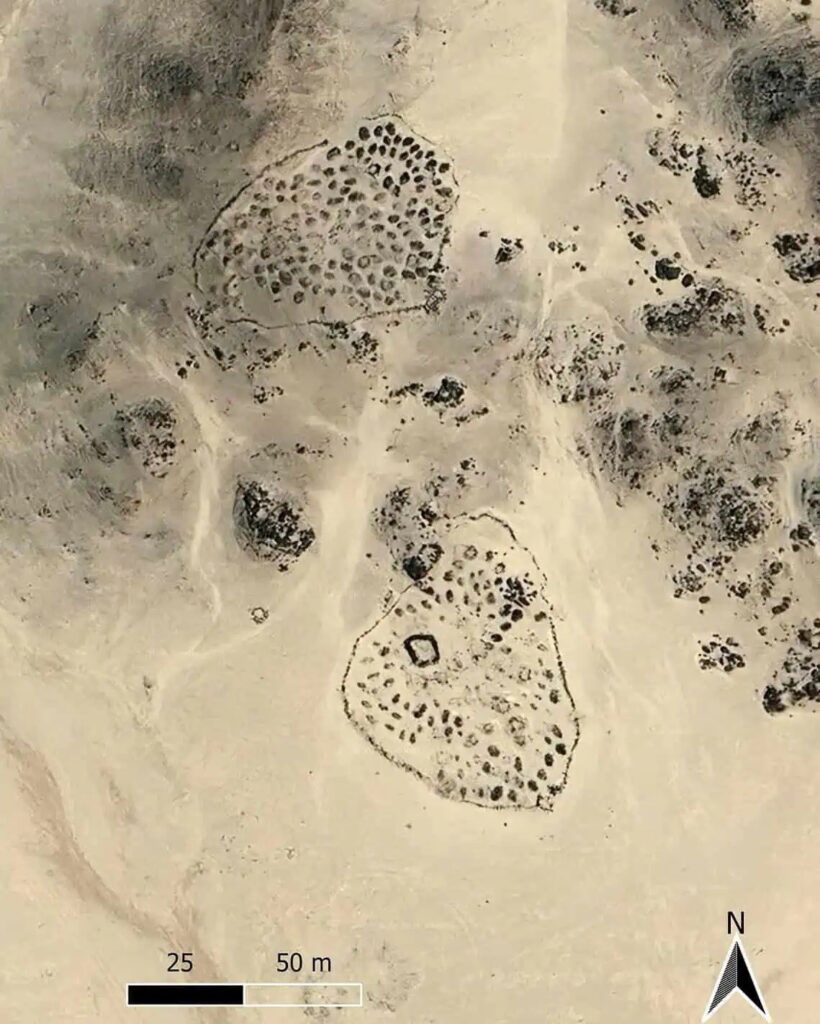
Burials arranged around a “primary” burial.
Saharan Nomads: Who Built the Mysterious Monuments in the Desert
Such circular funerary monuments were previously known only from a few excavated examples in the Egyptian and Sudanese deserts and had long puzzled scientists. Each individual case appeared to be an exception. But satellite imagery revealed a different picture. What seemed like isolated examples now forms a unified pattern — possibly traces of a shared nomadic culture that spanned a vast territory of the desert.
Radiocarbon dates and ceramics from the few excavated monuments suggest that these people lived approximately in 4000–3000 BCE — just before the Egyptians unified into the state we know as Ancient Egypt of the pharaohs. But the nomadic builders of these burials had almost nothing in common with the settled farmers of the Nile Valley. These nomads (people leading a nomadic lifestyle) had little overlap with the urban and agricultural Egyptians — they were true desert nomads.
According to the researchers’ calculations, building a single average funerary structure would have required more than 160 full working days for one person. This indicates serious coordination and planning — a highly organized pastoral society capable of mobilizing labor in one of the harshest landscapes in Africa.
First Signs of Inequality Among Saharan Nomads
Not all those buried inside the stone circles were equal. Some structures contain “secondary” burials arranged around a “primary” burial — possibly a chief or another important community member. For archaeologists, this is valuable material: the arrangement of bodies can reveal social hierarchy.
The question of when Saharan nomads ceased to be an egalitarian society has occupied archaeologists for decades. Most agree that it was during the fourth millennium BCE that a distinct “elite” class emerged among them. While this was still far from the chasm between rulers and subjects seen in Egypt with its pharaohs and peasants, it already represented the first glimmers of inequality.
In other words, hierarchy in human societies originated not only in cities and along rivers, but also among herders scattered across the desert.
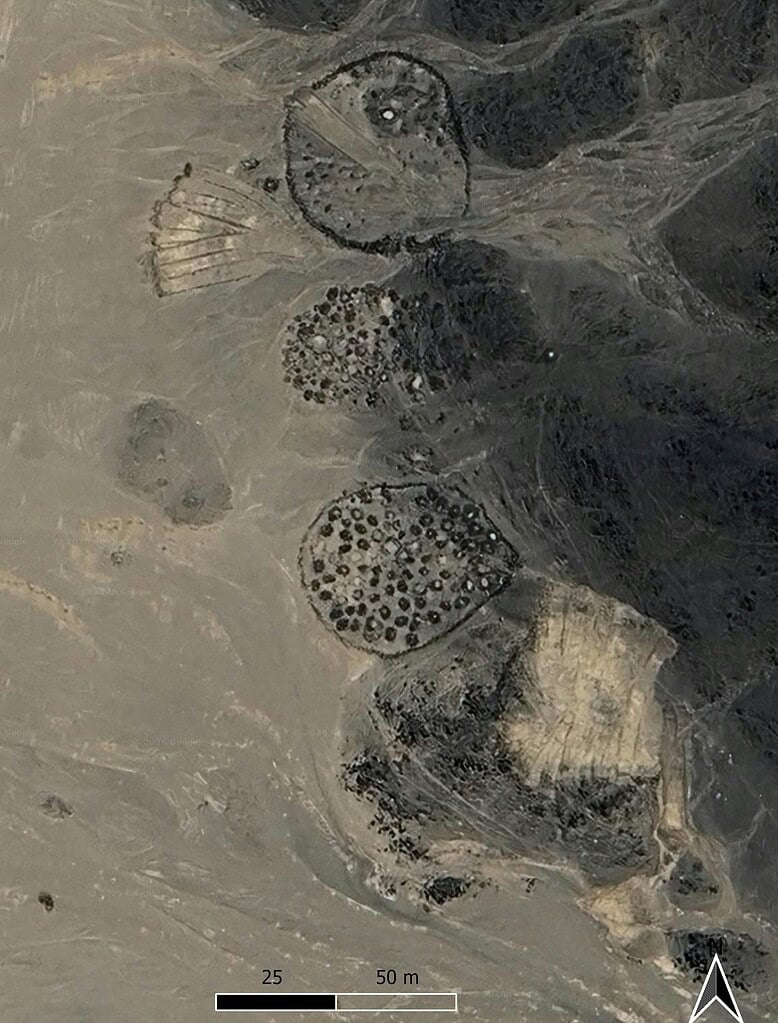
Another satellite image of a group of burials. Some of them have recently been vandalized.
Why Livestock Was Buried Together with People: The Most Valued Possession and Status Symbol of Saharan Nomads
Cattle were apparently extremely important to these prehistoric nomads — a theory also confirmed by rock art in the same region. By burying themselves alongside their herds, the nomads demonstrated how highly they valued animals. In the largest excavated monument, approximately 18 separate cattle burials were discovered.
The Sahara was once significantly greener and wetter. During the so-called African Humid Period, North Africa received much more rainfall, and a significant part of the Sahara was covered with grasses, trees, and lakes. But the dates of the monuments cluster around 4000–3000 BCE — a period when the once-green Sahara was already drying out.
The summer monsoon was gradually retreating from north to south, rainfall was decreasing, and pastures were shrinking. This forced nomads to abandon water-demanding cattle, increase herd mobility, migrate south, or move toward the Nile. Under such conditions, maintaining a large herd of cows in the desert could have been a way to display an expensive and rare possession — a prehistoric equivalent of a Ferrari. This probably explains why livestock was so often buried together with their owners.
Interestingly, thousands of years later, local nomads reused these “ancient” structures for their own burials, sometimes nearly 4,000 years after they were originally built. The prehistoric nomads essentially created cemeteries that endured for millennia.
Why the Ancient Burials Were Built Near Water
The monuments are primarily located near what were then favorable water sources: rock pools in valleys, dried-up lakes, and seasonal riverbeds. This suggests that when they were built, the desert was already quite harsh and dry.
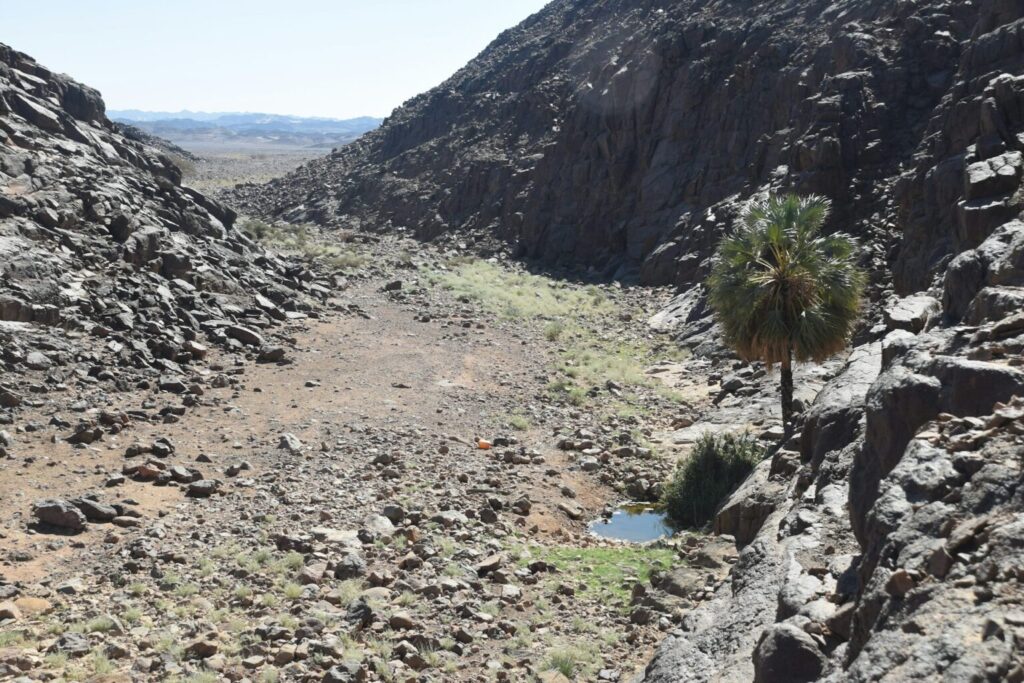
Burials were located near freshwater sources, such as this small pool in a gully.
This connection to water is no coincidence. The placement of the burials, according to the authors, can be read as a “map” of favorable locations for grazing and watering, and therefore for the life of a nomadic community. This is likely where herd migration routes converged, and where people wanted to rest after death.
At some point, grass and shrubs finally gave way to sand and stones, and keeping livestock became impossible. What exactly became of these people is not known for certain. But the burials themselves prove that even scattered nomadic communities were extraordinarily well organized and able to adapt.
Why the Unique Monuments of the Sahara May Disappear
This discovery, according to the authors, changes the history of the Saharan deserts and the prehistory of the Nile. The burials serve as a kind of prologue to the monumentalism of the kingdoms of Egypt and Nubia and show that the region is not just about pharaohs, pyramids, and temples. Long before the great civilizations, there existed a complex nomadic culture with its own hierarchy, rituals, and architecture.
But there is also a troubling part. Many of these monuments are currently being destroyed or vandalized due to unregulated mining in the region. Unique burials that stood for millennia could disappear in less than a week.
This discovery is important for two reasons. On one hand, satellites and remote sensing now allow us to peer into places that until recently could not be reached without a long and dangerous expedition. On the other hand, scientists noticed these monuments just in time: what endured for millennia may soon be lost forever.