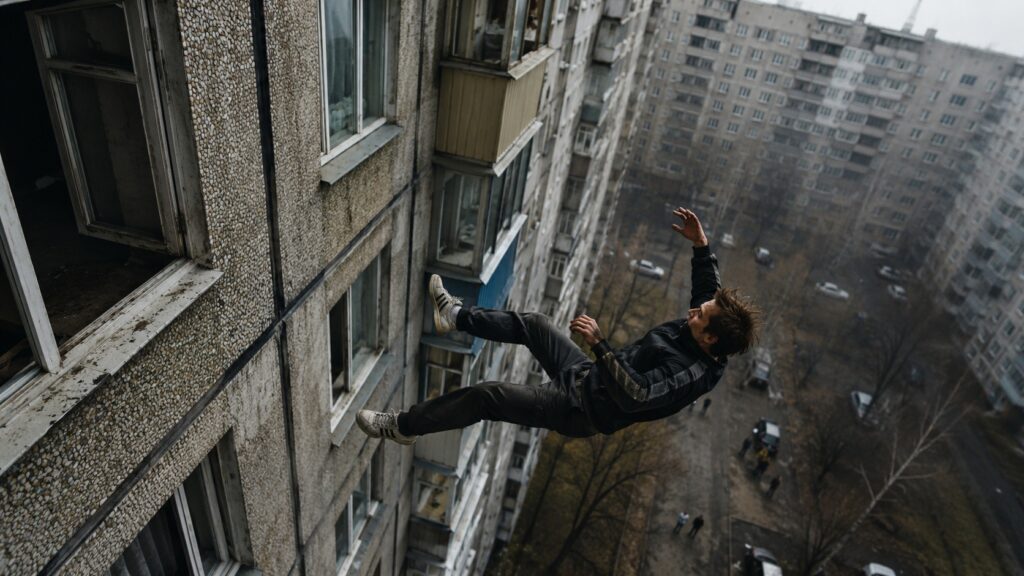
Scientists study everything, including the specifics of falling from height
Which floor is more dangerous to fall from, the third or the fourth? Anyone would say without hesitation that the fourth is more dangerous, because higher means scarier. But that’s wrong! Here’s a paradox that will make you question the laws of logic: the third floor can lead to death, while the fourth may result in only severe disability. And sometimes people even survive falls from the 72nd floor, and there’s an explanation for that too.
How the Body Behaves During a Fall
When a person falls from a height, their body doesn’t simply fly straight down. It rotates around the center of gravity — a point located roughly around the navel in a standing person. If there was no push, for example during an accidental slip from a roof, the body follows a parabolic trajectory and gradually flips over. This is described in the Great Russian Encyclopedia.
Imagine you dropped a long stick that you were holding vertically by one end. It wouldn’t just fall straight down — it would start rotating. Something similar happens with the human body: the head and legs have different masses, and gravity spins this non-uniform structure during flight.
This is precisely why forensic experts can reconstruct the circumstances of a fall from the nature of the injuries: the height, the initial body position, and even whether the person was pushed.
The Danger of Falling from the Third Floor
Experiments with mannequins revealed a surprising pattern. When falling from a height of 7–8 meters — roughly the third floor — the body has enough time to rotate exactly 180 degrees. If the person was standing upright, they land head-first, in the most dangerous position.
From the fourth floor, however, the body completes a 270-degree rotation and meets the ground with its back. The impact is distributed over a much larger area, the load is spread differently, and although the speed is higher when falling from the fourth floor, the chances of surviving a back landing are significantly greater than from a head-first impact.
Here’s how body position changes depending on the height of the fall:
- 7–8 meters (3rd floor) — 180-degree rotation, head-first landing;
- 10–11 meters (4th floor) — 270-degree rotation, back landing.
Of course, these figures are averages. The actual rotation angle depends on the height, weight, body type, and initial position of the specific person.
What Affects Speed During a Fall
Many people think that heavier objects fall faster than lighter ones. But body mass has virtually no effect on falling speed — Galileo established this long ago. The difference arises only due to air resistance: a feather falls slower than a weight not because it’s lighter, but because air slows it down more.
For the human body over short distances, air resistance plays almost no role. The speed at the moment of landing is determined only by the height of the fall and gravitational acceleration — according to NASA, this is approximately 9.8 m/s². The higher the starting point, the faster the body flies.
This is where the paradox lies: the severity of injuries depends not only on speed but also on which part of the body takes the impact. That’s why the third floor can be more dangerous than the fourth — the speed is slightly lower, but the impact falls on the head.

Height determines falling speed, but not always the severity of injuries
How Forensic Experts Study Falls
Forensic experts divide falls into two types. Passive — when a person simply loses their footing, for example, slipping on a roof. Active — when additional acceleration is applied: being pushed, or pushing off from a windowsill.
Interestingly, a push doesn’t always increase the distance the body lands from the wall. If force is applied far from the center of gravity — for example, a push to the shoulder or legs — the body may not fly outward but rather flip and fall almost vertically downward, right at the base of the building.
A blow near the navel, closer to the center of gravity, on the other hand, throws the body farther from the wall. This is an important detail for forensics: based on the landing spot, an expert can determine whether the person was pushed and exactly where the force was applied.
Falling from a Vehicle or Train
A separate situation involves falling from a bicycle, car, motorcycle, or jumping from a train. Here, the speed of the vehicle is added to the falling speed. The body continues moving forward due to inertia, even after separating from the vehicle.
From a purely physics standpoint, it makes more sense to jump backward, against the direction of travel. This way, the jump speed is subtracted from the vehicle’s speed, and by the time you touch the ground, you’re moving slower. But in practice, jumping forward in the direction of travel is safer, and here’s why: upon touching the ground, the feet stop, but the upper body continues flying. When jumping forward, a person instinctively extends a leg and can take several running steps, dissipating the inertia. When jumping backward, there’s no such saving movement, and falling onto your back is almost inevitable.
By the way, it’s better to throw luggage from a train in the opposite direction, against the movement. A suitcase doesn’t need to balance on legs, and the reduced speed will lessen the force of impact with the ground.
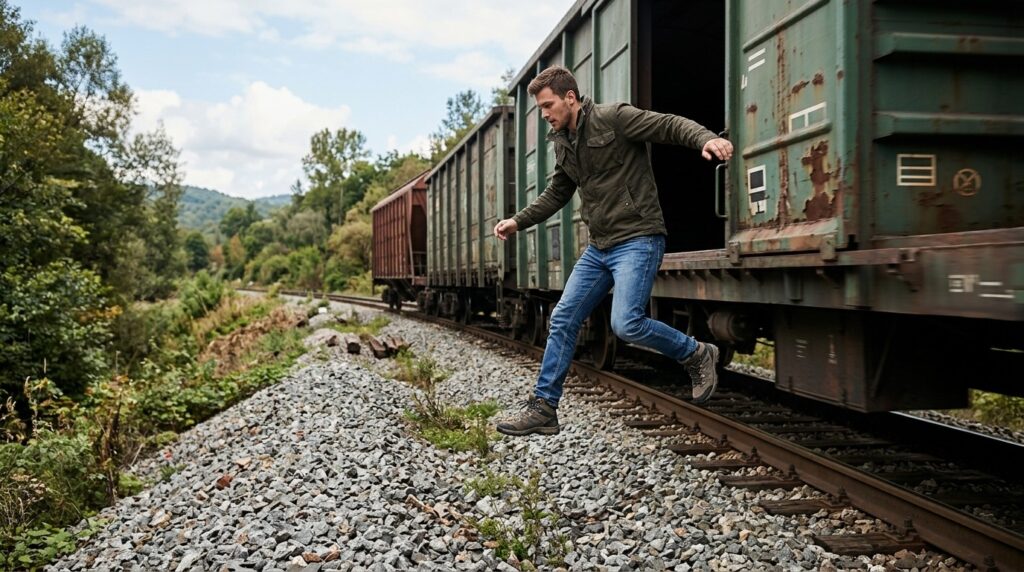
Jumping from a train: physics recommends one thing, but the body suggests another
How the Body Cushions Impact During a Fall
The human body is not a brick. Body tissues are elastic, muscles and joints work as shock absorbers, and different body parts have varying degrees of resilience. All of this significantly reduces the force of impact upon landing.
During a fall, people reflexively grab anything within reach: balconies, branches, cornices. The hands suffer from this, but by the time of the final impact with the ground, the speed has noticeably decreased. Each such catch absorbs part of the energy that would otherwise go into a destructive contact with the surface.
The safest way to land is through simultaneous contact of several body points with elastic bending of the limbs. This is exactly what paratroopers and parkour practitioners are taught: don’t land on straight legs, but distribute the load through a roll.
Knowledge of the physics of falls is not just a grim theory. It helps design safer buildings and balconies, develop safety systems, and ultimately understand how to behave in an extreme situation. It’s also a vivid demonstration that simple laws of mechanics govern life at literally every step, even when it comes to something as dramatic as the flight of a human body.