Gut bacteria under the microscope: a diverse ecosystem inside us
People who live together gradually exchange gut bacteria — and not just any bacteria, but the most beneficial ones. This is the conclusion reached by scientists from the University of East Anglia. The results, published in the journal Molecular Ecology, provide surprisingly clear evidence that the human microbiome is not just a personal matter, but also a matter for your housemates.
The Human Microbiome: What Are Gut Bacteria and How Do They Work
Inside each of us lives a vast community of bacteria, fungi, and other microorganisms. This is the microbiome — an invisible ecosystem that helps us digest food, supports our immune system, and even affects memory and mood. The majority of this community resides in the gut, in an almost oxygen-free environment.
Among gut bacteria, anaerobic microorganisms play a special role — those that live only in an oxygen-free environment. They cannot survive in open air, which means they are not transmitted through surfaces or dust. The only way to acquire them is through close physical contact with another person (or animal). These bacteria became the focus of the new study.
Previous human studies had already hinted: spouses and long-term housemates have similar microbiomes, even when their diets differ significantly. But these observations had a problem — too many variables. A shared refrigerator, the same air, similar daily routines — which of these actually makes a difference? The new study provides a much cleaner answer.
How Birds Helped Study Bacterial Exchange
To understand exactly how social bonds change the body’s microflora, the researchers turned to an unusual model — the Seychelles warbler. These small songbirds inhabit Cousin Island in the Seychelles archipelago. The island is tiny — just 29 hectares — and the birds never leave it.
This is precisely what makes the warblers ideal research subjects. As project leader Professor David Richardson explained, “this gives us the best of both worlds: we can study animals living natural lives while still collecting detailed data on each individual.” Every bird on the island is marked with colored leg bands, and scientists have been tracking their behavior, health, and genetics for years.

A Seychelles warbler with colored bands — a participant in a long-term study
Dr. Chuen Zhang Li, who led the practical part of the work as part of his dissertation, collected hundreds of droppings samples from these birds over several years. It sounds unremarkable, but fecal samples are the primary tool for analyzing gut microflora. They contain complete information about which bacteria inhabit a specific bird’s gut.
How Proximity Between People Changes the Body’s Microflora
Warblers are social birds. They live in pairs, but helpers — young individuals that assist in feeding chicks — often join the nest. The researchers compared microbiomes of birds with varying degrees of closeness: nesting pairs, pairs with helpers, birds from the same group but not sharing a nest, and completely unrelated individuals.
The result was unequivocal: the more time birds spent together, the more similar their gut bacteria became. And this specifically concerned anaerobic microorganisms — those that cannot be transmitted through air or a shared environment. They are transmitted only through direct contact: shared time in the nest, feeding, and physical closeness.
This point is key. If microbiome similarity were explained simply by a shared environment — the same island, the same insects in the diet — then aerotolerant bacteria (those that can also survive in air) would also match. But it was specifically the anaerobic microbes that showed a clear link to social proximity. This means it’s not about a shared kitchen, but about a shared bed — in the literal, avian sense.
How Human Interaction Affects Gut Microflora
Of course, humans are not warblers. But the basic principles of how the gut microbiome works are similar across all vertebrates. Early studies on humans had already shown that spouses and long-term housemates have more similar microflora than strangers, even with different diets. Similar data have been obtained from wild baboons and mice: social contacts predicted similarity specifically in anaerobic gut bacteria.

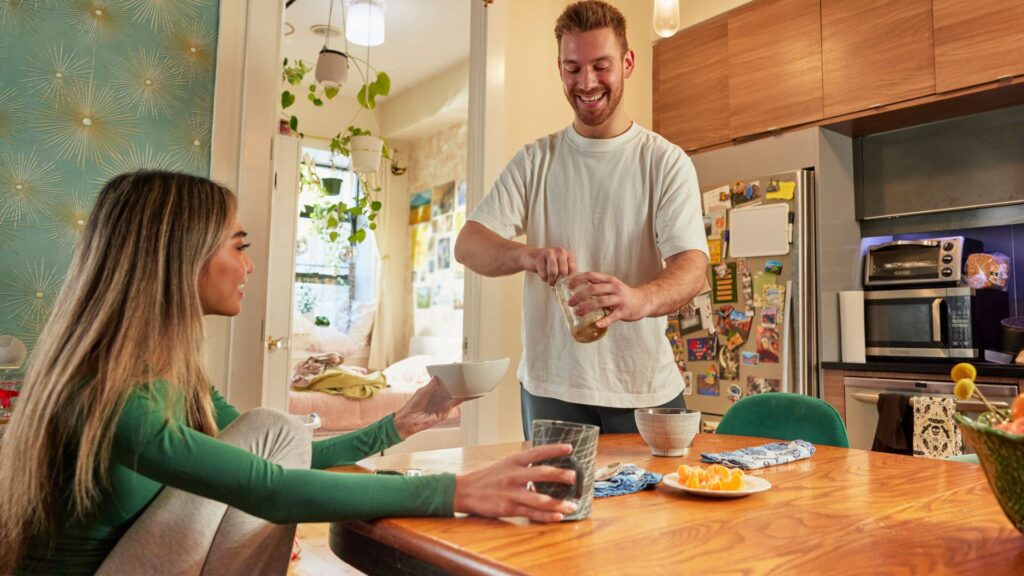
Shared dinners, hugs, and everyday little things — all of this subtly brings the microbiomes of family members closer together
As Dr. Chuen Zhang Li explained: “Whether you live with a partner, a roommate, or family — your daily interactions, from hugs and kisses to cooking together, can facilitate the exchange of gut microbes.”
In human terms, this means that evenings on the couch, a shared kitchen, and even just close physical presence gradually bring the microbiomes of members of the same household closer together.
It’s important to understand: this is not about getting infected with something harmful. Anaerobic gut bacteria are predominantly beneficial microbes. They help digest food, maintain the intestinal barrier, and prevent pathogens from establishing themselves in the gut. It’s no coincidence that any disruption to the microbiome, including taking antibiotics, has such a noticeable impact on health. The exchange of such bacteria between housemates is essentially an exchange of protective resources.
How the Exchange of Gut Bacteria Benefits Health
The scientists emphasize: social exchange of anaerobic microbes can strengthen the immune system and improve digestion for all members of a household. Once in the gut, these bacteria find an ideal oxygen-free environment, establish themselves, and form stable colonies. This makes their influence long-term — not a one-time visit, but an ongoing “collaboration.”
There is also a flip side. The researchers note that close social contacts increase not only the exchange of beneficial microbes but also the risk of pathogen transmission. However, most dangerous intestinal pathogens are actually aerotolerant, meaning they can be transmitted through the environment without close contact. But for the transfer of beneficial anaerobes, closeness turns out to be critically important.
A curious parallel conclusion: social isolation may work in the opposite direction. If close contact enriches the microbiome, then loneliness could theoretically deplete it. This is yet another reason why living together may be beneficial for health — and we’re not just talking about psychological comfort.
That said, it should be noted: there are no direct human experiments yet that would confirm this specific causal relationship. The current work is an observational study on birds. Its value lies in being the first to convincingly separate the influence of a shared environment from social closeness. But extrapolation to humans remains a hypothesis, albeit one well supported by previous data.
The microbiome is not personal property, but rather a shared ecosystem that exists at the intersection of our biology and our relationships. This study is another step toward understanding that gut health depends not only on what we eat, but also on who we spend time with. Microbiome science is young, and ahead lies the task of testing these mechanisms directly in humans. But it’s already clear: your housemates affect you more deeply than you think — literally down to the level of gut bacteria.