
Perhaps the infant brain already contains a rough ‘draft’ of neural connections, which life experience transforms into a precise instrument
For centuries, philosophers and scientists have debated: is the brain born empty, ready to absorb experience, or does it come into the world already with some innate ‘content’? A new study on mice has given an unexpected answer: it appears the brain doesn’t start from a blank slate, but rather from an excessively filled draft version, which it then edits and simplifies as it matures.
Why an infant’s brain is not a ‘blank slate’
Neurobiologists from the Institute of Science and Technology Austria (ISTA) investigated how the key memory circuit in the hippocampus of mice is organized — a brain region responsible for spatial orientation and converting short-term memories into long-term ones.
The scientists studied so-called CA3 pyramidal neurons — cells that form one of the hippocampus’s main networks. The result turned out to be counterintuitive: in newborn mice, this network was maximally dense and chaotic, with a huge number of random connections. As the mice matured, however, it didn’t expand — on the contrary, it became sparser, more organized, and more efficient.
“This discovery was quite unexpected,” says neuroscientist Peter Jonas from ISTA. “Intuitively, you might assume that the network grows and becomes denser over time. But here we see the opposite.”
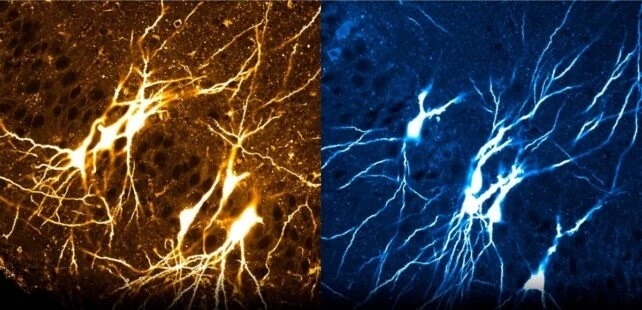
Left: the hippocampus of a young mouse is a dense neural network. Right: as the mouse matures, this network is reduced.
How a child’s brain eliminates excess neural connections
The researchers called the discovered mechanism the pruning model. The essence is that the brain begins life ‘overloaded’ with connections, and then gradually cuts away the excess, leaving only the necessary pathways. This fundamentally differs from the ‘blank slate’ model, in which neurons must first find each other, establish contact, and only then begin working.
Imagine two ways to find a path from point A to point B. The first: you already have a dense road network, and you only need to choose the optimal route. The second: there are no roads, and you have to build them from scratch. Obviously, the first option is faster — this is exactly how, according to the scientists, the developing brain operates.
The team measured electrical activity and cellular processes at three stages of mouse development:
- immediately after birth (7–8 days)
- at ‘adolescent’ age (18–25 days)
- in adulthood (45–50 days)
At each stage, neurons were labeled with a special substance — biocytin, which allowed their shape to be fully reconstructed and their connections traced. The result was consistent: from dense chaos to organized structure.
Why an infant needs excess neural connections
The exact reason for this arrangement is still unknown, but the researchers have a hypothesis. The hippocampus performs an exceptionally complex task: it must integrate information from different senses — vision, hearing, smell — and bind it into a unified picture.
“This is a complex task for neurons,” explains Peter Jonas. “Initially excessive connectivity with subsequent selective pruning may be exactly what enables such integration.”
In other words, if all possible connection routes are available to neurons from the very beginning, they don’t need to spend time searching for each other. They can immediately ‘test’ different connections and keep only those that actually work. This may be why infants begin understanding our world so early, noticing patterns that nobody has specifically taught them yet.
How the brain helps children understand the world from birth
An important caveat is needed here: the study was conducted on mice, and it is not yet known whether the same mechanism works in the human brain. The authors of the paper, published in the journal Nature Communications, directly point out this limitation.
Nevertheless, the idea of neural ‘pruning’ is not new to neuroscience. It was previously known that in the human brain, the number of synapses (contacts between neurons) peaks in early childhood and then decreases — particularly actively during adolescence. The new study adds a detailed picture of exactly what this process looks like at the level of a specific neural circuit.
If it is confirmed that the human brain develops according to a similar principle, this could affect understanding of developmental disorders. For example, some hypotheses link autism spectrum disorders specifically with disruptions in neural connections — when excess connections are not removed in time.
How innate neural connections change learning

Brain development resembles the work of a sculptor: the excess is cut away to reveal the form
The results of this work offer a beautiful and nontrivial metaphor: the brain is not a blank canvas upon which experience paints a picture, but rather a block of marble from which life experience carves a sculpture. Excess connections are removed, while necessary ones become stronger and more efficient.
Of course, these are only preliminary data obtained from one animal species and in one specific brain region. But they raise an important question: if the brain comes into the world not empty but ‘full,’ then to what extent do our innate neural structures determine our ability to learn, perceive, and even intuitively understand the world around us? Answering this question will require new research — this time involving the human brain.