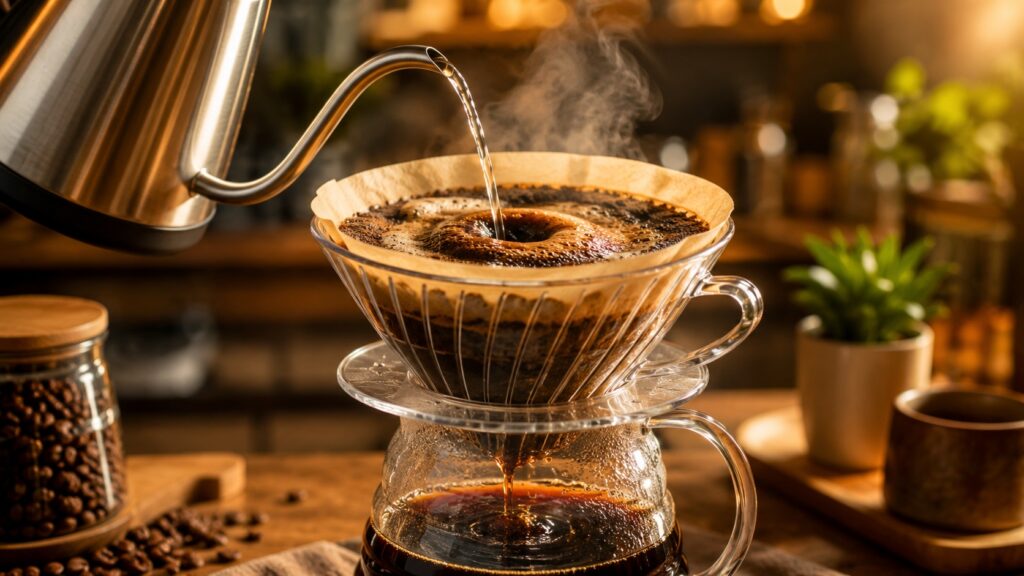
Even the way you pour water can affect the taste of coffee
Every morning, millions of people brew coffee out of habit: scoop in the ground beans, pour hot water, wait. We use scales, thermometers, and timers, but rarely think about the complex physics happening inside the filter. Scientists have found that even with perfect beans and water, you can lose up to 10% of the flavor simply because you’re pouring incorrectly. One unnoticed parameter that nobody controls determines whether the drink will be bright and rich or flat and watery.
What Happens to Coffee During Brewing
Brewing coffee through a filter or pour-over is primarily a task of extracting compounds. Hot water must pass through the ground beans and carry away as many oils as possible. The more evenly the water washes over each particle, the more efficiently the extraction of soluble flavor compounds proceeds directly into the cup.
Many baristas use timers, scales, and thermometers, but rarely think about the physics of the falling stream. To understand what exactly happens at a microscopic level, scientists had to look inside the coffee bed during the brewing process itself.
How Lasers and Transparent Gel Revealed the Pour-Over Secret
The problem with studying coffee lies in its opacity — it’s impossible to see the movement of tiny particles through black grounds. To overcome this obstacle, the study authors replaced real coffee beans with transparent silica gel granules. The resulting mass was placed in a glass funnel, illuminated with a special laser, and the process was filmed using a high-speed camera. This setup made it possible to see exactly how water carves its path through the dense layer.
It turned out that with the right pressure, a microscopic coffee avalanche effect occurs. The water doesn’t simply seep through the grounds — it literally drills a crater into them. Particles from the edges collapse into the center, constantly mixing and exposing fresh surfaces to the flow of hot water.
Why a Thin Kettle Spout Changes the Taste of Coffee
The main secret of brewing coffee lies in maintaining this effect. This is a state in which the stream remains smooth, even, and doesn’t break into individual drops before making contact with the coffee surface.
An ordinary wide spout of a kitchen kettle is not suitable for this, as water pours out of it chaotically. This is precisely why professionals prefer kettles with long curved spouts. They form a narrow and focused stream of water that hits the coffee puck with the right force, causing the particles to actively circulate.
If the stream breaks into drops, the water simply wets the top layer and takes the path of least resistance, leaving some of the grounds dry. In this case, the drink’s flavor turns out flat and watery, and some of the coffee is wasted.
Step-by-Step Instructions for Saving Coffee
Understanding hydrodynamics allows you not only to make a tastier drink but also to reduce bean consumption. Researchers calculated that thanks to active mixing of the grounds, you can confidently use 10% less coffee without losing richness. The study results were reported by the authors at ZME Science.
To replicate the physics experiment in your own kitchen, just follow a few simple rules:
- Measure your beans, reducing your usual portion by 10%;
- Heat the water and use a kettle with a thin spout;
- Raise the kettle to a height of about 30 centimeters above the filter;
- Begin pouring the water slowly and evenly, making sure the stream doesn’t break into drops.
The higher you raise the kettle, the more the coffee is mixed, but only as long as the flow remains continuous. As soon as the stream starts to splash, lower the kettle slightly.
It seems scientists have discovered an entirely new perspective on familiar kitchen rituals. One simple change in pouring height proves that the perfect cup of coffee depends not only on the bean variety or roast level but also on skillful management of basic laws of nature. Discoveries like these make us look at how science works in our everyday lives in a whole new way.