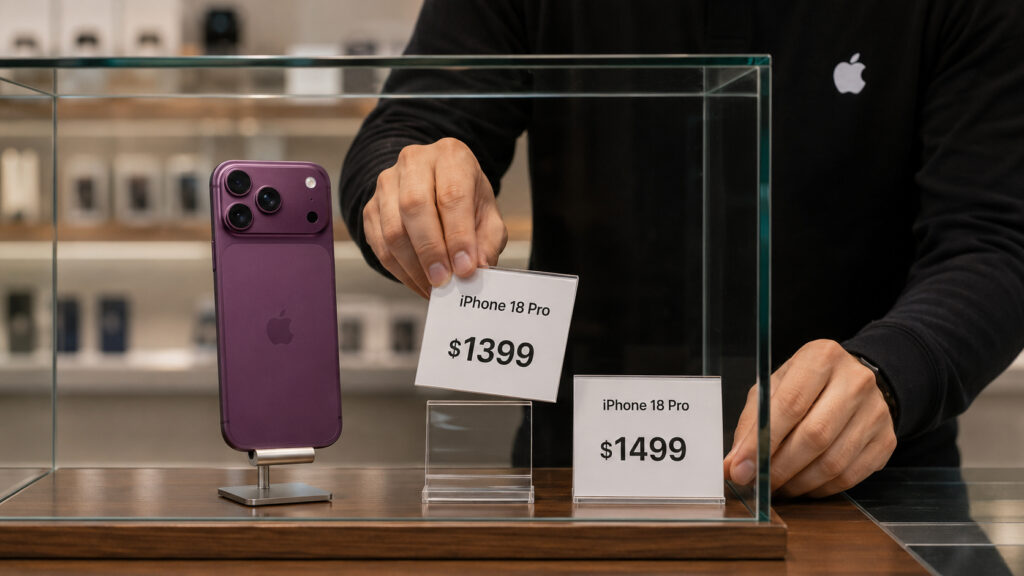
Just as we came to terms with the idea that due to rising memory prices iPhone 18 Pro will be more expensive than its predecessor, another wave of bad news arrived. It turned out that memory was only the first wave. Starting next year, the second key smartphone component is getting more expensive, and Apple won’t be able to avoid it no matter how hard they try.
The price may change once again
Why Apple Raised Prices on Its Devices
In June, the company did what everyone had expected all year but still hoped wouldn’t happen. Apple raised prices on almost everything: Mac, iPad, accessories. In some cases, the increase exceeded 50%, and the surcharge for upgrading memory and storage doubled in some configurations. The maximum configuration of the 16-inch MacBook Pro in the US crossed into five-figure territory, and the joke about “a laptop that costs as much as a used car” isn’t really a joke anymore.

Previously Apple had already raised prices on almost everything except iPhones
The company’s official stance sounded gentle. Apple said they understand how unpleasant this news is and are working on a solution. A nice-sounding statement, but with zero specifics. No timelines, no promise to restore old prices, no hint that the increase is temporary.
Western publication readers didn’t buy it immediately. In polls, the majority agreed that the new prices are here to stay, and memory was just a convenient excuse. And almost everyone admitted they would change their behavior: upgrade less frequently, stick with their current device longer, look more often at previous generations. Essentially, Apple has with its own hands extended the upgrade cycle it had spent years trying to shorten.
It’s the same story with iPhone. The September presentation is still ahead, but a price increase for iPhone 18 is already considered a done deal. The only question is how elegantly the company will present it: raise the price tag head-on or eliminate the base configuration, making the lineup start at 512 GB. The second option looks far more likely because psychologically it’s easier to accept.
Why Apple Processor Prices Are Rising
And now the main reason this article exists. According to Nikkei Asia, Taiwan’s TSMC plans to raise prices on contract chip manufacturing starting in 2027. And it’s not just about the most advanced process nodes — it also includes mature lines used to make all sorts of peripheral components like controllers and modems.
New chips will cost Apple a pretty penny
The increase will range from 5% to 10% depending on the client and process node. The company explains this with a standard set of reasons: materials and equipment are getting more expensive, plus enormous costs of building new factories outside Taiwan. The American facility in Arizona alone runs into tens of billions of dollars, and someone has to recoup that money.
The most interesting part of the report is hidden in the details. TSMC reserves the right to add a premium of up to 15% on top if a client wants to increase order volume beyond the initial forecast. For Apple, this is a direct risk. If the company underestimates demand for some new product and rushes to print more chips, every additional processor will cost significantly more than planned.
TSMC itself declined to comment on the situation. Officially, they only say that they continue to work closely with clients and explain the value of their services. Negotiations with customers, according to sources, have already been completed, meaning bargaining is over and the numbers are locked in.
How New Chips Will Affect the Price of Future iPhones
Look at how the picture is coming together. In 2026, prices rose due to memory because a global shortage of modules hit all manufacturers at once. This is a one-time shock, theoretically reversible: the memory market is cyclical, and the situation could normalize in a couple of years. But chip price increases work differently — they get baked into the cost structure for years to come.
Apple has almost no room to maneuver here. All A-series and M-series processors are made by TSMC, and there simply are no alternatives for advanced process nodes on the market. Samsung Foundry and Intel still can’t match TSMC’s yield stability, and there’s nowhere to move production. This means the increase will have to be accepted and passed on to retail prices.
There’s a second point too. iPhone 19 will coincide with a new process node, and TSMC’s latest nodes always come at a premium. Add the 10% increase on top and you get a situation where the flagship processor gets more expensive twice: first due to the transition to a smaller technology, then due to the general price revision. That’s exactly why 2027 looks more dangerous than the current year.
The timeline also hints that the company was preparing in advance. We wrote about the price increase before it happened officially, and there were plenty of signs. Now exactly the same picture is forming, only this time it’s about chips. The signals can be read in advance if you follow the suppliers rather than just the presentations.
When Is the Best Time to Buy an iPhone
First and most obvious: if you need the device, it’s better to buy now. Each following year adds another layer to the price tag. There’s no point waiting for prices to drop because none of the factors are working toward a decrease. Memory is expensive, chips are getting pricier, logistics too.

I didn’t wait and upgraded my wife’s smartphone now
Second: stop chasing the latest generation. The difference between a two-year-old flagship and a new release is barely noticeable in real life, and the savings are substantial. I recently decided not to wait for the new iPhone and got my wife the current model, and I haven’t regretted it once. A year from now it would cost the same but would already be last year’s model.
Third: pay close attention to the configuration. It’s the surcharges for memory and storage that have increased the most, so the maxed-out version has become less worthwhile than ever. The base version with an external drive or cloud storage often handles the same tasks for far less money.
And fourth: don’t panic. Price increases don’t mean all tech has suddenly become unaffordable. It means that purchases should be planned rather than made on impulse. Upgrading every four years instead of two is a perfectly normal strategy, and most people are already doing it.