A Reddit user says they connected a digital simulation of a fruit fly (Drosophila) brain to the card game Balatro and, after reward-and-penalty training, got it to win roughly 20% of runs on the easiest difficulty with the standard Red Deck. The claim comes from a hobbyist project, not from professional scientists, and the author has not released source code or any technical evidence, so it remains unverified. It continues a series of informal experiments in which the same simulated fly brain was reportedly hooked up to DOOM and Super Mario, but Balatro, a game built on logic and card combinations, is the most unusual task yet.

A smartphone running Balatro among playing cards and poker chips
What you need to know
- Reddit user ActualAerie1011 says a digital fruit fly brain simulation was trained to play Balatro using a reward-and-penalty (trial-and-error) scheme.
- The author claims a win rate of about 20% on the easiest difficulty with the standard Red Deck, and says training is ongoing.
- No source code, GitHub repository, or other technical proof has been published, and commenters have questioned the claim.
- The same simulated brain was previously reported to have been connected to DOOM and Super Mario.
Why the fruit fly brain is a model organism
Fruit flies have served as a central model organism for geneticists and neuroscientists for more than a century. Their life cycle lasts only a couple of weeks, they are easy to breed, and a significant share of Drosophila genes have direct counterparts in humans.
The fly’s nervous system is relatively simple, yet it supports complex behavior: the insect can navigate its environment, avoid danger, and search for food. That combination is why researchers want to map its brain in detail, hoping to uncover basic principles that apply to brains in general.
From a neuron map to a software model
According to the source, Google recently released a complete map of neural connections in the adult fruit fly. That detailed wiring diagram made it possible to turn raw biological data into a flexible software model, and access to the simulation soon reached ordinary enthusiasts, who began applying the virtual brain to unconventional tasks.
The source notes that projects using the simulated insect brain to steer a virtual car or even make cryptocurrency trading decisions have appeared online. Video games are the latest target.
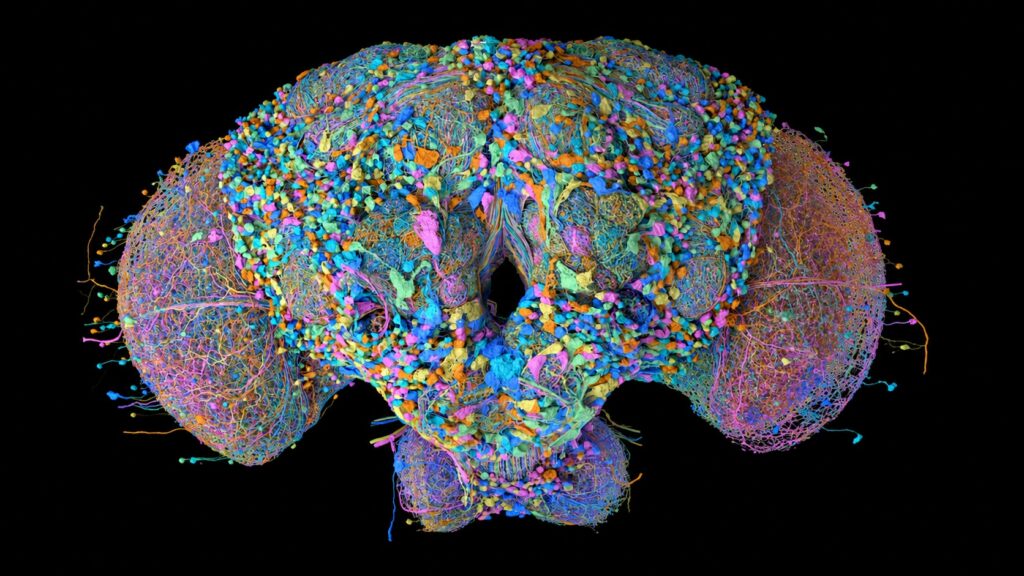
A digitized fruit fly brain
How the simulated brain was trained on Balatro
Reddit user ActualAerie1011 set out to test the virtual fly’s analytical abilities in Balatro, a popular indie game that blends poker hand rules with solitaire-style mechanics. Players must assemble card combinations and use multipliers wisely to rack up record scores.
The training reportedly followed a classic trial-and-error approach. Because Balatro generates its runs randomly, the author first wrote an algorithm to search for favorable starting layouts, known as seeds.
The author then had both a baseline algorithm and the brain simulation play the same runs. When the network made good decisions and scored points, the program rewarded it; mistakes were penalized. Over time, the author says, the connections inside the virtual brain began to reorganize around the new task.
Claimed results and community skepticism
According to the author, the model can currently win roughly 20% of games. That figure applies to play with the standard Red Deck on the lowest difficulty setting. The author stresses that training is still in progress and expects the win rate to improve.
Many commenters on the project doubted its authenticity. So far the developer has not provided source code, a GitHub repository, or other technical evidence that would let independent specialists verify the claims. Until such data is published, the project is best treated as an entertaining forum post rather than a demonstrated result.
Why the idea is still interesting
Even unverified, the approach illustrates a growing overlap between biology and machine learning. If a simulated insect brain can genuinely learn card games, it would point to new directions for AI development, and the source suggests such simulations could eventually inform more efficient neural networks that borrow principles from living systems. For now, that remains a possibility, not an established outcome.