Xiaomi’s new global tablets, the Xiaomi Pad 9 and Pad 9 Pro, arrive with higher launch prices in China but, according to the source author’s spec comparison, no processor upgrade over last year’s Pad 8 series. The base Pad 9 uses the same Snapdragon 8s Gen 4 as the Pad 8, while the Pad 9 Pro swaps the Pad 8 Pro’s flagship Snapdragon 8 Elite for a Snapdragon 8 Gen 5, which the author describes as a sub-flagship part. The headline-grabbing Pad 9 Pro Max, with Xiaomi’s own XRing O3 chip and a 12,000 mAh battery, is a China-only exclusive and is not part of the global lineup.
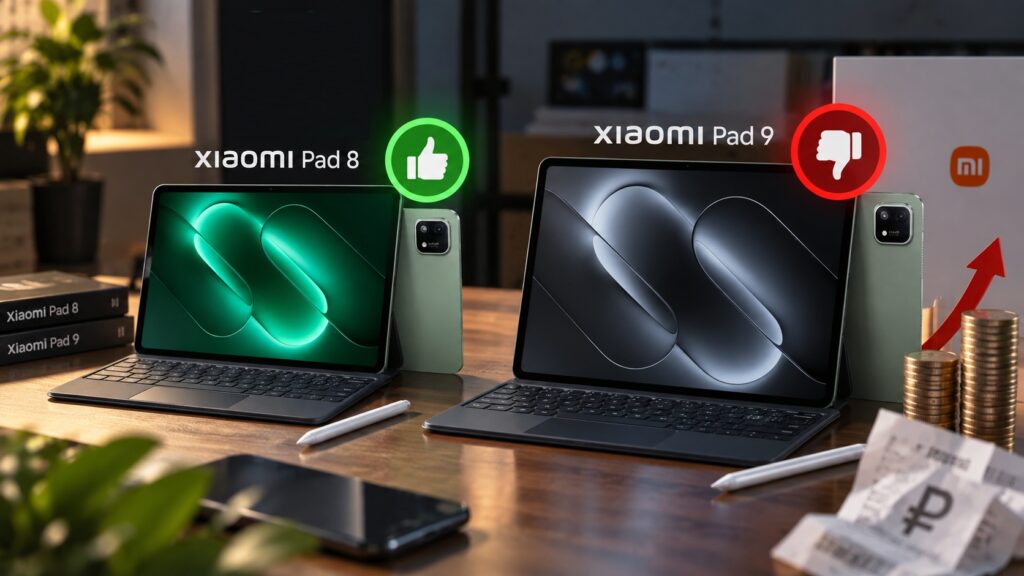
The source author argues the Xiaomi Pad 9 is both more expensive and a weaker value than the Pad 8
What you need to know
- The Xiaomi Pad 9 keeps the exact same Snapdragon 8s Gen 4 chip as the Pad 8; its main upgrade is a battery increase from 9,200 to 9,720 mAh (about 6%).
- The Pad 9 Pro moves from the Snapdragon 8 Elite (Pad 8 Pro) to the Snapdragon 8 Gen 5, but gains a 12.5-inch display, an 11,000 mAh battery, six speakers and 1,000-nit brightness.
- Chinese launch prices rose by 1,000 yuan for the base model (1,999 to 2,999) and 800 yuan for the Pro (2,999 to 3,799).
- The Pad 9 Pro Max with the XRing O3 chip is sold only in China; global markets get the Pad 9 and Pad 9 Pro.
The processor question
The source author’s central complaint concerns the chips. Last year’s Xiaomi Pad 8 Pro runs on the Snapdragon 8 Elite, which the author describes as a 3 nm flagship-class processor. The new Xiaomi Pad 9 Pro runs on the Snapdragon 8 Gen 5, which the author characterises as a sub-flagship chip and, on that basis, concludes that the Pad 9 Pro is weaker than the Pad 8 Pro in raw processor performance. The author attributes the downgrade to a crisis in the memory market, though the article does not provide benchmark data or a statement from Xiaomi to support either point.

The new Xiaomi Pad 9 and Pad 9 Pro

The base model is a simpler story. The Xiaomi Pad 8 uses the Snapdragon 8s Gen 4. The Xiaomi Pad 9 uses the Snapdragon 8s Gen 4 as well: the same chip, unchanged after a full product cycle.
What actually changed, generation to generation
To be fair to the new models, the source lists the concrete upgrades.
Xiaomi Pad 9 vs Pad 8
- Battery grows from 9,200 to 9,720 mAh, an increase of 520 mAh, or roughly 6%.
- According to the source, nothing else of substance changes.
Xiaomi Pad 9 Pro vs Pad 8 Pro
- Display grows from 11.2 to 12.5 inches, a genuine change in form factor.
- Battery grows from 9,200 to 11,000 mAh.
- Six speakers instead of four.
- Peak brightness rises from 800 to 1,000 nits.
- Processor changes from the Snapdragon 8 Elite to the Snapdragon 8 Gen 5, which the author considers a downgrade.
In short: a larger screen, a larger battery and more speakers, paired with a chip the author rates as less powerful.

Prices went up in China
The specs are only half of the argument. Xiaomi also raised launch prices in its home market, based on the figures compiled by the source.
| Model | Launch price in China |
|---|---|
| Xiaomi Pad 8 (8 GB / 128 GB) | 1,999 yuan |
| Xiaomi Pad 8 Pro (8 GB / 256 GB) | 2,999 yuan |
| Xiaomi Pad 9 (8 GB / 128 GB) | 2,999 yuan (+1,000) |
| Xiaomi Pad 9 Pro (8 GB / 128 GB) | 3,799 yuan (+800) |
The base Xiaomi Pad 9 now starts at the price the Pad 8 Pro launched at a year earlier, yet the Pad 8 Pro shipped with a Snapdragon 8 Elite while the Pad 9 carries the Snapdragon 8s Gen 4. Note also that the Pad 9 Pro’s listed price is for a 128 GB configuration, whereas the Pad 8 Pro figure is for 256 GB. The source did not cite confirmed global retail prices; it only offered estimates for one regional marketplace, which are omitted here.
Why the source recommends last year’s Pad 8 series

The Xiaomi Pad 8, which the source says was discounted at the time of publication
The source author argues that the global versions of the Xiaomi Pad 8 and Pad 8 Pro, still on sale at the time of writing, represent better value than the new models. The relevant specifications, as listed in the source:

Xiaomi Pad 8
- Snapdragon 8s Gen 4, the same chip as the Xiaomi Pad 9.
- 11.2-inch IPS display, 144 Hz, 3.2K resolution, which the source says is identical to the Pad 9’s panel.
- 9,200 mAh battery with 45 W charging.
- Four speakers, HyperOS.
Xiaomi Pad 8 Pro
- Snapdragon 8 Elite, which the author rates above the Snapdragon 8 Gen 5 in the Pad 9 Pro.
- 11.2-inch IPS display, 144 Hz, 800 nits.
- 50 MP main camera, 32 MP front camera.
- 9,200 mAh battery with 67 W charging.
- Four speakers, stylus and keyboard support.
The author’s conclusion is that moving from the Pad 8 Pro to the Pad 9 Pro means paying more for a less powerful processor in exchange for a larger screen, a larger battery and two extra speakers. If the 12.5-inch display is a priority, the author concedes the Pad 9 Pro makes sense; otherwise, the Pad 8 Pro is described as the objectively stronger buy at a lower price.
When the Pad 9 Pro is still the right choice
There is one scenario in which the source sees a case for the new model. Buyers who specifically want a large 12.5-inch tablet with an 11,000 mAh battery will find that the Pad 9 Pro fills that role, and the author notes that a large 3:2 display for documents and reading is a materially different experience from an 11.2-inch panel.
For everyone else, the author suggests buying the Pad 8 or Pad 8 Pro while stock remains at current prices, warning that once the Pad 9 reaches global markets, prices for the previous generation could rise or remaining units could sell out quickly. This is the source author’s forecast rather than a confirmed development, and availability and pricing will vary by region.