Turning down the car stereo before squeezing into a tight parking space looks absurd on paper: your ears do not steer the wheel or check the mirrors. Yet the habit has a sound explanation. Parking sharply raises the brain’s cognitive load, and vision and hearing compete for the same limited pool of attention. Lowering the volume frees up processing capacity for the maneuver and makes it more likely that useful sounds, such as a horn or a parking sensor beep, actually register. Researchers treat this reflex as a logical response to stress rather than a quirk.
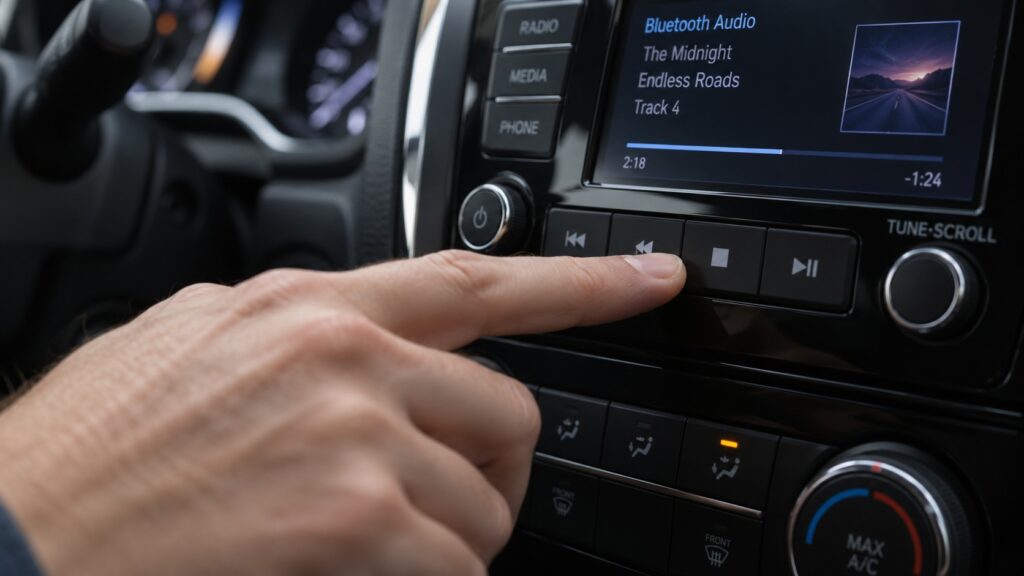
A person pausing the music in a car
What you need to know
- Parking requires judging distances, plotting the car’s trajectory, working the wheel and brake, and watching mirrors, cameras and pedestrians almost simultaneously, which sharply increases cognitive load on limited working memory.
- Vision and hearing rely on separate organs but share decision-making centers in the brain, so actively processed music competes with spatial judgment for attention.
- Under heavy visual strain, drivers can experience “inattentional deafness” and fail to consciously register horns, parking-sensor alerts or footsteps.
- Music is not always harmful: on a monotonous, empty road at night it can help keep a driver alert.
The source author reports noticing the behavior repeatedly among acquaintances: as soon as they need to pull into a narrow gap or parallel park, a hand automatically reaches for the volume knob. The internet is full of memes about turning down the music “to see better.” The joke works because the two senses seem unrelated, but the underlying mechanism is real.
How parking overloads working memory
On a familiar, straight road most driving actions are automatic. Drivers do not consciously decide how far to turn the wheel or how hard to press the accelerator; the brain runs on rehearsed templates. Pulling into a parking space changes that completely. The driver must, almost at once:
- estimate the distance to neighboring vehicles;
- calculate the trajectory of the car body;
- turn the wheel at the right moments and meter the brake;
- monitor the mirrors, the camera and any pedestrians.
In the scientific literature this is described as an increase in cognitive load. Human working memory is limited, and the more elements that must be tracked at once, the faster its resources are depleted. Research cited by the source indicates that even the mundane task of hunting for a free space in a crowded lot pushes the brain toward its limits, demanding constant switching of attention.
Vision and hearing compete for the same resources
Intuition says the eyes and ears should not interfere with each other. The visual and auditory systems use different organs, so music seemingly cannot get in the way of checking a mirror. However, the two senses share common decision-making centers in the brain.
Music is not merely mechanical vibration. The brain continuously analyzes rhythm, picks out familiar words and anticipates the chorus. Attentive listening engages the same neural networks a driver needs to judge the distance to the next car’s bumper. The two processes end up fighting over a limited attentional budget. That does not mean music should be banned from the car altogether; the source notes it has real benefits, particularly for passengers.
The risk of inattentional deafness
Even when a track is playing purely in the background, the body spends energy filtering out the unwanted noise. Under high load, the brain begins actively suppressing extraneous sounds. This is why a driver can negotiate a complex interchange and have no memory of which song was playing.
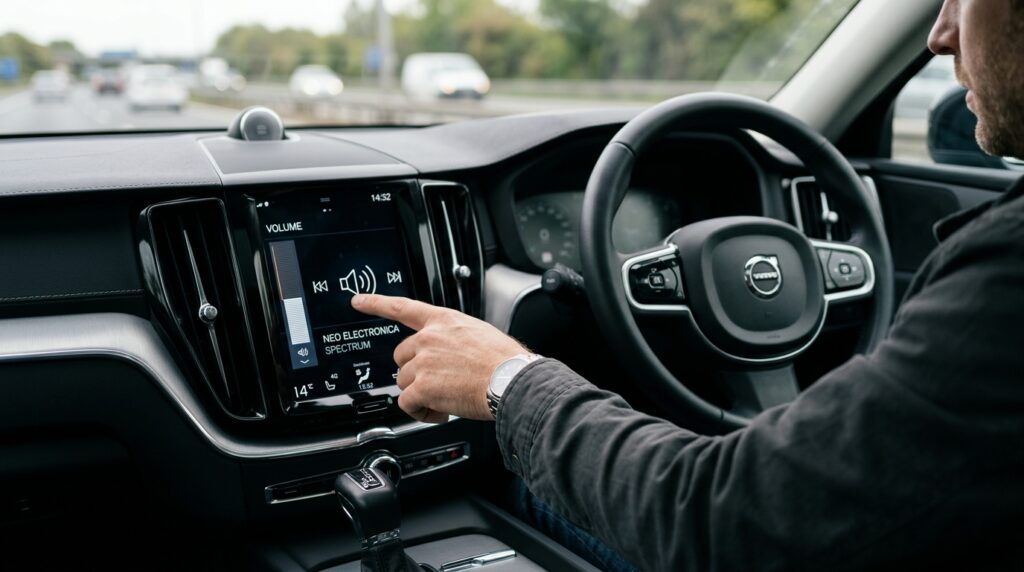
A driver lowering the music volume on a car’s touchscreen
When the brain is pushed to its limit, a phenomenon known as inattentional deafness can occur. A person with perfectly normal hearing stops consciously perceiving surrounding sounds because of intense visual strain. According to the source, driving-simulator studies have shown that staring intently at the car’s dimensions raises the risk of missing an important signal: another car’s horn, the beep of a parking sensor or a pedestrian’s footsteps.
Turning down the volume addresses this directly. Quiet gives useful signals a better chance of breaking through into the driver’s awareness, improving the overall safety of the maneuver.
Why beginners need quiet more than veterans
Driving experience strongly affects how much sound interferes with parking. For someone with twenty years behind the wheel, pedal work is automatic. A novice consciously monitors every action each second: recalling which way to turn the wheel, worrying about stalling and fretting over the gap to the next car.
Experiments involving recent driving-school graduates, as reported in a source cited by the article, suggest that fast, rhythmic music noticeably worsens their reaction to hazards. The same track imposes a far greater mental load on a beginner than on an experienced taxi driver.
Muting the stereo is not the only such reflex. In difficult traffic situations people also stop talking, ask passengers to be quiet, or involuntarily lean closer to the windshield. All of these are attempts to shut out surplus information.
When music in the car helps
Researchers are not calling for driving in total silence. On an empty highway at night, the monotony of the road induces drowsiness, and here a favorite playlist acts as an effective stimulant. Under those conditions, the source says, music helps maintain alertness and barely degrades concentration.
The more demanding the road, however, the less attention the stereo should receive. Tracks with lyrics always pull attention more strongly than instrumental ones, but the decisive factor is the context of the driving situation itself.
In the end, reaching for the volume knob is not a sign of inexperience or poor hearing. It reflects the body’s ability to cut out the unnecessary at the exact moment the brain needs all its available processing power for a single complex maneuver.