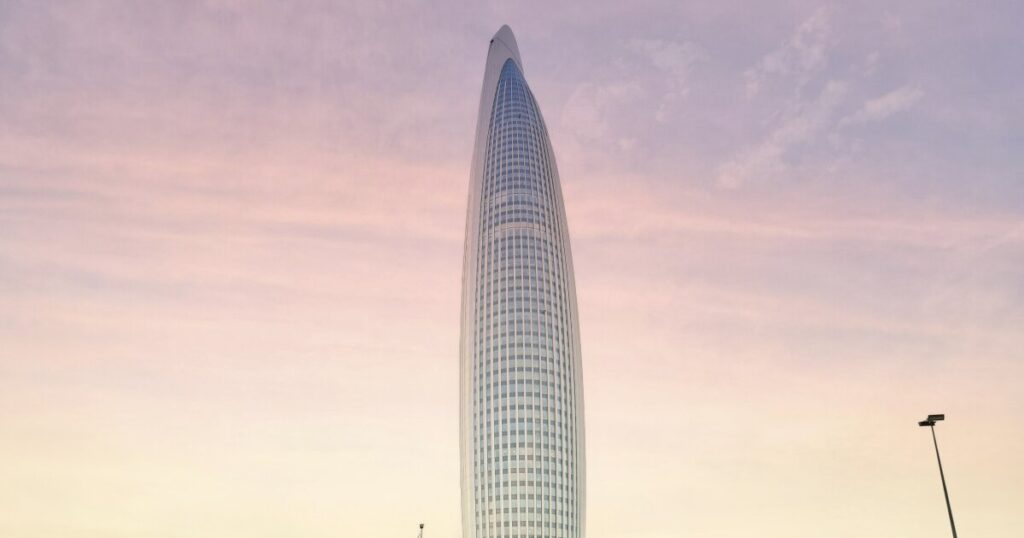
Mohammed VI Tower is designed to resemble a Saturn V rocket
Morocco has opened a 55-story skyscraper standing 250 meters tall, making it the tallest building in the country and one of the tallest on the entire African continent. Of course, it’s no Burj Khalifa at 828 meters, but it’s still an impressive structure. The Mohammed VI Tower, shaped like a rocket on a launch pad, is not just an architectural statement: behind it lies a story that began with a visit to NASA over half a century ago.
A Skyscraper Shaped Like a Saturn V Rocket
The idea for the tower belongs to Moroccan billionaire Othman Benjelloun, the 93-year-old founder of Bank of Africa and the wealthiest person in Morocco. In 1969, he was invited to a NASA facility where the Saturn V rocket was being prepared for launch for the Apollo 12 lunar mission — the second crewed Moon landing, during which one of the many U.S. flags was planted on the satellite. The sight of the giant rocket on the launch pad made such a deep impression on Benjelloun that decades later he decided to bring that image to life in architecture.
Saturn V is NASA’s legendary super-heavy launch vehicle that sent astronauts to the Moon. It stood 110 meters tall — roughly equivalent to a 36-story building. The skyscraper inspired by its silhouette turned out to be more than twice the height of the original: 250 meters and 55 stories. However, the building’s form is not simply a copy of a rocket. The tower tapers toward the top, and its facade combines glazed and opaque panels with decorative metal ribs and sun-shading louvers.
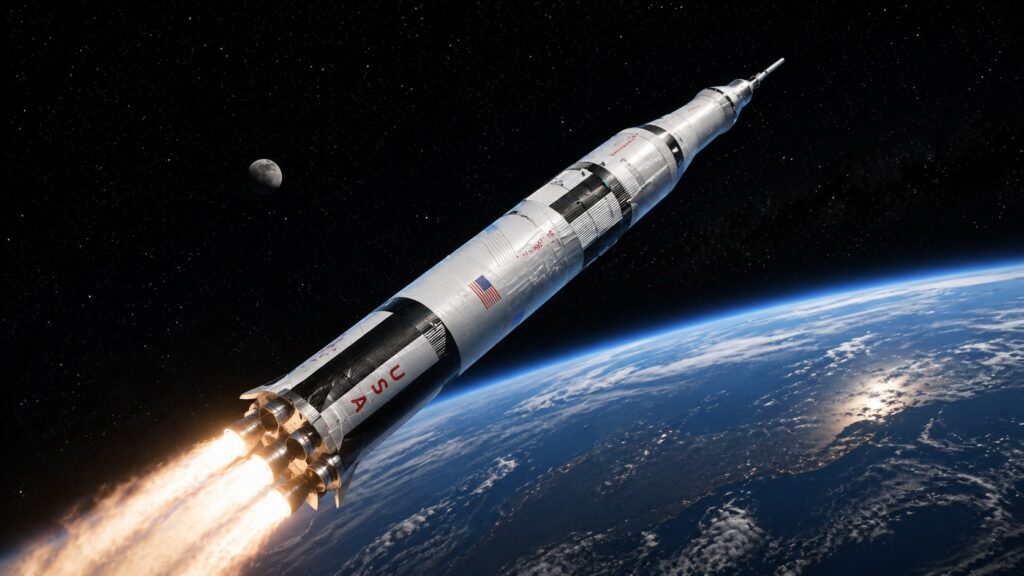
Saturn V launch vehicle in space
The Tallest Skyscraper in Morocco
The Mohammed VI Tower has officially become the tallest building in Morocco — nothing else in the country even comes close to this mark. On the African level, it ranks third: ahead of it are Egypt’s Iconic Tower in the new administrative capital (393.8 m) and the under-construction Tour F in Abidjan, Côte d’Ivoire, which is expected to reach 421 meters.
It’s important to understand the context. Until recently, African cities mostly grew outward rather than upward. Skyscrapers were more of an exception, concentrated in a few financial centers like Johannesburg, Cairo, and Lagos. The situation is now changing, and high-rise construction is actively developing in Casablanca, Algiers, Addis Ababa, and other cities, and the tower in Salé is a vivid example of this trend.
How the Skyscraper Is Protected from Earthquakes
The construction site proved challenging: high seismic activity, strong wind loads, and proximity to the Bouregreg River. To ensure stability, engineers laid the foundation to a depth of 60 meters and anchored it on 104 deep concrete piles.
The load-bearing structure follows a “tube-in-tube” principle: an inner high-strength concrete core combined with an outer steel frame provides resistance to lateral loads from wind and earthquakes. This allows for column-free floors — open floor plans for offices, hotels, and apartments.
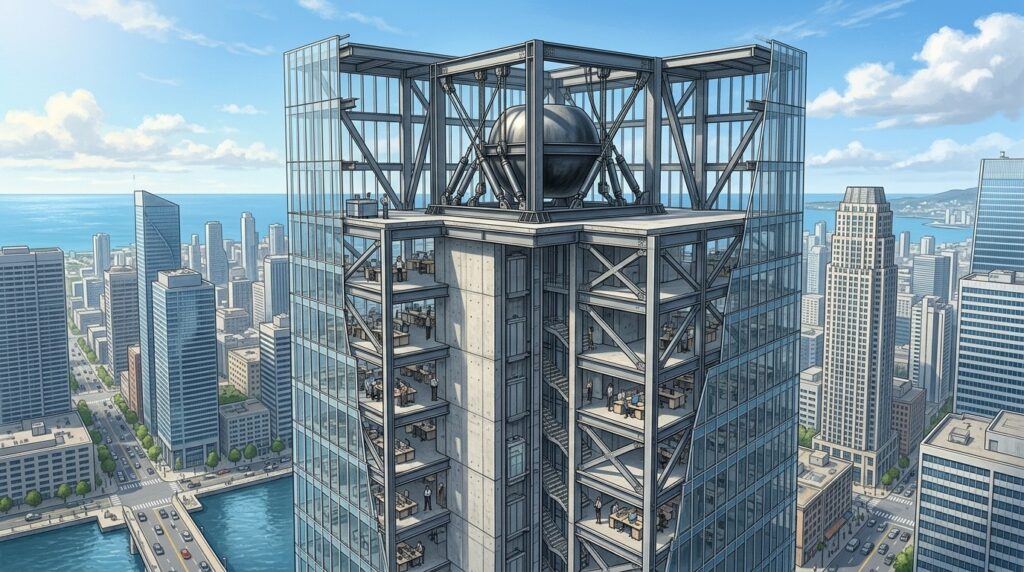
Schematic diagram of a high-rise building with a damper on the upper floors
At the top of the tower, a 160-ton tuned mass damper is installed. Its operating principle is simple: it’s a massive weight that swings in counter-phase to the building’s movement. When wind or a seismic tremor causes the tower to lean in one direction, the damper shifts in the opposite direction, dampening the oscillations. Such devices are installed in many high-rise buildings around the world — for example, the famous 660-ton pendulum in Taipei’s Taipei 101.
What’s Inside the Mohammed VI Tower
The building’s total area is approximately 102,800 square meters. Inside it houses:
- a luxury Waldorf Astoria hotel;
- office spaces;
- premium residential apartments;
- an observation deck on the upper floors with panoramic views of Rabat, Salé, and the Bouregreg Valley.
The tower is served by 36 elevators: 21 in the main tower and 15 in the podium section of the building. The podium is the massive base of the skyscraper, which houses retail and public areas.
Energy efficiency is a separate point of pride for the project. Approximately 3,900 square meters of solar panels are installed on the facades and the podium roof, providing a significant portion of the building’s energy consumption. A rainwater collection system and well-designed sun protection on the southern facade allowed the tower to earn LEED Gold certification — an international green building standard.
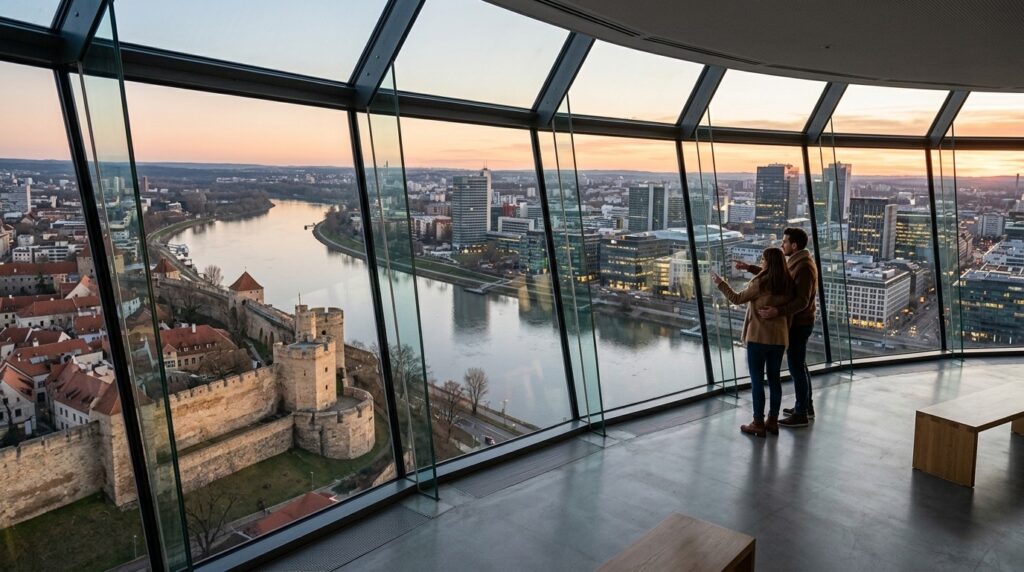
The observation deck at the top of the tower offers views of historic neighborhoods and the river
Cost, Timeline, and Contractors of the Mohammed VI Tower
Construction took eight years and cost $700 million — significantly more than the initial budget of $422 million. The cost overrun is explained by extremely complex foundation work, delays caused by the COVID-19 pandemic, and rising material prices, primarily aluminum. About 2,500 specialists from 15 countries worked on the construction site.
The general contractor was the Belgian company BESIX — the same firm that participated in the construction of the Burj Khalifa in Dubai, the world’s tallest building. Working alongside them were Moroccan firm TGCC and Chinese company CRCCI. The architects were Spaniard Rafael de La-Hoz and Moroccan Hakim Benjelloun.
The grand opening took place on April 13, 2026: Crown Prince Moulay El Hassan toured the lobby, a model apartment, the Waldorf Astoria hotel, and the observation deck at the top.
Morocco is preparing for a major influx of tourists: the country will co-host the 2030 FIFA World Cup together with Spain and Portugal, and in 2025 it already welcomed 19.8 million visitors. The Mohammed VI Tower fits into a large-scale development program for the Rabat–Salé region, where the Grand Theatre of Rabat designed by Zaha Hadid is already operating nearby and hotels from global chains are opening. The skyscraper, visible from 50 kilometers away, has become the capital’s new calling card — and perhaps the most unusual monument to a single visit to NASA. That is the impression one gets, at least, after reading the source material at New Atlas.