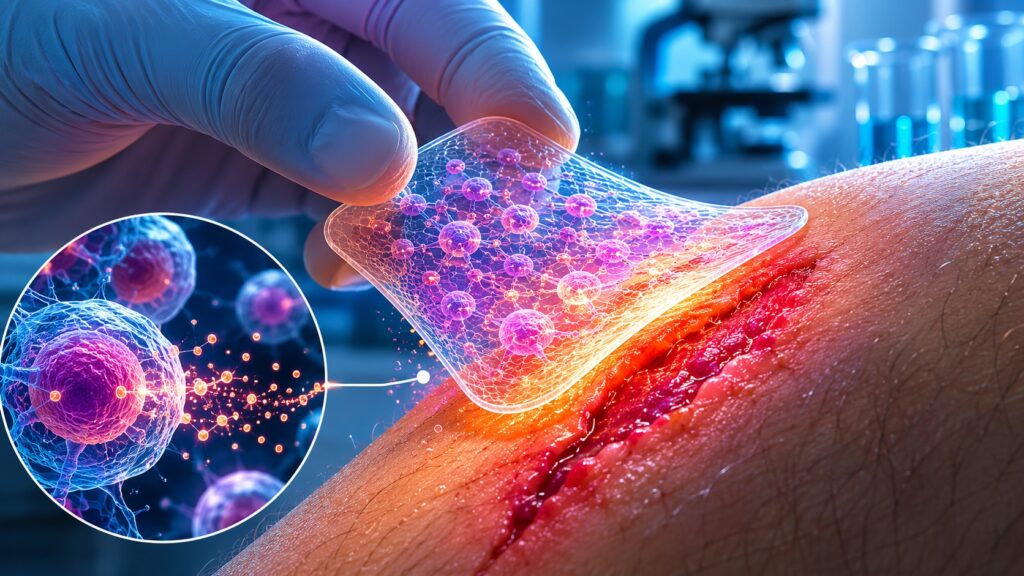
This new type of bandage can heal even chronic wounds
A regular bandage works simply. We place it on a wound, it protects from infections, and the body handles healing on its own. But recently, scientists developed a living bandage with human cells that literally shows our body how to heal skin. During tests on mice and pigs, this bandage helped deep wounds close much faster.
Why Wounds Take a Long Time to Heal
Slow-healing wounds are far more common than one might think. They affect millions of people, especially the elderly, as well as those with diabetes and poor blood circulation. Such wounds may not heal for months and increase the risk of infections, cause pain, and in severe cases can even lead to limb amputation.
The paradox is that healing is often hindered by the immune system itself. Immune cells linger in the wound too long, leading to chronic inflammation. In this state, new tissue cannot form properly, and the wound remains open and vulnerable.
Most current treatments for chronic wounds maintain moisture, protect against infections, or remove damaged tissue. This helps but doesn’t always trigger the processes needed for skin restoration.
How the New Wound-Healing Bandage Works
According to the authors at ZME Science, the new bandage works entirely differently. Instead of applying a medication whose effect fades over time, the bandage places living cells in the wound, and they produce therapeutic proteins on their own for several days.
Inside the bandage are laboratory-modified human cells sealed in capsules made of alginate gel. This substance is derived from seaweed. The gel holds the cells inside but allows nutrients and oxygen to reach them, while releasing healing proteins outward. It essentially creates a small “factory” of medicinal molecules right on the wound.
What Are Cytokines and How They Speed Up Healing
The therapeutic proteins released by the cells in the bandage are called cytokines. These are small signaling molecules through which immune cells and tissue cells communicate with each other. Cytokines can calm inflammation, attract repair cells to the wound, and influence how new tissue forms.
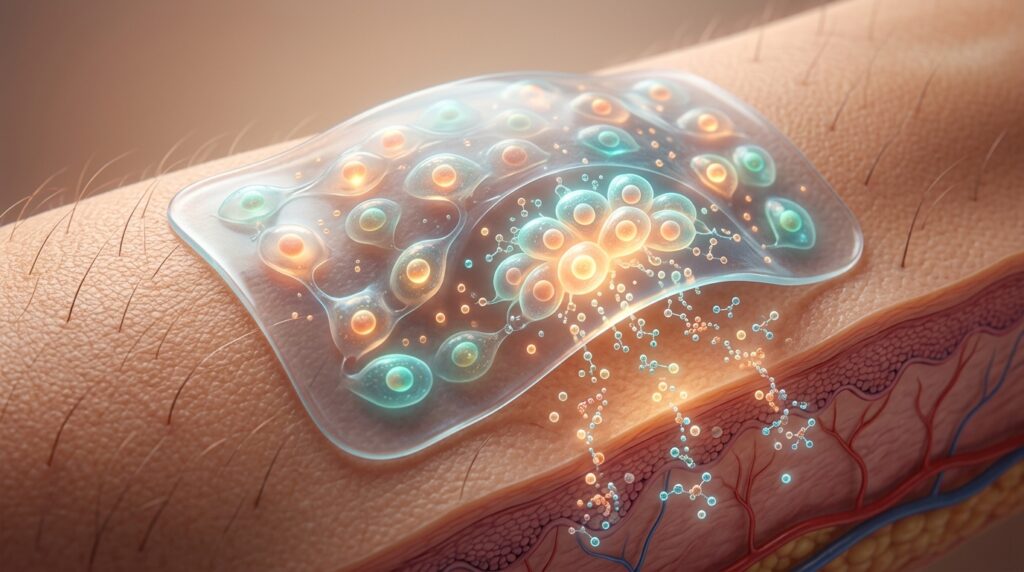
Cells inside the bandage release signaling proteins directly into the wound
The problem is that using cytokines as a regular medication is difficult. They break down quickly and often don’t stay where the doctor placed them. The living bandage solves this differently: instead of a single dose that quickly disappears, it maintains a constant presence of the right signals directly at the wound.
How the Bandage for Chronic Wounds Was Tested
During the studies, when the bandage was applied to deep wounds, the cells inside remained alive and continued releasing proteins for several days. As a result, treated wounds closed faster in both mice and pigs. The experiments on pigs are particularly important because pig skin is very similar to human skin.
The researchers also examined the healing tissue and found changes in the activity of genes responsible for new skin growth and collagen assembly. For reference, collagen is a protein that gives skin its strength. These molecular-level changes matched what was visible on the outside — the wound was closing faster.
However, it’s important to be honest. The bandage has not yet been tested on humans, and results in animals don’t always replicate in people. So it’s too early to talk about exact acceleration figures for humans. This is an early, though very promising, result.
When Will the Living Bandage Appear in Hospitals and Pharmacies
One of the advantages of the living bandage is that it can be customized. In future versions, scientists will be able to change which proteins the cells release, in what quantity, and at what moment. The same bandage can be tailored to different types of injuries, from diabetic ulcers to complex surgical wounds.
But living bandages won’t appear in hospitals and pharmacies anytime soon. Before such a bandage reaches clinics, human trials and years of safety testing will be needed.
The main value of this work lies in the very concept of a living bandage. With this new discovery, a dressing stops being just a covering over a wound and becomes an active helper that sends the body the right signals from within.
If the benefits of such a bandage are confirmed in human studies, it could transform the treatment of precisely those wounds that medicine struggles with the most today. The results have been published in the journal Nature Biomedical Engineering, and what to watch for next are the first human trials.