The most dangerous place in the Solar System, surprisingly, is not the Sun
You’ve probably heard that the most dangerous thing in the Universe is the Sun or something distant and exotic. That’s not the case. It’s a narrow strip of space around Earth where satellites fly, debris accumulates, and on which almost all of modern civilization depends. It is near-Earth space that combines constant threats, growing risks, and our total dependence on its stability.
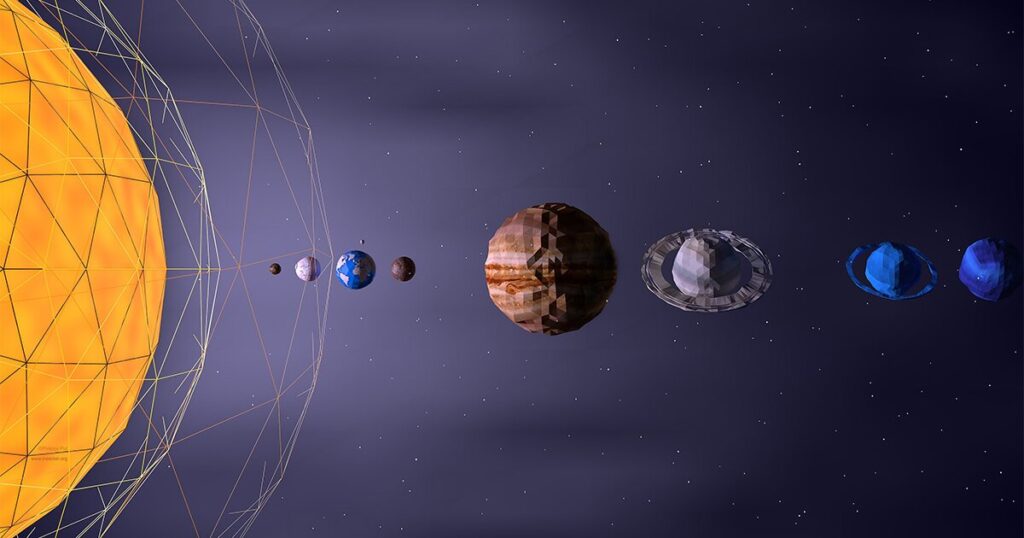
The Most Dangerous Places in the Solar System
If you ask someone to name the most dangerous place in the Solar System, the answers will be predictable. Some will name the Sun with its monstrous temperature, solar flares, and coronal mass ejections that can damage satellites and even knock out power grids on Earth and completely shut down the internet.
Others will name Venus, where it rains concentrated sulfuric acid and surface pressure is 92 times higher than Earth’s.
Some might venture to suggest that Saturn’s rings are the most dangerous, where chunks of ice and rock hurtle at breakneck speed and would turn any spacecraft into a sieve.
There’s also Io, a moon of Jupiter — the most volcanically active body in the Solar System. Lava lakes, sulfur eruptions hundreds of kilometers high, and on top of that — Jupiter’s powerful radiation belts, which would kill a human in a matter of minutes.
All of these are truly extreme places. But none of them poses such a real, daily, and growing threat to humanity as the space literally a few hundred kilometers above our heads.
What’s Happening in Near-Earth Orbit
Around Earth there exists a relatively thin region of space on which the daily lives of billions of people depend. In low Earth orbit (from 200 to 2,000 km) and at higher geostationary orbits, thousands of satellites operate, reliably staying in place without falling to Earth. They provide what we take for granted:
- GPS navigation, from smartphone routes to precise positioning of sea vessels;
- Weather forecasts and climate monitoring;
- Global communications — from television broadcasting to the internet;
- Time synchronization for financial systems and stock exchanges;
- Defense and intelligence infrastructure.
In short, a significant part of modern civilization depends on the uninterrupted operation of this narrow strip of space. And the problem is that the stability of this zone is under an increasing threat.
Space Debris: A Bolt Flying Faster Than a Bullet
Near-Earth space is becoming increasingly cluttered. Millions of debris fragments are in orbit: defunct satellites, collision remnants, rocket stage fragments, and even tiny paint flakes. Most of them travel at speeds up to 28,000 km/h, which is several times faster than a bullet.
At such speeds, even a small object possesses colossal kinetic energy. A collision with a bolt-sized fragment can destroy a small satellite. Larger fragments can completely destroy a spacecraft, generating even more debris.
This is where the effect known as Kessler syndrome — a chain reaction of collisions — comes in, where each new destruction creates a cloud of debris that increases the probability of the next collision. This is not a theoretical scenario: satellite collisions have already occurred, and the resulting debris clouds remain in orbit for years and decades. Unlike a dramatic volcanic eruption or solar flare, this is a slow-motion catastrophe that we ourselves are fueling.
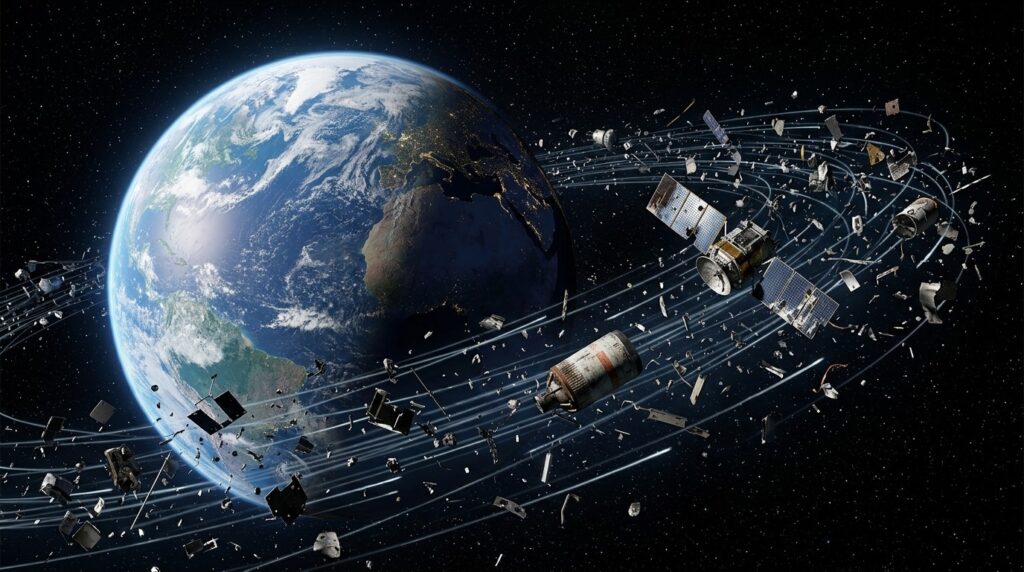
Visualization of space debris in near-Earth orbit — each dot represents a tracked object
The Danger of Solar Storms to Civilization
Space debris is not the only threat in near-Earth space. This is where Earth is most vulnerable to solar activity. When the Sun ejects a powerful stream of charged particles, it interacts with the magnetic field and upper layers of our planet’s atmosphere. The results range from beautiful auroras to serious problems: satellite malfunctions, GPS failures, and disruptions to power grids.
In 1859, the so-called Carrington Event occurred — the most powerful geomagnetic storm in recorded history. Telegraph systems failed at the time. Today, a similar storm could paralyze aviation, banking systems, and supply chains worldwide. The danger lies not so much in the event itself, but in the fact that over a century and a half we have become critically dependent on technologies operating in this very vulnerable zone.
Asteroids at the Doorstep: Near-Earth Cosmic Bodies
There is yet another layer of risk — less frequent but far more destructive. Asteroids and comets regularly cross Earth’s orbit. Most are harmless, but some are not. An asteroid about 10 kilometers in diameter caused the mass extinction of the dinosaurs. Even a significantly smaller object could lead to a regional catastrophe.
At the time of writing, approximately 41,549 near-Earth objects are known, of which 879 have a diameter of more than one kilometer. But not all can be tracked: some asteroids approach from the direction of the Sun, where they are extremely difficult to detect in advance.
And even if a dangerous object is spotted a few weeks ahead, humanity still has no full-fledged response plan. Experiments like the DART mission are first steps, but a reliable planetary defense system is still far off.
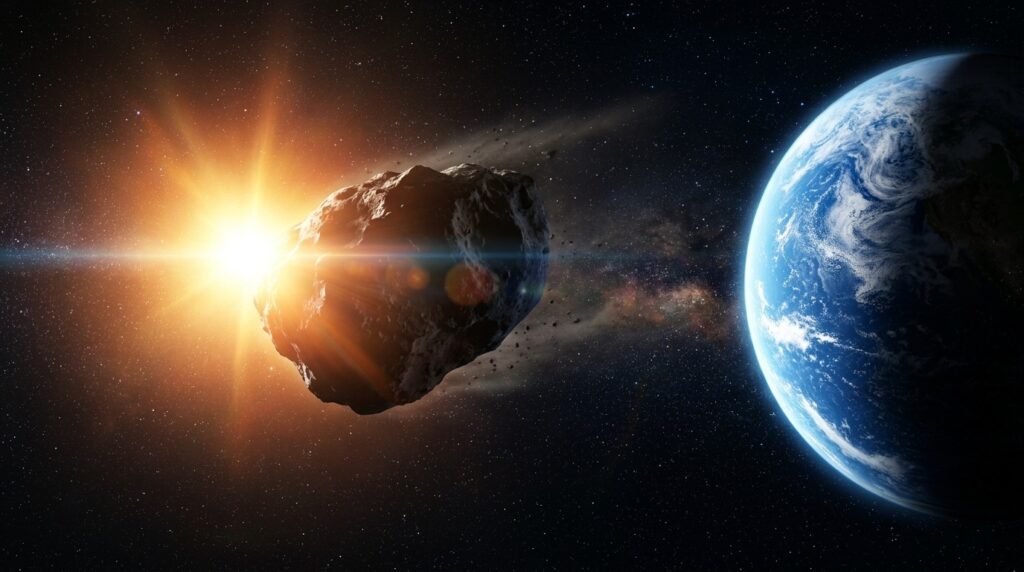
Some asteroids approach Earth from the direction of the Sun, making their early detection difficult
Why the Danger of Near-Earth Space Will Only Grow
What makes near-Earth space the most dangerous place in the Solar System is not the extremity of conditions, but the combination of three factors:
- The threats here are constant, not one-time events;
- The risks increase with each new launch, rather than staying at the same level;
- Our dependence on this zone is total, not hypothetical.
Every year, more and more satellites are placed into orbit. Mega-constellations such as Starlink aim to provide internet coverage to the entire planet. Plans for building orbital stations, lunar missions, and future flights to Mars — all of this passes through or depends on near-Earth space.
Managing near-Earth space is becoming one of the key challenges of the space era. It requires international coordination, regulation, new technologies, and — perhaps most difficult of all — global cooperation. Because, unlike distant planetary threats, this problem cannot simply be ignored.
The most dangerous place in the Solar System is not where it’s hottest, most toxic, or most radioactive. It’s where fragile infrastructure on which billions of lives depend exists alongside growing chaos. And this space begins just a few hundred kilometers above our heads.
All of this, of course, was not my idea. The dangers listed above were identified by the authors of the website Refractor.io. Do you agree with their opinion?