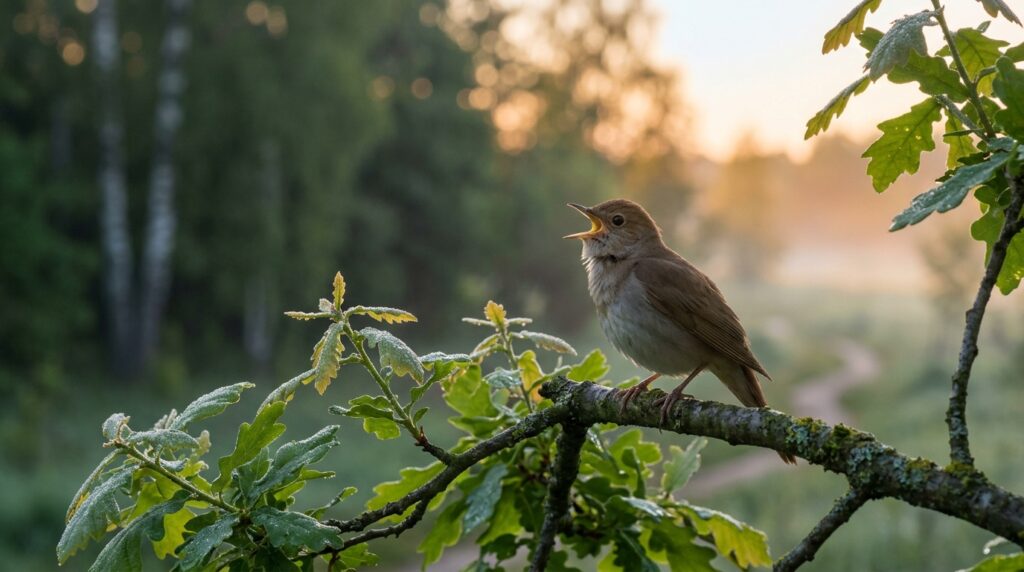
A whole orchestra of different birds sings in the morning in Russia
Every spring I wake up to a powerful bird concert outside my window — not at seven in the morning, but around half past four. At first it was annoying, then it became intriguing: who are all these singers and why can’t they wait until breakfast? I figured out which birds sing in the morning in Russia in spring and summer, and now I can distinguish at least five voices by ear. Here’s what I found out.
The Nightingale — the Main Soloist of the Russian Dawn
The common nightingale is perhaps the most recognizable morning singer. Its song is complex, multi-layered, with trills, whistles, and sharp “knees” — that’s what ornithologists call individual fragments of a trill, as I learned. The nightingale sings most actively in May and June, and not only at dawn but also at night. However, it’s in the morning silence that its voice sounds especially powerful.
In southern Russia, the nightingale appears at the end of April; in central Russia — in mid-May, preferring shrubs near bodies of water. Look for it in river floodplains, parks, gardens, and even urban thickets. The nightingale sings most actively early in the morning, roughly until 7–8 AM, and in the evening hours after 8 PM.
An interesting detail: only the female builds the nest and incubates the eggs, while the male sings the entire time. As soon as the chicks appear, the father goes nearly silent, so the nightingale concert lasts only a few weeks.
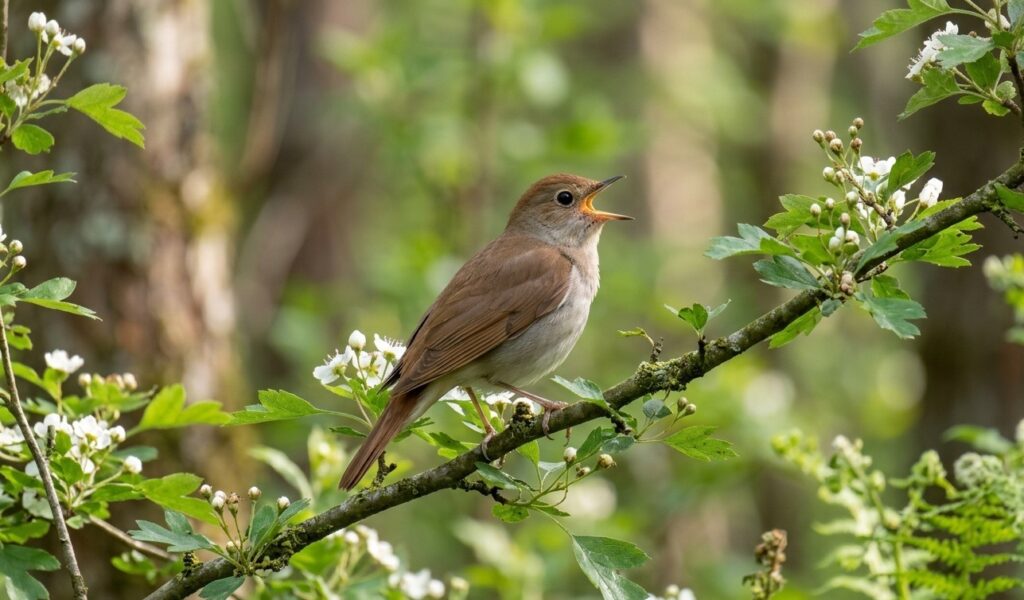
Nightingales sing beautifully but usually hide
Thrushes, the Robin, and the Chaffinch — the Foundation of the Morning Chorus
Everyone who has ever spent a night outside the city has heard thrushes. In the morning, they are among the first to start singing. The song thrush produces bright, repeating phrases — as if it’s saying the same thought several times over. The blackbird sounds completely different: soft, flute-like, measured. Both species are common in parks, gardens, and forest belts throughout the European part of Russia.
The European robin (also known as the robin redbreast) is a small bird with a thin, “silvery” song. It loves to sing precisely at twilight and dawn, when other voices haven’t yet started. You can find the robin at forest edges, in shrubs, and in gardens.
The chaffinch is one of the most abundant forest singers in European Russia. Its song is short and energetic, and it repeats it dozens of times in a row. In spring mornings, the chaffinch literally fills the soundscape — you can hear it in almost any forest or park.
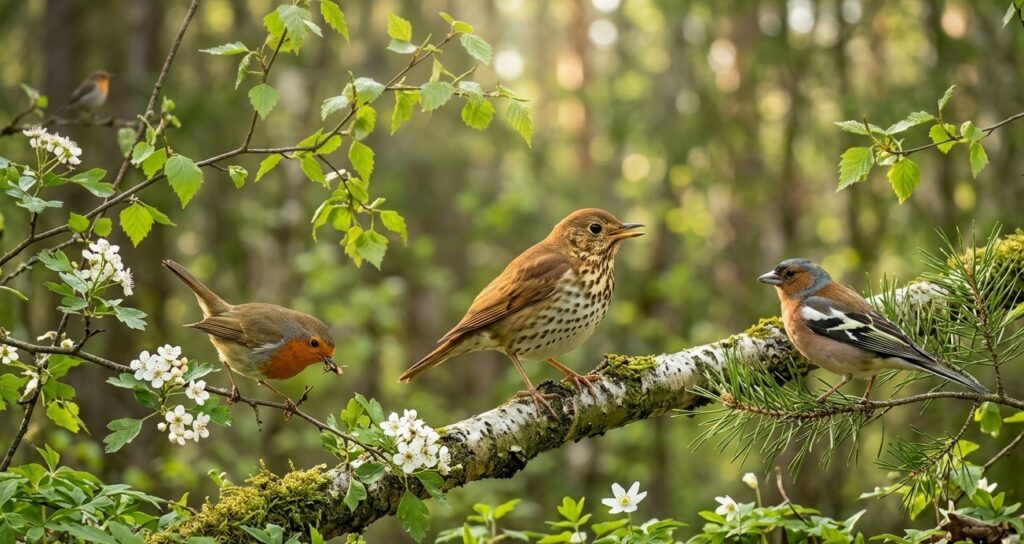
Thrushes, the robin, and the chaffinch
Warblers, Sylvia Warblers, and Buntings — Quiet but Persistent
There is a whole group of small birds that are hard to see but easy to hear. The willow warbler, the chiffchaff, the wood warbler — they sing persistently and for long stretches. They are small, but in the morning their voices can be heard in almost any deciduous or mixed forest, in plantations, and in parks.
Sylvia warblers — the common whitethroat, the garden warbler, the blackcap — sing hurriedly, with a babbling quality. Their songs are beautiful, but for the untrained ear they are less recognizable than nightingale or thrush trills.
The yellowhammer is a characteristic voice of the village outskirts. It sings from bushes, wires, and treetops. Its song is simple, rhythmic, and dry — a typical sound of fields, forest edges, and dacha settlements.
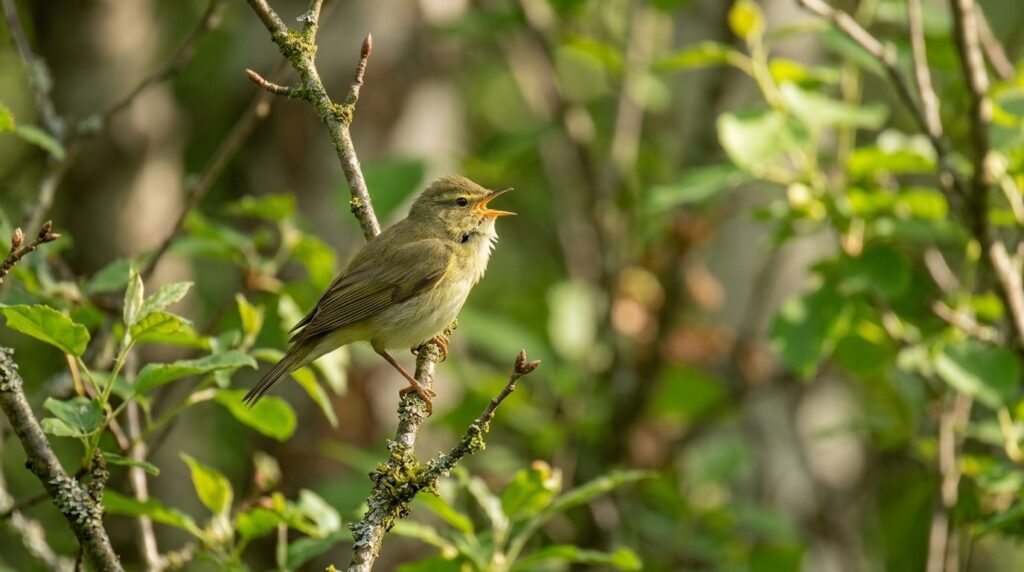
A warbler singing on a branch in a deciduous forest
The Starling — a Talented Mimic at the Dacha
The common starling deserves a separate conversation. It has a wide range of sounds: whistles, chirps, creaks, meowing — and experts call it an excellent “mimic” whose imitation abilities are especially noticeable in large colonies.
Every year, starlings fool beginner naturalists by imitating the voices of migratory birds that haven’t yet returned from warmer regions. At a dacha or in a village, you can hear the starling from early morning — it weaves other voices into its song, and sometimes even everyday sounds. In the starling’s mating song, you can make out fragments of other birds’ songs, croaking, and even the sounds of machinery.
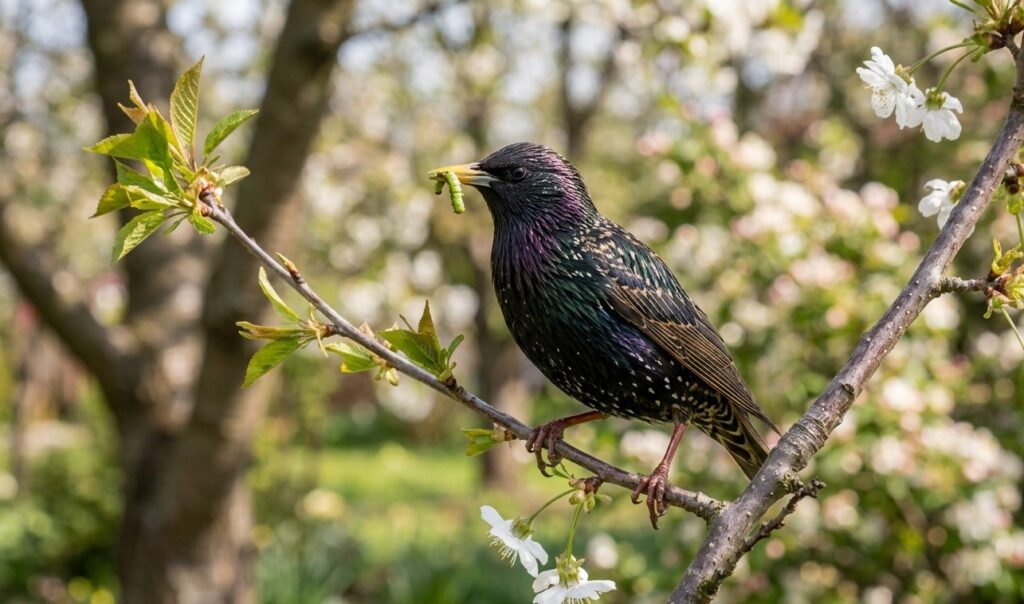
The starling is good at imitating other sounds
The Skylark, the Golden Oriole, and the Cuckoo — Voices of Open Spaces and Forests
The Eurasian skylark is one of the most characteristic voices of spring in open spaces. It sings at dawn, hovering high above a field. If you wake up in a village near fields, that continuous, bright stream of sound from above is most likely a skylark.
The golden oriole inhabits deciduous forests and old parks. Its voice is flute-like and very noticeable, although the bird itself is hard to spot because it stays high in the canopy. The tree pipit is common at forest edges and clearings — its morning song is often accompanied by a courtship flight.
And the cuckoo — although not a “songbird” in the everyday sense — can be heard almost everywhere in spring mornings. Especially in forests and near forest edges. Everyone knows its “coo-coo,” and it’s often the cuckoo that becomes the sound triggering the association of “summer, morning, countryside.”
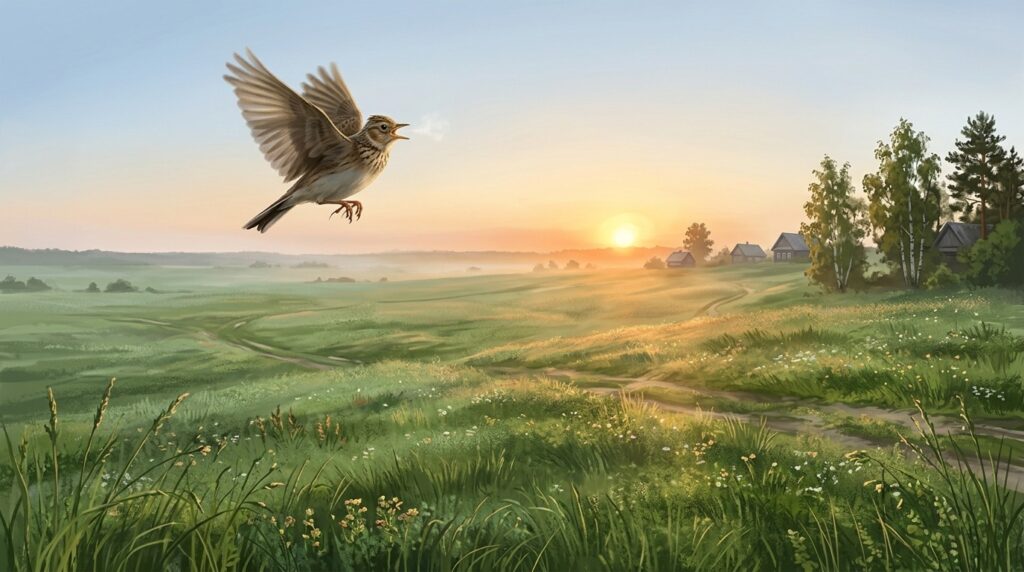
A skylark singing in flight above a morning meadow
Which Birds Sing in the Morning in the City, Forest, and Near Water
The composition of the morning chorus depends heavily on where exactly you are listening. I put together a quick cheat sheet by habitat:
- In the city and at the dacha: starling, blackbird, chaffinch, great tit, robin, redstart, and in some places the nightingale;
- In forests and parks: song thrush, chaffinch, leaf warblers, Sylvia warblers, robin, cuckoo, golden oriole, flycatchers;
- In meadows and fields: skylark, yellowhammer, whinchat, tree pipit;
- Near water and in shrubs: nightingale, bluethroat, reed warblers.
The bluethroat, by the way, is also a notable mimic — it sings with great variety and sometimes imitates other species.
Why Birds Sing Specifically at Dawn
The morning concert is no accident. Research leads to the conclusion that birds sing at dawn because their internal clocks and the environment synchronize. Hormones prepare the body, and light gives the signal to act. The combination of accumulated energy, alertness, and social instinct creates the morning chorus.
In spring and early summer, males are especially active at dawn for several reasons:
- They are marking their territory — signaling to neighbors that the area is occupied;
- They are attracting a mate — a loud and complex song demonstrates the singer’s health and strength;
- There are fewer competing sounds in the morning — no insects, no wind, no city noise;
- It’s still too early to forage — searching for food in low light is difficult, but singing is perfectly timed.
Loud singing early in the morning demonstrates that the singer was strong and healthy enough to survive the night. It’s a kind of morning roll call and competition at the same time: whoever sings more powerfully claims the best territory.
Now, when I wake up to the dawn chorus, it no longer annoys me — instead, it turns into a little game. Nightingale or thrush? Chaffinch or warbler? And that strange whistle — could it be a starling copying the neighbor’s car alarm? If you want to try it yourself, the best time is a spring or early summer morning.