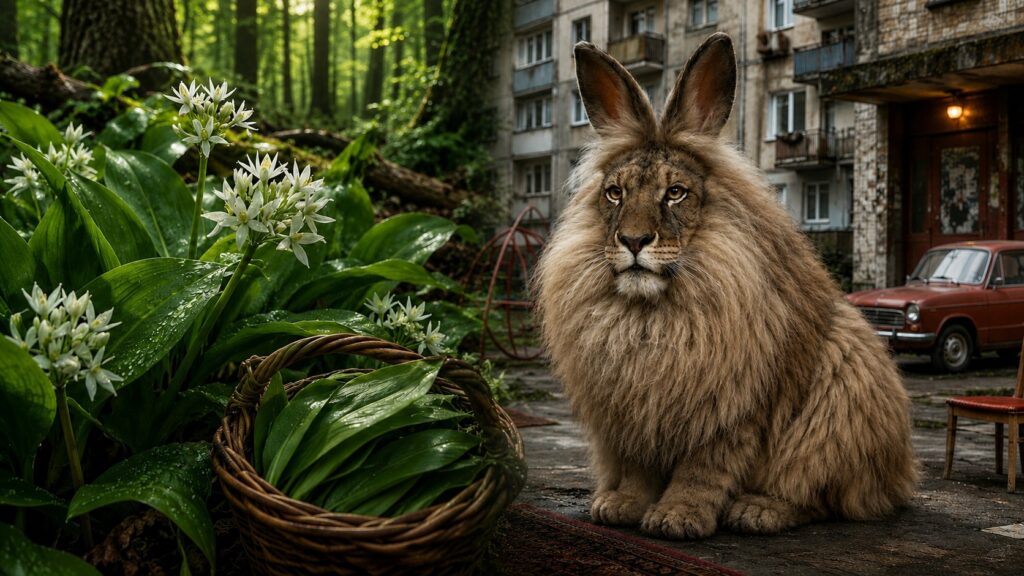
In 2026, ramson is not just a plant, but also a meme
In 2026, the word ramson seems to live two lives. Some think of a spring plant with a pungent garlic smell — the very one people gather in the forest and toss into salads. Others immediately think of the meme — a fluffy creature that supposedly never existed, but which Soviet citizens allegedly used as a hat, a fan, and practically even a car.
Ramson, or Wild Garlic
Ramson is a perennial herbaceous plant, a close relative of onion and garlic. In botany, it’s known as bear’s garlic (Allium ursinum) or victory onion (Allium victorialis), depending on the species. In common speech, it goes by simpler names: wild garlic, bear leek, or kalba.
Ramson earned the name “wild garlic” for its characteristic sharp smell that’s impossible to mistake. Just rub a leaf between your fingers, and a thick garlicky aroma fills the air.
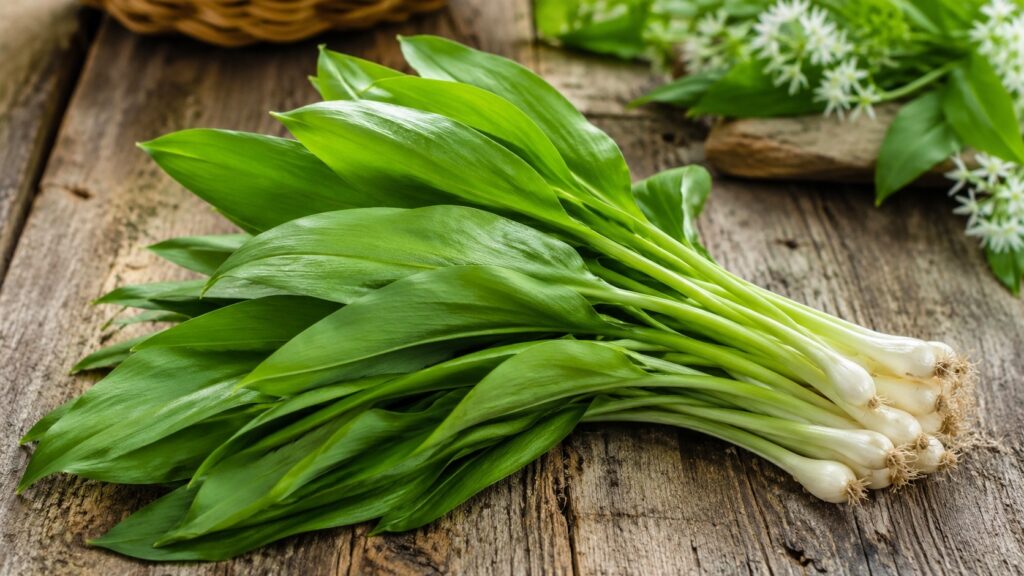
Ramson is prized for its garlicky aroma and flavor with a slight tang
Its taste also resembles garlic, only milder and with a light spiciness. Ramson grows in shady forests, along riverbanks, and on moist slopes, primarily in the Caucasus, Siberia, the Russian Far East, and some regions of European Russia.
It’s harvested in early spring, in April–May, when juicy, broad leaves emerge from the ground, resembling lily of the valley leaves. This is when it’s at its most delicious and nutritious. Later, when the plant flowers, the leaves become tough and lose their delicate flavor.
Health Benefits of Ramson and How It’s Eaten
Ramson is one of the first fresh greens after winter, and it was valued long before arugula became available year-round in supermarkets. Ramson leaves are rich in vitamin C — by some accounts, even more so than lemons. They also contain vitamins A and B, essential oils, and phytoncides — the very substances that give the plant its natural antiseptic properties.
How ramson is eaten and what it’s added to:
- eaten fresh — added to salads, sandwiches, okroshka;
- pickled and salted — as a winter snack;
- used as filling for pies and dumplings;
- made into pesto, as an alternative to the classic recipe with basil;
- stewed and added to soups, especially popular in the Caucasus.
In the Caucasus, pickled ramson is an almost obligatory part of any feast. In Siberia, it’s traditionally salted in large quantities. And in recent years, ramson has become trendy in restaurants as well — chefs use it as a seasonal ingredient in their spring menus.
How Not to Confuse Ramson with Poisonous Plants
Ramson resembles some poisonous plants, and this poses a significant danger. Ramson leaves look similar to lily of the valley and autumn crocus leaves, both of which are toxic. Every spring, cases of poisoning are reported when inexperienced foragers confuse them.
The main way to tell ramson apart from a poisonous plant is by smell. If you rub a leaf and detect a distinct garlic aroma, you have ramson. Lily of the valley and autumn crocus don’t have that smell.
IMPORTANT: If you've already picked some ramson and your hands smell like garlic, your nose can deceive you — you'll detect a garlic scent from any leaf.
How to properly forage ramson:
- smell each leaf individually while your hands are still clean;
- pay attention to the stem: each ramson leaf grows on its own separate stalk from the ground, while lily of the valley has two or three leaves wrapping around a single shared stem;
- if you’re not sure — don’t pick it.
In a number of Russian regions, ramson is listed in the Red Book (endangered species list), and its collection is restricted or prohibited. So before heading into the forest with a basket, it’s worth checking the regulations for your area.
What Is Cheremsha in the USSR Meme
Now — on to the other cheremsha. The one with ears, a mane, and a purr.
In 2020, the French art project Les Createnoutes published an image of a fantastical hybrid on social media — a rabbit with a lion’s head. The picture was part of a series featuring imaginary animals and didn’t cause much of a stir. But in 2025, someone on Russian-language TikTok made the image black-and-white, captioned it “cheremsha” — and the meme took on a life of its own. That’s how the cheremsha animal was born.
At first, the image was simply inserted into videos and comments for its absurd effect. Then people forgot about it. But then another trend intervened — AI-generated clips about nostalgic Soviet daily life, which began appearing en masse on TikTok in late 2025.

The cheremsha meme
Accounts like Soviet Life Stories on TikTok published AI-generated videos narrated from the perspective of a Soviet worker: about food, daily life, habits. The clips were formulaic, with the same melody and a warm, cozy atmosphere. At some point, users began mocking this format: grotesque parodies appeared where Soviet citizens supposedly chewed roof tiles, slept on fiberglass insulation, and built furniture from cinder blocks.
It was precisely into this wave of absurd parodies that Cheremsha landed — the imaginary creature fit perfectly into a world where nothing was as it was in reality.
Why the Cheremsha Meme Went Viral
The meme’s logic is simple: take the nostalgic AI video format and push it to complete absurdity. In these parodies, Cheremsha is a universal helper for the Soviet citizen. It replaced pillows, hats, flash drives, air conditioners, lie detectors, and even power plants. According to the meme’s “canon,” scientists accidentally invented the creature in 1962 while trying to create the perfect insulation material.
The absurdity snowballed. First, Cheremsha simply heated apartments. Then it ran the country from 1965 to 1968. Then it turned out there was no USSR at all — people lived inside one enormous Cheremsha. And space didn’t exist because the Universe was governed by other Cheremsha creatures.
The same archetypal characters appear in the clips: Ivanych, Mikhalych, Zina, the mother-in-law, the neighbor. They all praise the furry helper with the same phrase, which itself became a meme:
They did it quietly, unhurried, without fuss.
And when even that got old, self-irony kicked in:
There were no people in the Soviet Union. Only Zinas, Mikhalyches, and mothers-in-law.
The trend’s main audience is schoolchildren and teenagers. Adults who actually lived through the USSR reacted in various ways, but most often with irritation: “There was no Cheremsha in our USSR!”, “What nonsense!” The video creators only fanned the flames — calmly calling their videos “documentary footage,” which thoroughly entertained the younger audience.
Who Are Brdyshch and Semga in the Memes
Like any meme, Cheremsha eventually started to wear thin. New characters from the same absurd universe came to replace it.
Brdyshch is a fish with a dog’s head. Semga is a rabbit with a tiger’s head and markings. Both creatures, like Cheremsha, were drawn or generated and embedded into the same format: AI clips about an alternative Soviet daily life, where fantastical animals help citizens solve everyday problems.
Essentially, this whole crew is part of one large post-ironic series that TikTok users create collectively. It has no single author, script, or ending. Anyone can add their own episode — all you need is an AI tool, an absurd idea, and a sense of humor.
Critics of the meme accused it of being meaningless. But fans rightly pointed out that absurd humor has always existed, from “mysh krodetsya” to jokes about shovels. It’s just that now it’s made with neural networks and watched in vertical videos.
Why AI Memes About Soviet Daily Life Are Racking Up Views
There are several reasons for the trend’s success. The first is that neural networks have made video production nearly free. Anyone can assemble a nostalgic image with a voiceover in a couple of minutes. There’s virtually no barrier to entry.
The second is that Soviet aesthetics remain a powerful visual code that everyone understands. Even teenagers born twenty years after the collapse of the USSR instantly recognize it: the grainy