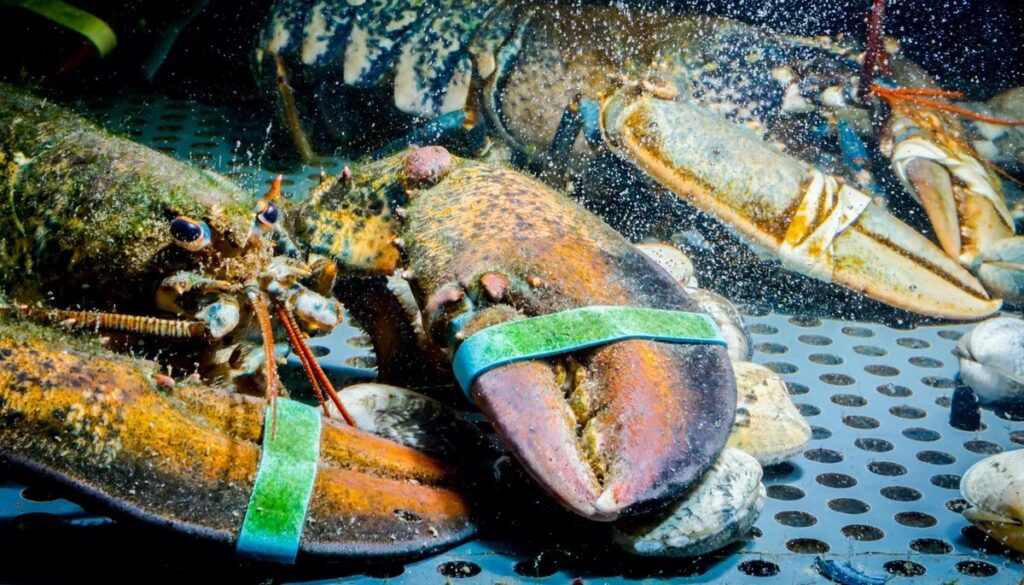
Does a lobster feel pain when it’s boiled? Scientists have been investigating.
Does a lobster experience pain, suffering, or even terror when it’s thrown into boiling water in the kitchen? This question has long occupied the minds of many: animal rights advocates, philosophers, biologists, and seafood suppliers who ponder the ethical side of their menu. It’s no coincidence that there is increasing debate about how knowing that animals feel pain, boredom, and stress changes our attitude toward food. In a new study, scientists delved into this topic and tested how crustaceans respond to painkillers.
Do Lobsters Feel Pain: The Short Version Without Gruesome Details
If we keep it short and factual, without the frightening details (of which there are plenty), here’s the bottom line: painkillers designed for humans reduce pain responses in lobsters — this is the conclusion reached by scientists from the University of Gothenburg in Sweden.
A new study published in the journal Scientific Reports shows that when crustaceans were given aspirin or lidocaine before a painful stimulus, their behavior changed in much the same way as in humans after taking the same medications. And this raises an uncomfortable question about what exactly a lobster feels when it’s thrown into boiling water…
Below are the details of the research and experiments conducted. Fascinating, but disturbing and unsettling. Because to find out whether lobsters feel pain, you have to hurt them.
How Scientists Tested Pain in Lobsters Through Experiments
A team of researchers led by Professor of Animal Physiology Lynne Sneddon purchased Norway lobsters (Nephrops norvegicus) at the Gothenburg fish market and transported them to the laboratory. For the experiment, 105 lobsters were divided into several groups. Two groups received electric shocks after being treated with aspirin or lidocaine, while another group was subjected to shocks without pain relief. Control groups received no shocks at all.
Aspirin was administered by injection at a dose of 10 mg/kg, and lidocaine was dissolved in the aquarium water at a concentration of 80 mg/L one hour before the stimulus. The lobsters were then subjected to an electric shock of 9.09 V/m for 10 seconds, and their behavior was observed before, during, and for two hours after the stimulus.
An important detail: the scientists didn’t just observe behavior. They also took hemolymph samples — the crustacean equivalent of blood — to measure stress markers, and after euthanasia they studied gene activity in nervous system tissues.
Aspirin and Lidocaine: Painkillers Affect Lobster Behavior
Lobsters that received electric shocks without pain relief reacted vigorously — they tried to escape by rapidly flicking their tails. This is a typical escape maneuver in decapod crustaceans: a sharp tail flick propels the animal backward, away from the source of danger.
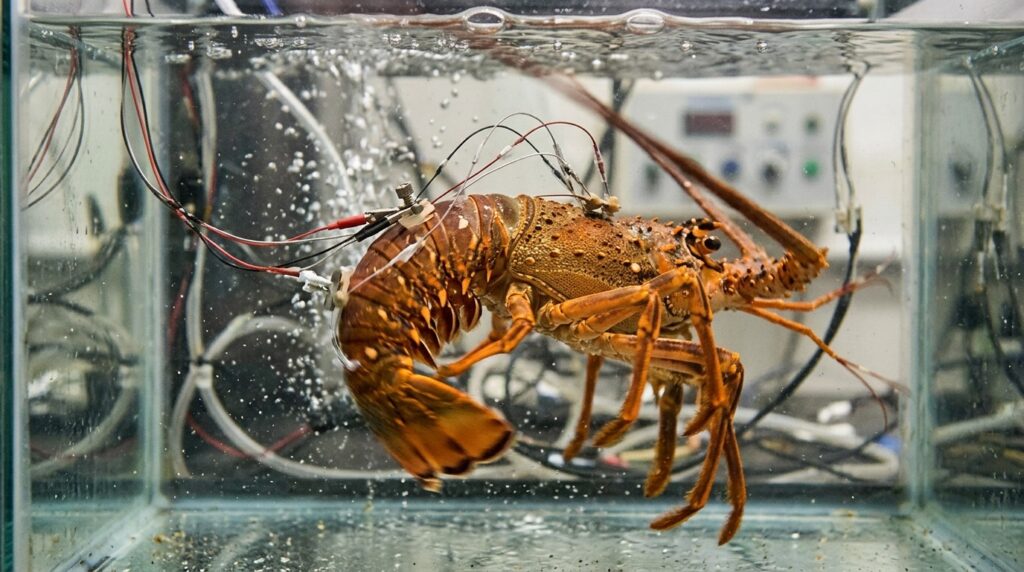
A lobster performs a tail flick — an escape maneuver from danger
On average, lobsters without pain relief performed about 10 tail flicks in 10 seconds. But after receiving painkillers, the number of flicks dropped to virtually zero. To be precise: only 3 out of 13 lobsters given aspirin, and 7 out of 13 lobsters on lidocaine, made even a single tail flick.
Aspirin did cause a side effect — after injection, the lobsters began grooming their legs and claws, which is a sign of stress. But even so, the number of tail flicks during the shock still decreased. Lidocaine, dissolved in water, provided similar pain relief with minimal side effects. Both medications thus demonstrated analgesic effects.
Tissue analysis showed that the experimental lobsters had elevated lactate levels in their hemolymph and altered gene expression in their nerve ganglia — these are biological stress markers that confirm the response was not simply mechanical but involved the nervous system.
Lobster Responses Are Not Just Reflexes
At first glance, the result seems obvious: painkillers relieve pain. But the significance of this experiment goes deeper. If the tail flicks were a purely mechanical reaction — like a leg jerking when tapped on the knee — then aspirin and lidocaine simply wouldn’t have worked. These medications act through nociceptive pathways (the system for detecting harmful stimuli), not through muscular reflexes.
Let me explain with a simple analogy. If you accidentally touch a hot stove, your hand pulls away automatically — that’s a reflex, which a painkiller won’t eliminate. But if your bruised finger hurts and you take a pill, the painkiller acts specifically on the pain perception system, not on the muscles. The fact that aspirin works on lobsters indicates that they have an analogous system at work.

The uncomfortable truth: lobsters feel pain just like us and respond to painkillers
This adds yet another compelling piece of evidence to the growing body of data showing that crustaceans such as lobsters are capable of nociception — the physical detection of harm, which is one of the key criteria in defining pain in animals.
Where Boiling Lobsters Alive Is Already Banned
The study appeared amid a global debate about crustacean rights. Norway, New Zealand, and Austria have already banned boiling live crustaceans on ethical grounds, and similar legislation is currently being considered in the United Kingdom.
Switzerland banned throwing live lobsters into boiling water back in 2018. Under the new law, crustaceans must be stunned before being killed — either by electric shock or rapid destruction of the brain.
In 2022, the United Kingdom expanded its Animal Welfare (Sentience) Act, officially recognizing lobsters, crabs, octopuses, and all other decapod crustaceans and cephalopod mollusks as sentient beings. This decision was based on a government review of more than 300 scientific studies conducted by experts at the London School of Economics, who concluded there was strong scientific evidence of sentience in these animals.
The fishing industry meanwhile is exploring electric stunning as an alternative to boiling alive. But as the new research shows, developing a truly humane method of killing requires more data — an improperly calibrated shock can cause severe pain.
How Lobster Pain Changes Our Understanding of Animal Consciousness
People tend to attribute consciousness to creatures that resemble them. The idea of boiling a chimpanzee or dolphin alive seems monstrous, but the same thought applied to a lobster provokes far less ethical discomfort.
“People tend to empathize with animals that are similar to us — that have facial expressions or a voice — and we spend more time with terrestrial animals, so we understand them better,” explained Professor of Animal Physiology Lynne Sneddon.
But science shows that a nervous system unlike the human one does not mean the absence of suffering. An octopus’s brain wraps around its esophagus in a ring, and a network of “mini-brains” extends through its tentacles — nothing in common with our anatomy, yet octopuses demonstrate complex behavior and signs of intelligence. Even sea urchins have been found to have a distributed “whole-body brain” that challenges conventional ideas about nervous systems.
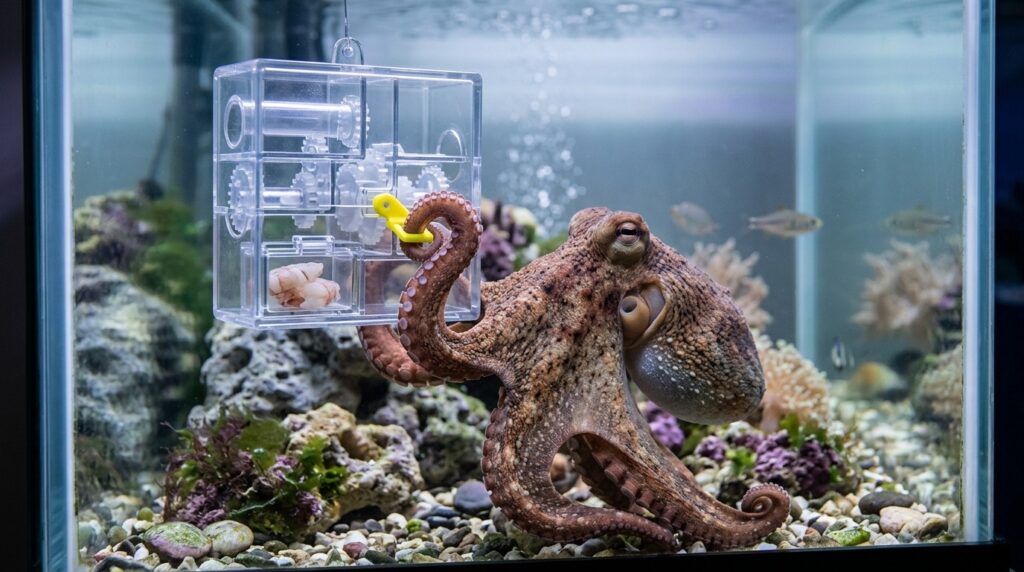
Octopuses demonstrate complex behavior despite having a nervous system radically different from ours
The study in Scientific Reports fits into this trend: debates about animal consciousness are expanding far beyond mammals, forcing us to reconsider which creatures deserve ethical consideration and protection from suffering.