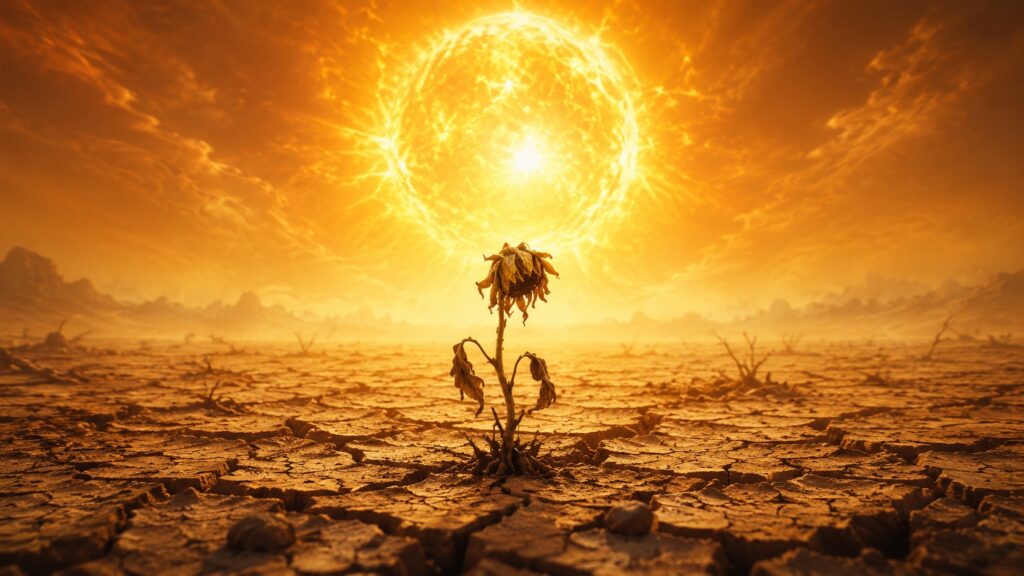
Plants on Earth could be destroyed by the Sun, and scientists have determined an approximate date
Scientists have calculated when not a single plant will remain on Earth. Not in a hundred years and not in a thousand — we’re talking about billions, but the exact date is now known. And the reason it will happen is not simply that the Sun will bake the planet. The mechanism will be more cunning and will affect more than just temperature. What exactly will be the final blow for all of Earth’s flora?
How the Sun Will Destroy Life on Earth
Plants make up about 80 percent of all biomass on our planet. To thrive, they need three basic things: sunlight, water, and carbon dioxide. But the balance of these elements will not last forever.
Researchers from the nonprofit Blue Marble Space Institute created a three-dimensional climate model to peer into the distant future. The key input was that the Sun is gradually becoming brighter and hotter. In roughly two billion years, our star’s luminosity will increase by 20%, triggering a chain of irreversible changes in the atmosphere and oceans.
How Plants on Earth Will Perish
How exactly plants will disappear depends on the natural carbon cycle. In nature, carbon dioxide is constantly washed out of the atmosphere into the oceans, settles on the seabed in the form of rocks, and then returns through volcanic eruptions and the movement of tectonic plates.
Since scientists don’t know for certain how this cycle will respond to intense warming, they calculated two possible scenarios:
- In the strong weathering model, the planet’s temperature remains relatively stable, but carbon dioxide levels drop critically. Under such conditions, plants will simply run out of building material for photosynthesis, and they will disappear in approximately 1.84 billion years;
- In the weak weathering model, carbon dioxide concentration does not drop, but the planet begins to heat up rapidly. When the average temperature reaches 65 degrees Celsius, no terrestrial plant will be able to survive. This will happen in 1.87 billion years.
It is the second scenario that the authors of the study, published in the Journal of Geophysical Research: Atmospheres, consider the maximum lifespan of our vegetative biosphere. This period coincides with the time when the planet will begin to completely lose its oceans due to evaporation.
How Plants Might Evolve in the Future
This grim forecast comes with an important caveat: computer models operate on current data and completely disregard biological evolution. Life knows how to adapt to the harshest conditions.
The study’s authors suggest that as the surface heats up, plants could colonize the aerial environment. They could evolve to survive at enormous altitudes, in the stratosphere, where temperatures are significantly lower.
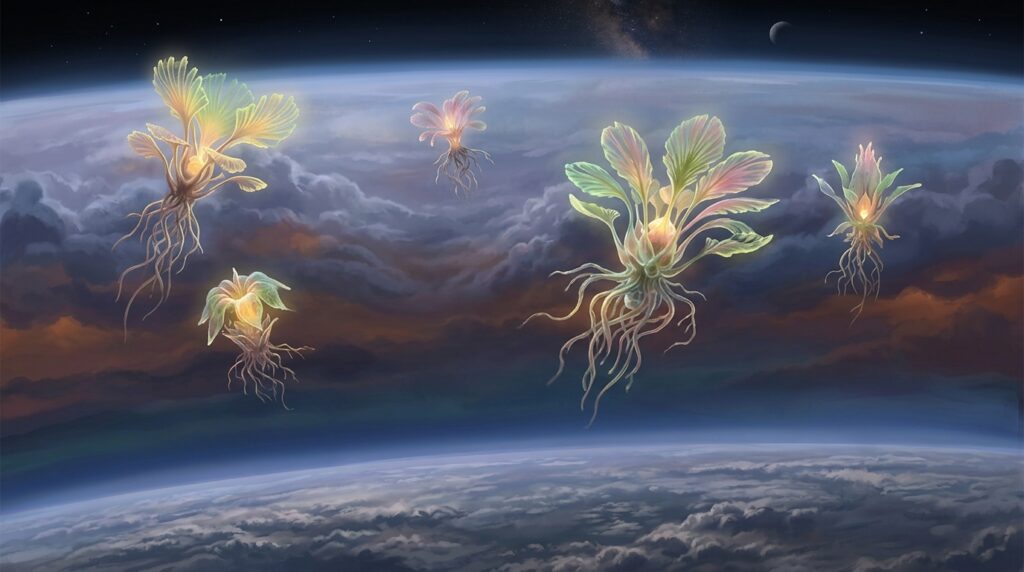
In the distant future, plants could adapt to life in the upper layers of the atmosphere
How to Save Plants from Extinction
Beyond natural evolution, technological progress should not be dismissed. If humanity or another intelligent civilization of the future survives until then, it could employ geoengineering methods.
Projects such as spraying reflective aerosols into the stratosphere or creating giant cosmic sunshades to shield the planet from the scorching Sun are already being discussed. There are also more radical theoretical ideas, from artificially altering our star’s mass to deliberately shifting Earth’s orbit farther from the growing heat source.
It’s still hard to say whether the planet will need fantastic plant-saving technologies or whether nature will manage on its own. But the scientists’ key finding inspires optimism: the limitations we see now are not a final verdict. Earth’s biosphere is incredibly resilient, and life will continue for as long as at least a drop of water remains on the planet.