Acid rain on Venus is not as dangerous as it might seem
Have you ever been caught in acid rain? On Earth, that would be a catastrophe because it corrodes skin, ruins clothing, and destroys plants. Now imagine a planet where such rain falls… constantly. Where would you hide? Under an umbrella? In a cave? On Venus, the answer will shock you: you don’t need to hide at all. Because not a single drop of sulfuric acid ever reaches the surface. Does the planet somehow look out for hypothetical tourists?
What Are Venus’s Clouds Made Of
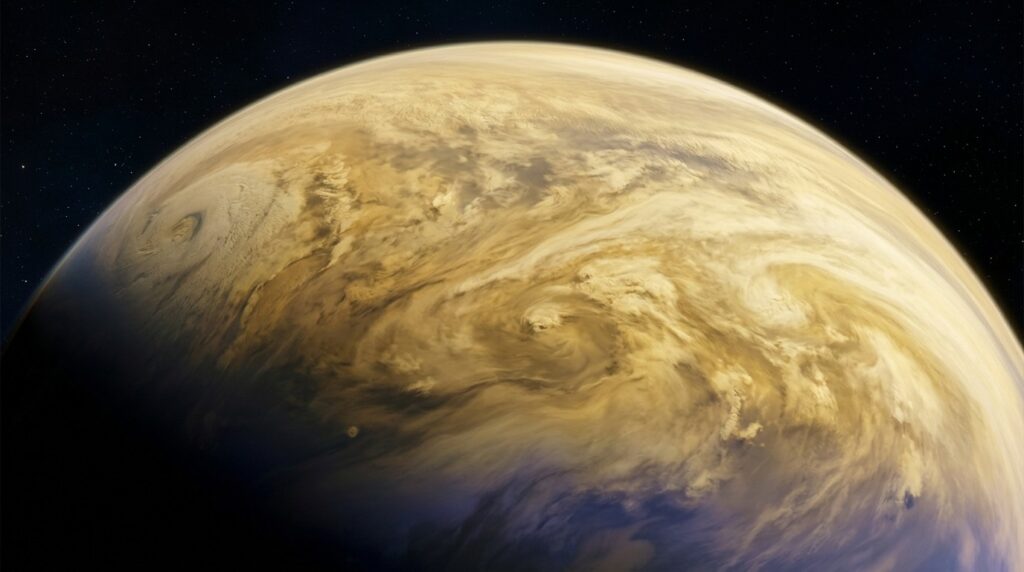
Venus, the second planet in the Solar System, is completely shrouded in dense clouds. According to NASA, these clouds hide its surface from any observer. But they are very different from Earth’s clouds because they consist not of water vapor, but predominantly of droplets of concentrated sulfuric acid.
The planet’s atmosphere is 96% carbon dioxide, with the rest being nitrogen and traces of other gases, including sulfur dioxide. The cloud cover extends at altitudes from 48 to 68 km above the surface, while thin hazes stretch even higher, up to 90 km. It is these clouds that reflect about 80% of sunlight, which is why Venus appears so bright in Earth’s sky.
But while creating a powerful greenhouse effect, these clouds simultaneously prevent any precipitation from reaching the ground. To understand why, we need to examine what happens between the clouds and the surface.
What Is Virga on Earth and Venus
On Earth, there is an atmospheric phenomenon familiar to anyone who has been in deserts or arid steppes: rain falls from a cloud, but the drops never reach the ground. This is virga — from the Latin word meaning “rod” or “branch.” It looks like semi-transparent streaks hanging from beneath a cloud and dissolving into the air.
The mechanism is simple: precipitation falls from a cloud, but upon entering a layer of dry or hot air, it evaporates before touching the surface. Virga on Earth is commonly seen in the deserts of the southwestern United States, North Africa, Australia, and the Middle East.
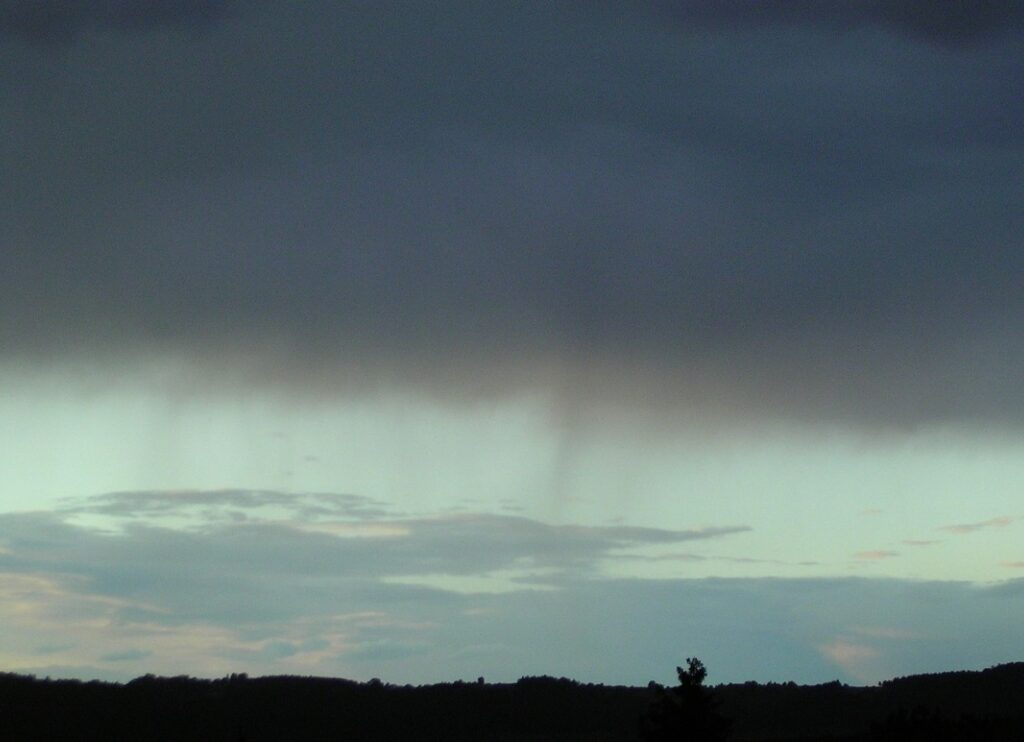
Virga on Earth. Image source: wikipedia.org
On Venus, virga is not the exception but the rule. Sulfuric acid condenses in clouds at altitudes of tens of kilometers, drops begin to fall downward, and enter an inferno. Temperature rises rapidly with each kilometer closer to the surface, and the drops simply cannot withstand it: they evaporate and return back into the atmosphere, completing an endless cycle.
Temperature and Pressure on Venus’s Surface
To grasp the scale of what’s happening, it’s worth recalling the numbers. The temperature on Venus reaches approximately 467 degrees Celsius — enough to melt lead. And the atmospheric pressure is 93 times greater than Earth’s at sea level, comparable to the pressure at a depth of about 900 meters in the ocean.
Such conditions create an environment in which carbon dioxide near the surface behaves almost like a supercritical fluid — something between a gas and a liquid. Wind near the surface is weak, just a few kilometers per hour, but due to the enormous atmospheric density, even a light breeze can move rocks and dust.
This is precisely why sulfuric acid doesn’t stand a chance of reaching the ground. Long before the drops approach the surface, the hellish heat of the lower atmospheric layers turns them back into vapor.
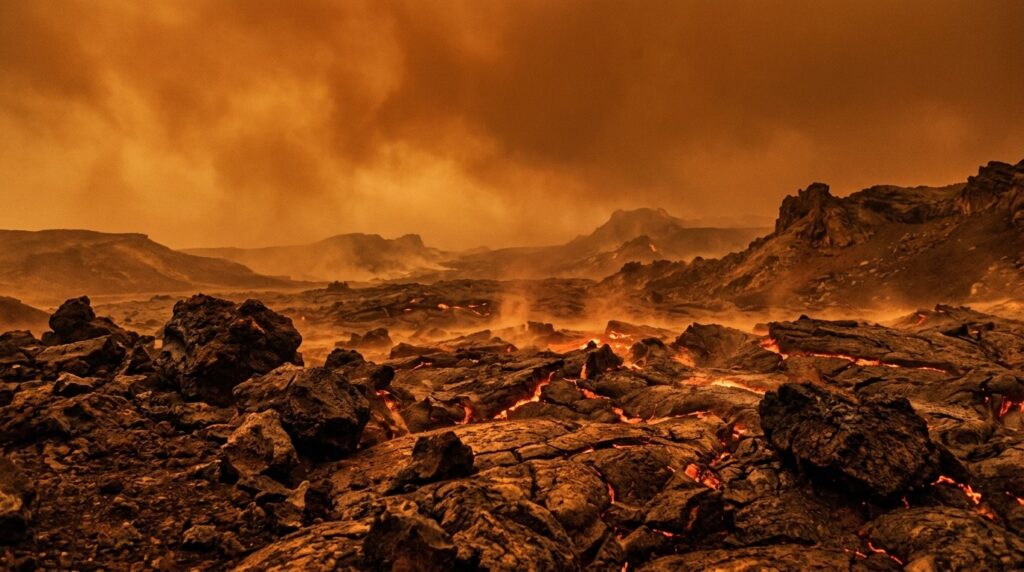
The scorching surface of Venus: temperatures here melt lead
The Soviet Space Program to Venus
Everything we know firsthand about Venus’s surface was obtained by the Soviet Venera program. These were the only spacecraft that ever made soft landings on the planet and transmitted data from its surface. Conditions were so extreme that the probes’ lifespans were measured in minutes — from 23 minutes for Venera 7 to a record of just over two hours for Venera 13.
Venera 7, which landed on the planet in December 1970, became the first spacecraft to make a soft landing on another planet and transmit data from there. Venera 13 in 1982 operated on the surface for 127 minutes — although it was designed for only 32 — and managed to take color photographs of the rocky landscape and even record the sounds of Venusian wind.
These missions confirmed that the air near the surface is scorching hot and incredibly dense, while the horizon is surprisingly clear. The rocks visible in the photographs turned out to resemble terrestrial basalts of volcanic origin.
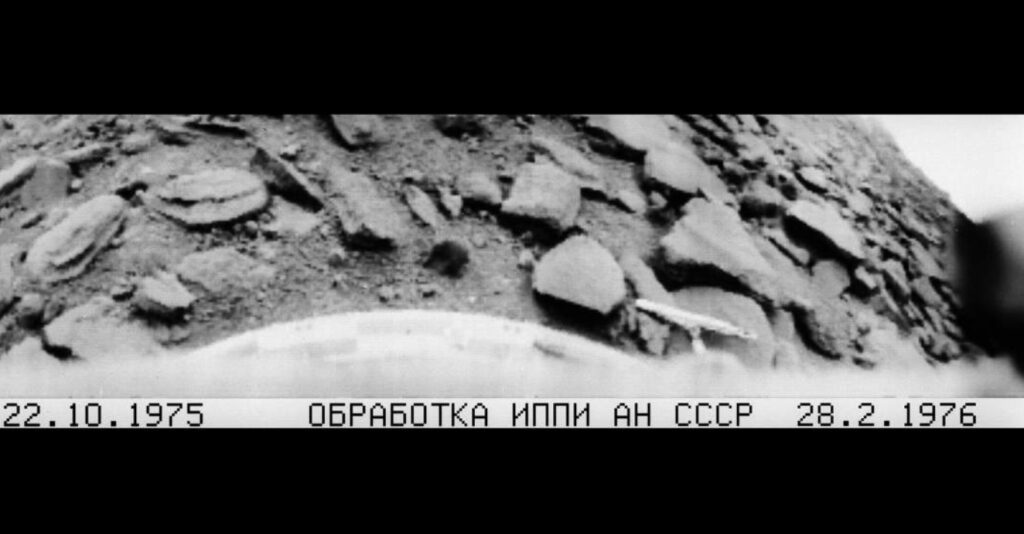
Photograph of Venus’s surface from the Venera 9 station. Image source: wikipedia.org
Unusual Rain in the Solar System
Venus is far from the only place with exotic precipitation. Our Solar System is full of weather surprises that make Earth’s rain look boring.
On the ice giants Uranus and Neptune, rich in methane, extreme pressures and temperatures deep in the atmosphere split methane molecules. The released carbon is compressed under colossal pressure into diamonds, and diamond rain falls there. Laboratory experiments with lasers have confirmed that such a process is indeed possible.
On the exoplanet OGLE-TR-56b, also known as a hot Jupiter, located very close to its star, atmospheric temperatures are so high that iron rain likely falls there. And on HD 189733b, winds blow at speeds of about 8,700 km/h and presumably carry with them glass rain, due to silicate particles in the clouds.
Against this backdrop, Earth’s water rain is a luxury. It is water, falling in liquid form and reaching the surface, that makes life possible in the form we know it.
What Venus’s Acid Virga Changes in the Search for Life on the Planet
The story of acid rain that never falls to the ground might seem like a curiosity. But in reality, it reveals fundamental processes that determine a planet’s climate and chemistry.
On Earth, water in the form of rain washes carbon dioxide, sulfuric acid, and hydrochloric acid out of the atmosphere, binding them with rocks. On Venus, none of this works because acid precipitation never reaches the surface and cannot participate in chemical weathering. All the acid remains in the atmosphere, locked in an endless cycle of condensation and evaporation.
This helps explain why Venus’s atmosphere contains so much carbon dioxide — roughly the same amount that is bound in carbonate rocks on Earth. Without rain that could wash carbon from the air, the greenhouse effect on Venus became runaway.
Studying this process is important not only for understanding our neighboring planet. Venus serves as a vivid example of what can happen when the greenhouse effect spirals out of control — and why ordinary Earth rain, which we are accustomed to and often complain about, is actually one of the greatest allies of our climate.