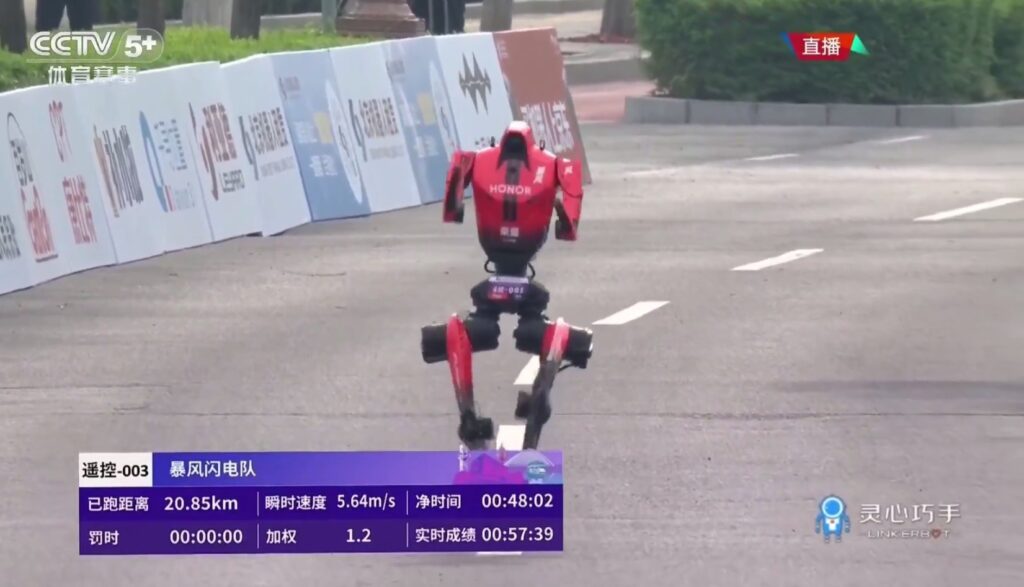
The “Lightning” robot finishes with a time of 50 minutes 26 seconds
The humanoid robot “Lightning” ran a half marathon in Beijing in 50 minutes and 26 seconds — faster than any human in history. Just a year ago, the best robot barely managed to finish within three hours, and now a machine has beaten the world record among humans. This race became a vivid test of Chinese robotics capabilities.
Results of the 2026 Beijing Robot Half Marathon
According to RIA Novosti, on April 19, 2026, the second half marathon featuring humanoid robots took place in Beijing’s Yizhuang Economic and Technological Development Zone. This year, more than 100 teams lined up at the start — nearly five times more than the previous year. Participants included international teams from Germany, France, and Brazil.
Robots and humans ran the same 21.1 km route, but machines were given a separate lane, and starts were staggered at 30-second intervals.
The drama unfolded at the finish line. The first to cross was robot “Lightning” number 001 from the “Jueying Chitu” team — it posted a net time of 48 minutes 19 seconds. However, this robot was remotely controlled rather than autonomous, so the organizers applied a penalty coefficient. As a result, the entire podium went to fully autonomous robots.
The winner was “Lightning” №009 from the “Qitian Dasheng” team — 50 minutes 26 seconds. Silver went to “Lightning” №011 with a time of 50 minutes 56 seconds, and bronze to “Lightning” №008 at 53 minutes 1 second. All three robots were developed by Honor.
How the Robot’s Result Compares to the Human World Record
To appreciate the scale, it’s worth comparing the robots’ results with the best human achievements. Sources cite Ugandan runner Jacob Kiplimo’s record of 56 minutes 42 seconds. However, there’s a caveat: World Athletics did not ratify this result, set in Barcelona in 2025, due to suspicions that the pace car created an aerodynamic advantage for the runner.
The official world record for the half marathon currently stands at 57 minutes 20 seconds. It was set by the same Kiplimo on March 8, 2026, in Lisbon, beating Ethiopian Yomif Kejelcha’s previous record by 10 seconds.
But even compared to the unofficial Barcelona result, the “Lightning” robot was faster by more than 6 minutes. And against the ratified record, the gap is nearly 7 minutes. For a half marathon, that’s a colossal difference.
It’s important to note that the comparison is conditional. The robots have legs 90–95 cm long, specifically designed for the biomechanics of fast running. A robot doesn’t tire the way a human does — it has no lactic acid in its muscles and doesn’t need oxygen. But it has its own limitations: drive overheating, battery consumption, and the need to make decisions in real time on a complex route with turns and inclines.
How Fast Are Running Robots Progressing
The most impressive number in this story isn’t “Lightning’s” result itself — it’s the difference from last year’s winner. In April 2025, at the world’s first half marathon for humanoid robots, the winner was “Tiangong Ultra” from the Beijing Innovation Center for Robotics. It completed the distance in 2 hours 40 minutes 42 seconds — slower than most amateur runners.
Back then, only six out of 21 robots made it to the finish. Some fell right after the start, one had to have its head taped back to the body with adhesive tape, and the small robot “Xiaojuren” (Little Giant) started smoking from its head due to overheating.
In one year, the winner’s result improved more than threefold — from 160 minutes to 50. Such a rate of progress in robotics is hard to find in any other field. For comparison, it took humans decades to shave even a couple of minutes off the half marathon world record.
How the “Lightning” Robot Is Built and Why It’s So Fast
Honor, known primarily as a smartphone manufacturer (a former Huawei subsidiary), entered humanoid robotics relatively recently. In May 2025, the company first demonstrated a robot capable of running at 4 m/s. By the 2026 half marathon, the speed had increased substantially.
According to Honor engineer Du Xiaodi, the robot was developed over about a year. The 90–95 cm legs are designed to mimic the biomechanics of elite runners. The drives are cooled by a liquid cooling system borrowed from the company’s smartphones — the very same technologies that keep phone processors from overheating under load.
This is an interesting detail: consumer electronics technologies turned out to be useful for robot athletes. According to Du, fast running isn’t the end goal. High speeds allow testing the reliability of the structure, cooling systems, and control algorithms under extreme conditions — and then transferring those solutions to industry.
How Robots Learned to Run Without Remote Control
In last year’s half marathon, robots were mostly remotely controlled. This year, about 40% of teams used fully autonomous navigation — the robot independently perceived its surroundings, plotted its route, and made speed and direction decisions without operator commands.
The course was challenging: the 21 km track included more than 10 types of surfaces — smooth asphalt, inclines, narrow sections, and turns. There were 12 left and 10 right turns in total, including several nearly right-angle ones. For an autonomous robot, each such turn is a challenge: the movement algorithm must be reconfigured in fractions of a second to maintain balance.
The organizers introduced a penalty coefficient of 1.2 for remotely controlled robots: their net time is multiplied by 1.2. This explains why the remote-controlled robot that clocked 48:19 didn’t make the podium — its adjusted result was worse than the autonomous “Lightning” robots.
This is precisely why the victory of autonomous robots is especially significant: the machine doesn’t just run fast — it understands on its own where and how to move.
What the Robots’ Running Victory Means for Industry
The half marathon is a stress test. Fifty minutes of continuous bipedal running on a real urban course tests everything simultaneously: joint mechanics, balancing algorithms, energy efficiency, heat dissipation, and the ability to make decisions in a changing environment.
But experts warn that running speed does not equal readiness for industrial application. The skills demonstrated at the half marathon don’t directly transfer to the tasks humanoid robots are created for — working in warehouses, on production lines, and in hazardous conditions. That requires entirely different abilities: precise manual work, object manipulation, and interaction with people.
Chinese companies still face difficulties developing AI software that would allow humanoid robots to perform no worse than a human on a factory floor. But the half marathon helps refine fundamental technologies: structural reliability, cooling, and navigation — which will later prove useful in commercial applications as well.
A year ago, robots could barely make it to the finish, losing their heads along the way and smoking from overheated motors. Now they’re outrunning the planet’s best runners. Progress is rapid, but between the ability to run fast and the ability to work usefully lies a distance more serious than any marathon. And that’s the distance worth watching in the coming years.