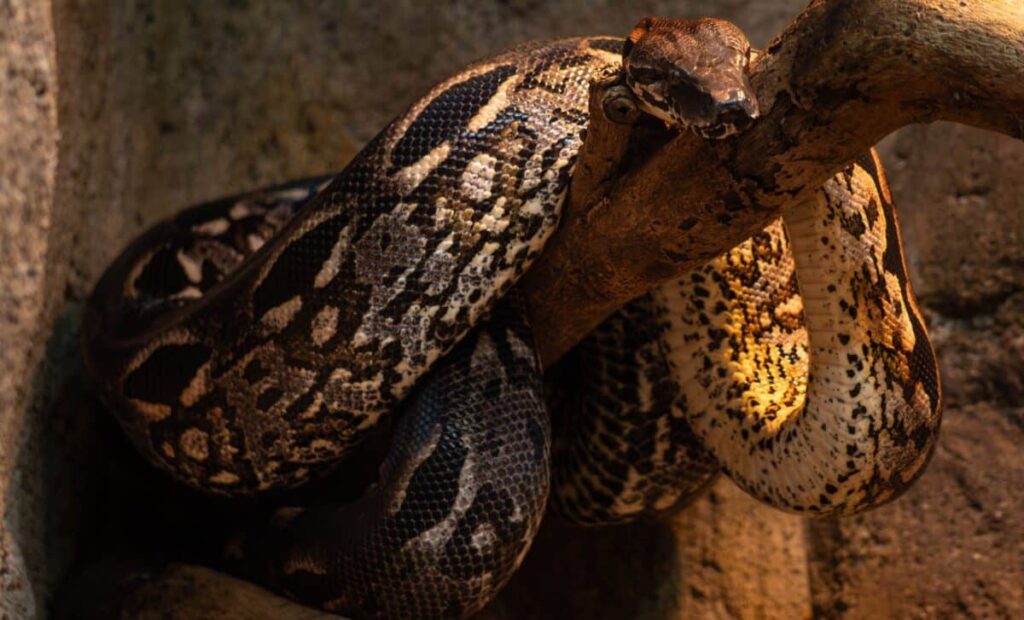
Remains of a 15-meter snake that eclipses Titanoboa found in an Indian mine
We’ve all heard about Titanoboa — the enormous ancient snake that swallowed crocodiles for breakfast. It seemed like no snake could be bigger. However, in an Indian coal mine, paleontologists dug up vertebrae of a creature that makes Titanoboa look like an ordinary boa constrictor. This giant’s length exceeded 15 meters. That’s longer than an ambulance, a bus, and three times your height all lined up together. And the most terrifying part is that this giant snake didn’t live in the age of dinosaurs but quite recently by geological standards.
Discovery of the Largest Snake in History
According to Scientific Reports, the story of this discovery began back in 2005, when paleontologist Sunil Bajpai extracted unusual fossils from a mine in the state of Gujarat. At the time, they were mistaken for crocodile bones and stored away in a laboratory. It wasn’t until nearly two decades later, when Debajit Datta joined the work, that scientists carefully examined the find and realized they were looking not at a crocodile but at an unknown giant snake.
In total, the researchers identified 27 well-preserved vertebrae, some of which were still lying in the same arrangement as they had been during the animal’s life. Each vertebra was up to 11 centimeters wide, and the diameter of the snake’s body was estimated at about 44 centimeters. Imagine a living creature as thick as a water barrel. That’s what Vasuki indicus looked like.
Based on the size of the vertebrae and comparison with modern boas and pythons, scientists calculated that the full body length of the giant snake ranged from 10.9 to 15.2 meters. At maximum estimates, this makes it one of the longest snakes in the entire history of the planet.
How the World’s Largest Snake Hunted
Despite its colossal size, Vasuki indicus was not a swift predator. This snake led a lifestyle similar to that of modern anacondas and pythons: a slow ambush predator that killed prey by constriction, wrapping it in its powerful body.
At that time, about 47 million years ago, during the middle Eocene epoch, the place where today’s arid mine in Gujarat is located was a coastal swamp with a warm tropical climate. The average temperature reached approximately 28 degrees Celsius, which was ideal for a cold-blooded giant: the warmer the environment, the larger reptiles can grow.
Among the fossils found in the same rock formations were rays, catfish, turtles, crocodiles, and even primitive whales. Any of them could theoretically have been prey for the giant snake, although the exact diet of the predator cannot yet be determined. There is no skull among the fossils, and it is precisely the skull that could hint at what the animal ate.
The researchers are confident that Vasuki was not venomous — it belonged to the family Madtsoiidae, a completely extinct group of large non-venomous snakes. This family existed for about 100 million years, from the Late Cretaceous to the Late Pleistocene.
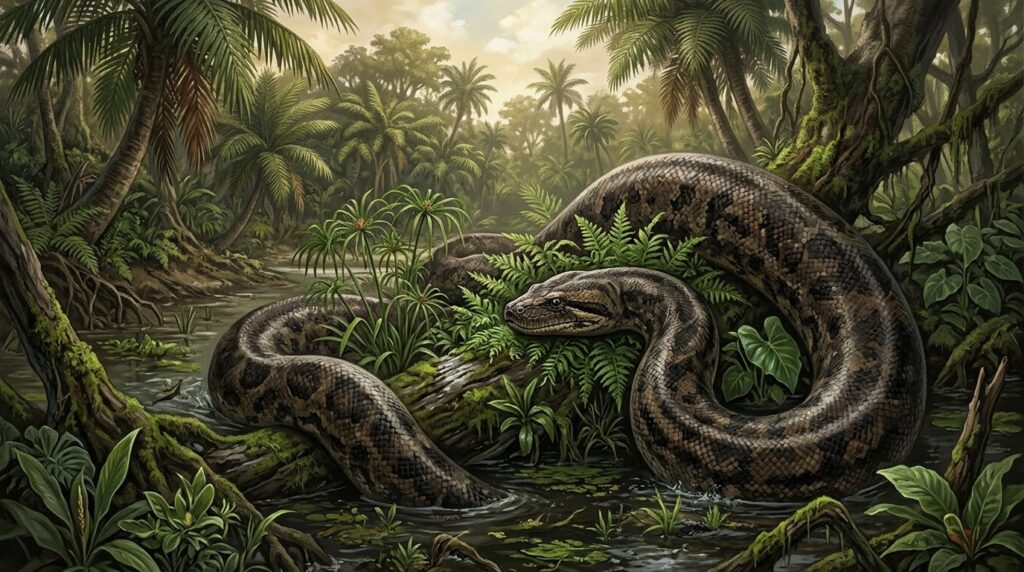
Reconstruction of Vasuki indicus in the tropical swamps of ancient India
Is Titanoboa No Longer the Largest Snake?
For over a decade, the title of the largest snake in history undisputedly belonged to Titanoboa — a giant boa discovered in 2009 in the coal mines of Cerrejón in northern Colombia. Titanoboa lived 58–60 million years ago and, by estimates, reached a length of about 12.8 meters, with some calculations suggesting up to 14.3 meters. It weighed on average over a ton.
The appearance of Vasuki indicus complicates this picture. The upper length estimates for the Indian snake — 15.2 meters — exceed most estimates for Titanoboa. However, study co-author Sunil Bajpai emphasizes that Titanoboa’s vertebrae are still somewhat larger, and it is currently impossible to say precisely which of the two giants was more massive.
It is important to remember that the length estimates for both snakes are based on extrapolation from vertebra sizes rather than complete skeletons. The authors themselves caution that the figures should be treated carefully.
Where Ancient Giant Snakes Lived
One of the most intriguing conclusions is geographical. Titanoboa inhabited the tropics of South America, while Vasuki indicus lived in the territory of India, which was a very different place at that time. About 50 million years ago, the Indian subcontinent had only just collided with Asia, and before that moment it had been drifting as a separate island-continent, carrying its fauna with it.
The discovery of Vasuki proves that giant snakes were far more widespread than previously thought — not only in South America but also on other fragments of the ancient supercontinent Gondwana. Scientists suggest that after India’s collision with Asia, madtsoiids were able to spread through southern Eurasia into North Africa.
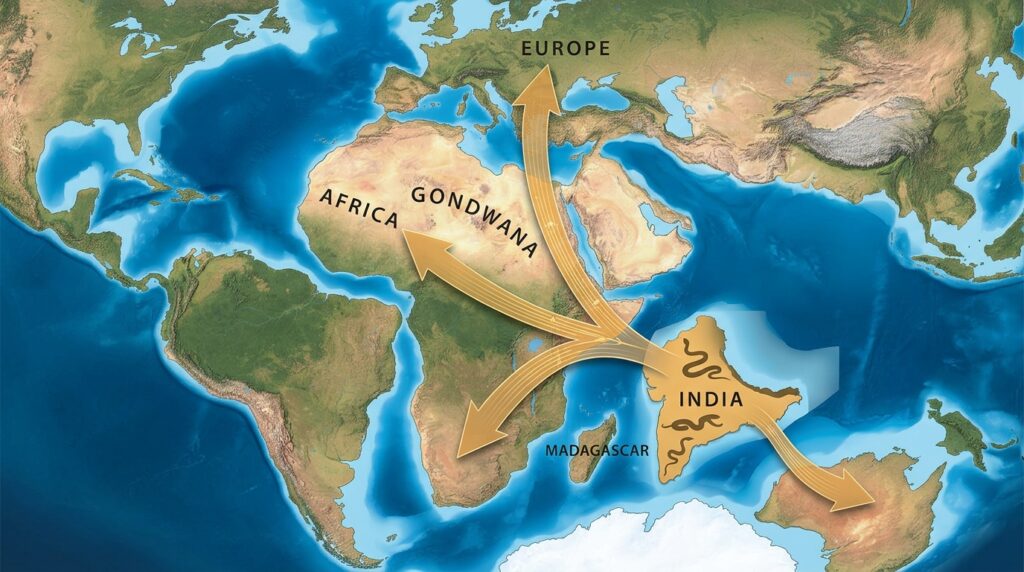
Presumed dispersal routes of madtsoiids from India to Africa and Europe
This changes paleontologists’ understanding of how the largest predators were distributed after the extinction of the dinosaurs. The world of the early Cenozoic — the era that followed the demise of the dinosaurs — turned out to be richer in giant reptiles than previously thought.
What Has Been Proven About Vasuki indicus and What Remains a Hypothesis
As with any paleontological discovery based on an incomplete skeleton, there is a clear boundary between facts and assumptions.
Scientists have currently proven:
- the existence of a new species of giant snake from the Madtsoiidae family in India;
- vertebra sizes indicating a body length of 10.9 to 15.2 meters;
- Vasuki indicus is the largest known member of the family Madtsoiidae;
- the snake led a terrestrial or semi-aquatic lifestyle in coastal swamps.
There is no evidence yet for the following points:
- whether Vasuki indicus was actually longer or more massive than Titanoboa;
- what exactly it ate;
- what its skull looked like and what the details of its behavior were.
The absence of a skull is the main limitation of the study. It is precisely the skull that helps paleontologists more accurately determine body size, diet, and the phylogenetic relationships of snakes. Without it, many conclusions remain approximate.
Nevertheless, the discovery of Vasuki indicus forces a reconsideration of the established picture in which Titanoboa was the sole and undisputed record holder. Now we know that during warm epochs of the past, Earth simultaneously produced giant snakes on different continents. And perhaps the most impressive discoveries are still ahead.