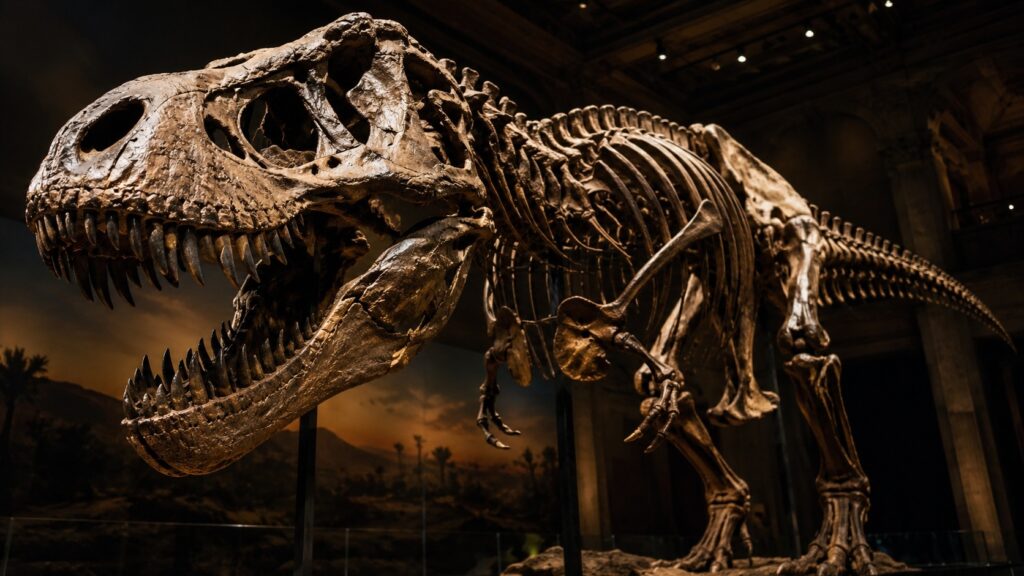
A tyrannosaurus skeleton is worth millions, and the price is justified
A tyrannosaurus skeleton named Gus will be put up for auction at Sotheby’s in New York on July 14, 2026. The estimated price for this lot is between 20 and 30 million dollars, making it the highest preliminary estimate ever given to a dinosaur skeleton. But to understand why a handful of ancient bones can cost as much as a skyscraper, you need to figure out what makes some fossils priceless while others remain just museum exhibits.
The Excavation of Gus the Tyrannosaurus
According to Artnet, Gus is a tyrannosaurus skeleton approximately 67 million years old, found in Harding County, South Dakota. He got his name in honor of ranch owner Gary “Gus” Liking, on whose land the remains were discovered.
Liking had been finding small bone and tooth fragments on his 6,500 acres for years and was convinced that something truly large was hiding somewhere in the ground. He invited a team of paleontologists, and over three summer seasons, from 2021 to 2023, they excavated the enormous skeleton.
Gary Liking himself did not live to see the end of the excavation — he passed away a year after it began. His widow Dana said that Gus was just one of many finds hidden in the land her husband loved so much.
Why a Complete T. rex Skeleton Is Extremely Rare
It might seem like tyrannosauruses are practically the most famous dinosaurs in the world, which would mean their skeletons should be plentiful.
In reality, it’s the opposite. For bones to survive 67 million years, an incredible combination of circumstances is required. The animal had to be quickly buried under a layer of sedimentary rock, minerals had to gradually replace organic matter, and then erosion or chance had to bring the fossil to the surface.
Gus the tyrannosaurus consists of 183 bone elements, including a well-preserved skull, two nearly complete feet, and a rare pair of humeral bones. Overall, the skeleton is approximately 63% complete, which is an outstanding result for a tyrannosaurus. When assembled, it reaches about 11.5 meters in length and nearly 4 meters in height.
Some of the bones show signs of healed fractures and even bite marks — traces of the hard life of a Cretaceous period predator. In terms of size and preservation, Gus is comparable only to two other famous T. rex skeletons that have gone to auction. These were Stan and Sue. Both were 12–13 meters long and also preserved at more than 60%.
How Much Have Dinosaur Skeletons Sold For
Dinosaur skeletons have already been sold at auctions. Here are the most notable deals:
- Sue (T. rex) — sold in 1997 at Sotheby’s for 8.36 million dollars. At the time, it was an absolute record;
- Stan (T. rex) — sold at Christie’s in 2020 for 31.8 million dollars. The buyer remained anonymous for a long time;
- Apex (Stegosaurus) — sold at Sotheby’s in 2024 for 44 million dollars. This is the current record for a dinosaur skeleton at auction;
- Young Ceratosaurus — unexpectedly fetched 30.5 million dollars at Sotheby’s in 2024, even though the estimated price was only 6 million.
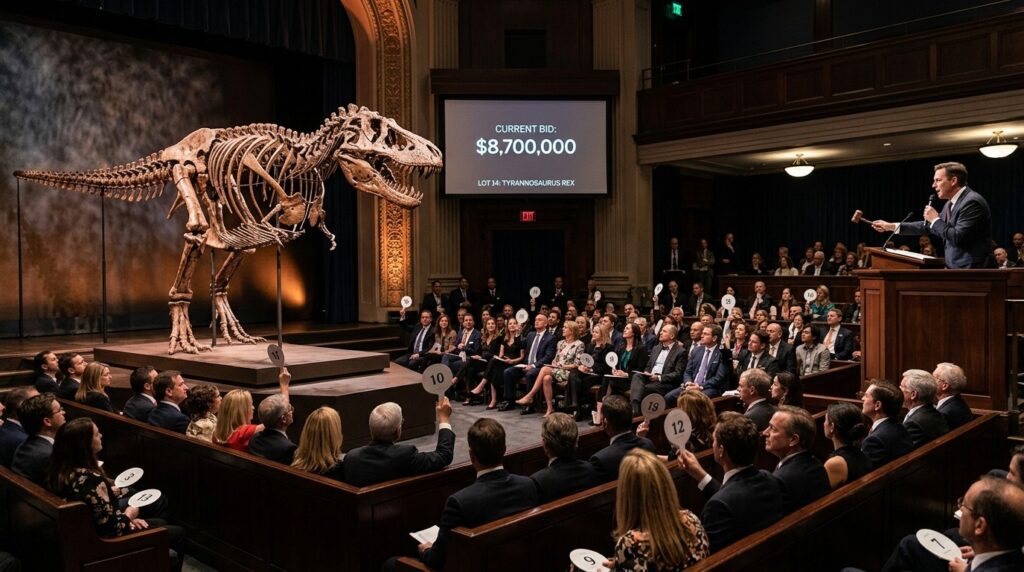
Sotheby’s auction hall during bidding for a dinosaur skeleton
For comparison, 44 million dollars could buy a painting on the level of Klimt or Monet. Dinosaur skeletons have entered the same price range as masterpieces of world art, and this is no longer a one-time spike but a sustained trend.
Who Buys Dinosaurs and Why
It might seem like only museums buy dinosaur skeletons. But the reality is more complex. Today, buyers include major international foundations, private collectors, and individuals who create their own exhibition spaces.
An ordinary person can indeed buy a dinosaur skeleton at auction. There are no legal prohibitions on this if the fossil was found on private land, as in the case of Gus, and was legally extracted.
However, many paleontologists believe that selling fossils to private individuals deprives science of crucial material. A skeleton bought by a billionaire for their living room may become inaccessible to researchers. Museums, on the other hand, often cannot compete with private buyers in terms of budget — the difference in resources is enormous.
Before the auction, the skeleton of Gus the dinosaur can be seen in person at the Breuer building in New York from July 1 to 14, 2025. Whether it will break the record of Apex the stegosaurus at 44 million will be shown by the auction results. But it is already clear that the fossil dinosaur market is growing very rapidly.