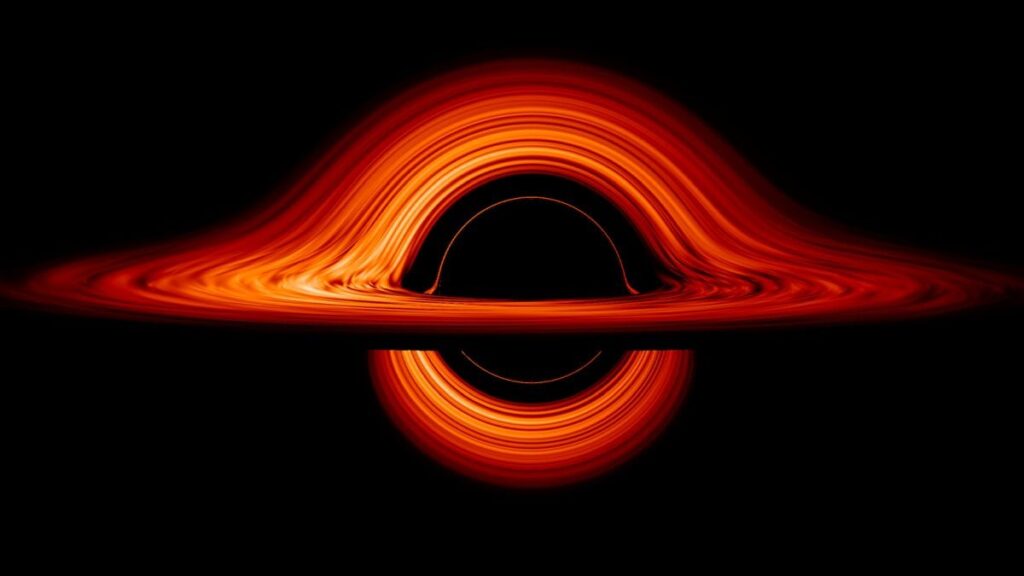
Scientists have discovered the first evidence of a black hole’s event horizon
Everyone knows the main rule of a black hole: nothing can escape from it. And yet a gravitational wave that rolled through the Universe after the collision of two massive black holes appears to have come right up to that boundary. Scientists have for the first time detected a signal that may carry information about the event horizon itself — that very point of no return beyond which not even light can escape. This is an important step toward answering the question of what lies inside a black hole. The result is preliminary, but if confirmed, it will be the closest approach to the edge of a black hole that humanity has ever achieved.
What Is the Event Horizon and Why Can’t We See It
It’s important to clarify the concepts right away. The event horizon is not the black hole itself, but rather the boundary separating the visible Universe from the region from which there is no return. Beyond this line, gravity is so strong that even light in a vacuum cannot reach the speed needed to escape.
This is precisely why the event horizon cannot be observed directly. It does not emit, reflect, or scatter light, and everything that crosses it can no longer send us a single photon. Until now, everything we knew about horizons was obtained indirectly — by how they affect the space around them. Although astronomers once managed to detect light from behind a black hole precisely due to the curvature of space.
How Gravitational Waves Allow Us to Hear a Black Hole
If light is powerless here, another information channel comes to the rescue. Gravitational waves are ripples in spacetime itself that arise when massive objects like black holes collide and merge. We can detect these ripples with detectors on Earth.
As theoretical physicist Sizheng Ma from the Perimeter Institute in Canada explains, the horizon cannot be seen in light, but gravitational waves offer another path. When two black holes orbit each other and merge, this violent process disturbs spacetime itself in the region near the very horizon of the newborn black hole. Some of these oscillations travel outward as waves and eventually reach our instruments.
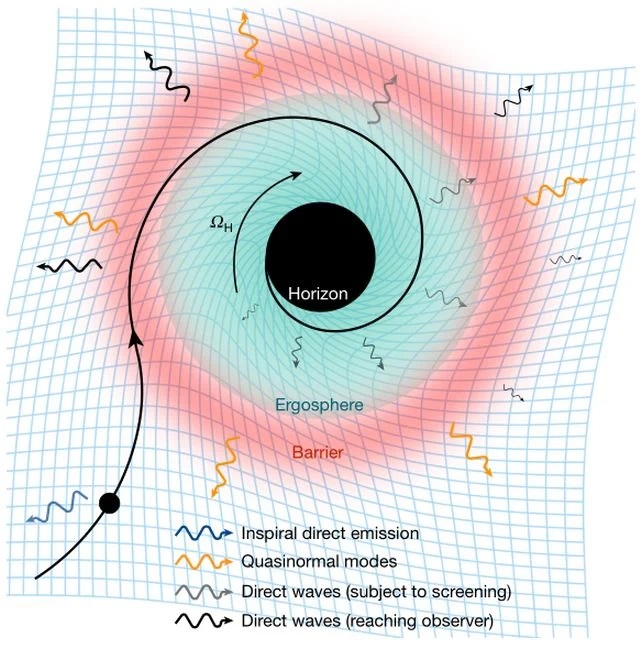
Diagram of gravitational wave emission during the black hole merger phase
The signal itself is complex. First comes the final approach of the two holes before collision, and then the newborn black hole rings like a bell — this stage is called the ringdown phase. The oscillations of this “ringing” depend on the black hole’s mass and spin, and it is from these that scientists typically calculate its properties.
What Is the Direct Wave and Why Is It Closest to the Horizon
There is a subtlety here. The usual ringdown oscillations are primarily associated with the light ring outside the horizon, not with the horizon itself. That’s why theorists proposed a more direct tool — the so-called direct wave, woven into the overall ringdown signal.
The idea is this: when the merger is complete, the motion is no longer governed by two black holes but begins to be defined by a single new object. Its extreme gravity literally drags spacetime along with it as it rotates, dampening and frequency-shifting the outgoing signals, and a single wave emerges, oscillating at nearly twice the rotation frequency of the horizon.
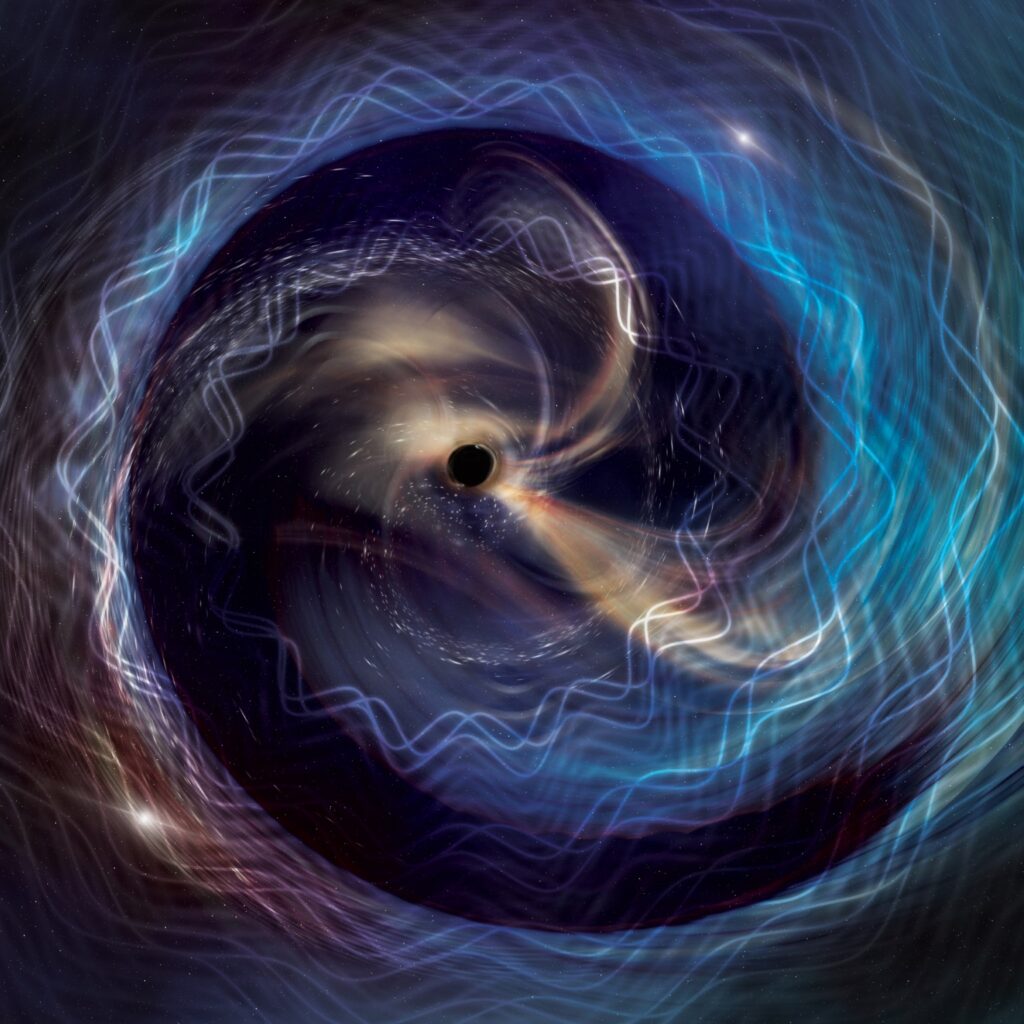
Visualization of the ringdown phase of GW250114 — an extraordinarily powerful gravitational wave event
Ma describes it vividly: everything approaching the horizon of a rotating black hole is dragged into rapid motion around it, but the signal quickly fades due to the powerful gravity. In the end, we see a final, fast, and rapidly dimming vortex right at the horizon.
Why the Record-Breaking Collision GW250114 Was Needed
It’s hard to overstate how weak gravitational signals are. By the time they reach Earth, they stretch and compress space by less than the width of an atomic nucleus. Detecting a subtle direct wave within this trembling is a nearly impossible task.
This is precisely why scientists needed an unusually powerful event. That event turned out to be GW250114 — the cleanest gravitational signal to date. At first, the researchers were cautious: the calculations looked convincing, but in such complex data it’s easy to mistake noise for a real signal.
According to Sizheng Ma, the initial reaction was mixed, but after preliminary checks the data behaved surprisingly well — exactly as theory predicted. The event was loud and clean, and the signal’s evolution matched the expected signature of the direct wave. That’s when the mood shifted from “this might be interesting” to “wow, this seems to be real.”
What the GW250114 Observation Changes for Black Hole Studies
To be honest: the result still requires additional verification with other gravitational signals, and the theory itself will be refined now that scientists have an observational benchmark. This is not final proof, but rather a strong first step.
But if the discovery is confirmed, it provides a fundamentally new way to study black holes. The direct wave can be analyzed to measure the rotation speed of the event horizon and how quickly gravity “devours” information at its edge. For a long time, general relativity described horizons perfectly well, but there was almost nothing to test it with right at the boundary.
Now physicists have a path toward more direct study of the region near the horizon. With new events and more sensitive detectors, this could allow more precise tests of general relativity and a deeper understanding of black hole physics. These objects long had to be studied only through indirect signs, which is why bold hypotheses arose around them — for example, that black holes might reflect echoes of gravitational waves, or that the Tunguska event was caused not by a meteorite but by a tiny black hole.
The main takeaway from this work is not the sensation, but a shift in approach itself. Previously, we could judge black holes only by the traces they leave in surrounding space. Now, by listening to the final moments of a merger, scientists are for the first time searching for an imprint of that very boundary which seemed forever closed to observation. The results are published in the journal Nature, and future collisions will show how reliable this first signal from beyond the edge truly is.