
Gorham’s disease literally strips people of their bones, and there is no cure for this condition
Gorham’s disease is an extremely rare condition in which a person’s bones begin to deteriorate for no apparent reason. It usually starts with a fracture or injury, but the bone doesn’t heal — instead, it gradually shrinks in size and literally disappears. Scientists still don’t know why this happens. There is no cure, so doctors can only slow the process but not stop it.
The First Patient with Gorham’s Disease
This frightening condition was first documented back in the 19th century. Medical reports described a young man who broke his arm three times in the same spot. Doctors tried standard fracture treatment methods, but the result was shocking: over time, the patient’s entire humerus simply disappeared, leaving behind only soft tissue.
A century later, in the 1950s, physicians Lemuel Gorham and Arthur Stout officially described this syndrome after studying a series of similar cases. It turned out that the disease can affect any part of the skeleton, including the skull, pelvis, and ribs. Patients often learn about the diagnosis accidentally after visiting a hospital due to dull pain or a fracture that occurred without any obvious cause.
How a Person’s Bones Can Disappear
Healthy bone is not a dead stone but a living tissue that constantly renews itself. Osteoclast cells are responsible for breaking down old bone, while osteoblasts are responsible for building new bone. In Gorham’s disease, this perfect renewal balance is disrupted due to an unknown malfunction in the body.
Instead of regenerating, the voids in the deteriorating bone are filled with abnormally overgrown lymphatic and blood vessels. In essence, vascular tissue aggressively consumes the bone, turning the solid framework into a soft sponge. In medical literature, this process is called massive osteolysis.
Most surprisingly, patients’ blood tests usually show no abnormalities. Calcium and phosphorus levels remain normal, and there is no systemic inflammation or cancer cells in the body.
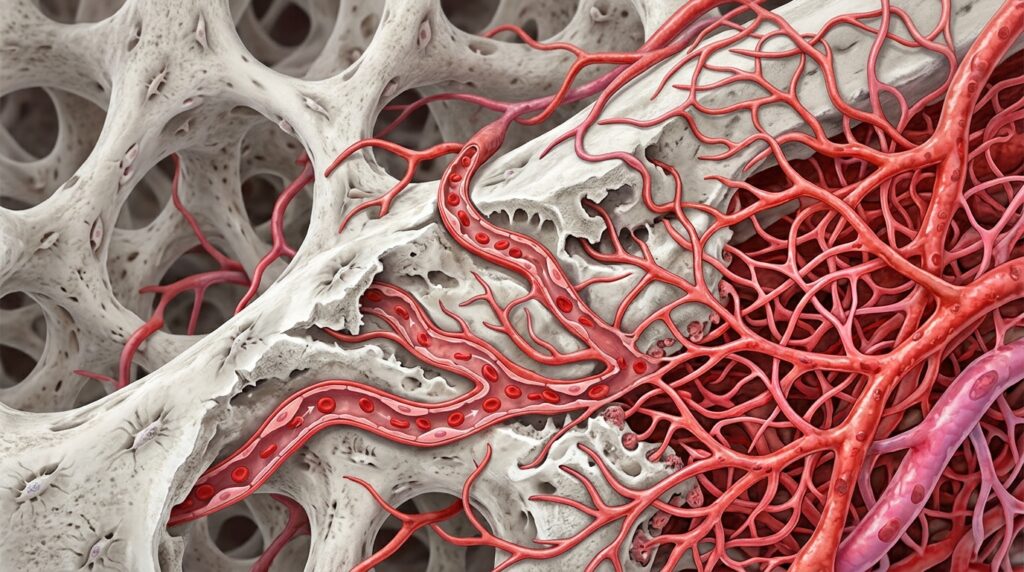
Replacement of bone tissue with blood vessels
Why Losing Ribs and Vertebrae Is Dangerous
Bone loss in an arm or leg leads to disability but doesn’t kill a person. The situation becomes critical when vanishing bone syndrome affects the rib cage or the cervical spine.
If vascular tissue begins to actively destroy the ribs, it leads to the following severe consequences:
- protection of internal organs weakens;
- the spine becomes deformed, which threatens paralysis;
- lymphatic fluid begins to accumulate in the chest cavity.
Fluid accumulation prevents the lungs from expanding, causing the patient to gradually lose the ability to breathe without medical intervention. It is precisely this complication that makes Gorham-Stout disease potentially fatal.
How Gorham’s Disease Is Treated
To date, only a few hundred cases of this disease have been recorded worldwide. Due to its exceptional rarity, there is no standard treatment protocol for Gorham’s disease in global medical practice. Medicine is currently unable to reverse the process or restore lost bone, but doctors have learned to slow its destruction.
Fighting Gorham’s disease consists of the following stages:
- Medications are prescribed that suppress the activity of cells that destroy bone;
- Radiation therapy is used to destroy abnormal blood vessels at the site of the lesion;
- In extreme cases, surgical procedures are performed to remove the damaged bone and install prostheses.
Recently, scientists have also begun testing immunosuppressants to block the growth of new lymphatic vessels through medication. This doesn’t restore patients’ bones but offers a real chance of stopping the disease from spreading to vital organs.
Gorham-Stout disease remains one of the greatest unresolved medical mysteries to this day. It vividly demonstrates how complex the self-regulation mechanisms of our body are. Solving the causes of this syndrome may open new paths to treating osteoporosis and other widespread diseases of the skeletal system.