Placebo works: scientists have uncovered a brain mystery that explains miracle healing
If someone gives you a sugar pill and tells you it’s a painkiller, the pain may actually subside. This fact has puzzled doctors for decades: the placebo effect is real, but exactly how the expectation of relief turns into actual pain reduction remained a mystery. Now a team of neuroscientists claims to have found a key part of the answer — and has described the neural circuit behind this effect.
How Scientists Induced the Placebo Effect in Mice
Usually biomedical discoveries move in one direction: first experiments on animals, then clinical trials on humans. Matthew Banghart’s group at the University of California, San Diego went the opposite way. The researchers used a “reverse translation” method — they took a placebo protocol that had already worked in experiments with humans and adapted it for mice.
It looked like this: mice were placed in chambers with distinctive visual and olfactory cues — stripes or dots on the walls, the scent of banana or lemon. In one specific chamber, the rodents received morphine before contact with a hot surface. Over several days, the mice developed a strong association: this room means “there will be no pain.”
Then the morphine was replaced with saline — a dummy that contains no medication. But when the mice found themselves in the “familiar” chamber, they still behaved as if the pain had become weaker. The placebo effect in mice was reproduced under controlled laboratory conditions.
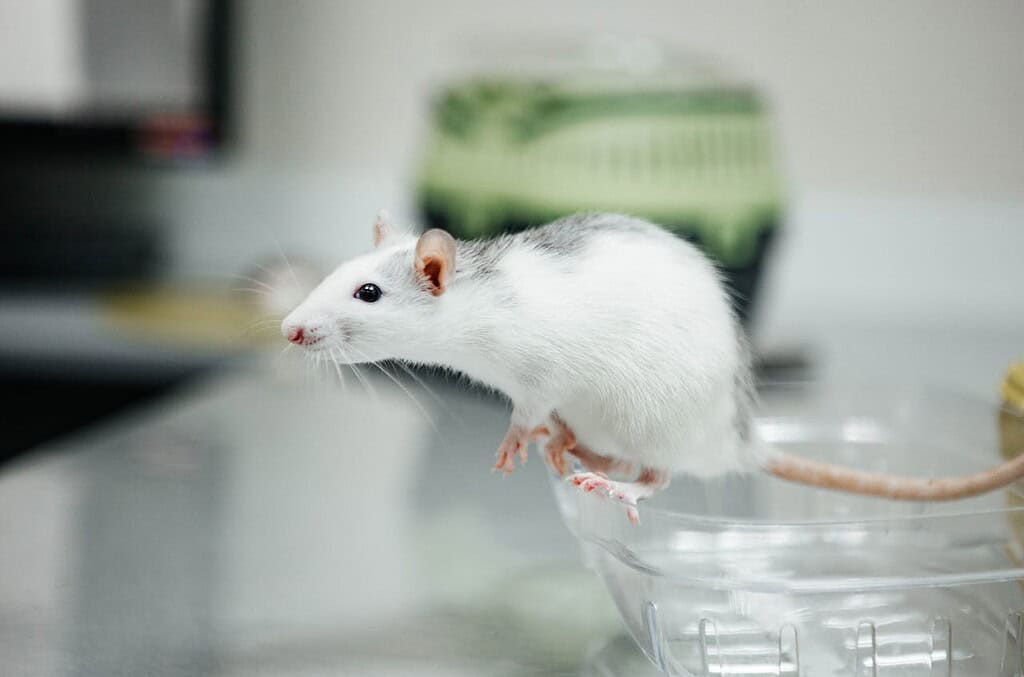
Doctors know that expectations can influence pain perception.
How the Brain Triggers Pain Relief During Placebo
Having confirmed that the placebo works, the scientists turned to the main question: what happens in the brain at that moment? To answer this, they focused on the cortex — the outer layer of the brain responsible for prediction, evaluation, and decision-making. After all, the mechanism works in reverse too: the expectation of pain is sometimes more agonizing than the pain itself.
It turned out that two cortical regions — the medial prefrontal cortex and the anterior cingulate cortex — send active signals downward into an ancient structure deep in the brainstem — the ventrolateral periaqueductal gray (vlPAG). Put simply: the “thinking” part of the brain sends a “relieve the pain” command to one of the most primitive pain centers. The vlPAG has long been known as an area with a high concentration of opioid receptors and a key node in pain modulation.
Using specially developed fluorescent sensors, scientists observed the vlPAG in real time. The moment mice found themselves in the “placebo room” and encountered a pain stimulus, the sensors recorded a rapid increase in opioid signaling — the brain was flooding this area with its own endorphins.
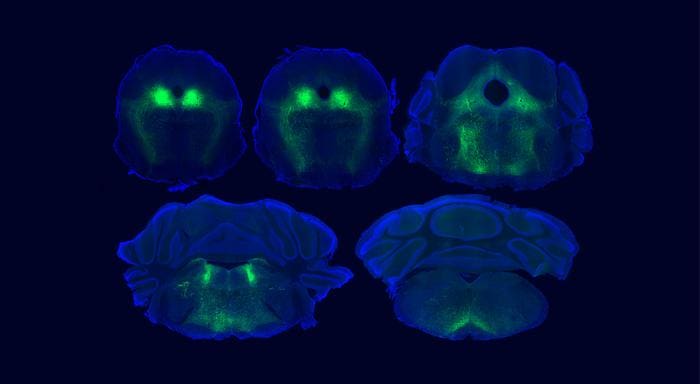
Fluorescent images of the key brain structure involved in placebo pain relief in mice. Green color — neurons regulating pain sensations.
How Scientists Switched Off Placebo in Mouse Brains
But correlation is not causation. To prove that it is specifically endogenous opioids in the vlPAG that provide pain relief, the researchers employed an elegant tool. They used a light-activated drug called PhNX — a “locked” version of naloxone, a medication that blocks opioid receptors and is used in overdose situations.
Through ultra-thin optical fibers implanted in the mice’s brains, the scientists directed a flash of ultraviolet light directly into the vlPAG. The light instantly “unpacked” the naloxone, which blocked opioid receptors at exactly the right spot. The result was immediate: the placebo effect completely disappeared, and the mice felt pain again.
This is elegant proof: the brain doesn’t simply “distract” itself from pain — it launches a specific biochemical mechanism that produces its own painkillers in a precisely defined location. Scientists had previously studied how placebo regulates pain, but this was the first time anyone was able to pinpoint the exact brain region and prove a cause-and-effect relationship.
Why Placebo Helps with Different Types of Pain
One of the most intriguing results: mice were trained on thermal pain (hot surface), but when their response to mechanical pain (a prick) was tested, the placebo effect still worked — the pain relief extended to different types of pain sensations, including pain from tissue damage.
This is an important point for medicine. Real pain — after surgery, injury, or during inflammation — doesn’t work through a single mechanism. If the expectation of relief triggers a broad analgesic response rather than a narrow reaction to one specific stimulus, the potential for clinical application turns out to be much wider, especially for chronic pain.
According to Banghart, this discovery has direct implications for how placebo training in humans could build pain resilience — both before a planned surgery and in the event of an unexpected injury.
How the Placebo Discovery Will Change Pain Treatment
It’s important to understand the limits of this discovery. The study was conducted on mice, and direct translation of the results to humans has not yet been proven. However, humans and mice share similar pain modulation systems: the cortex responsible for expectation and the brainstem pathways using endogenous opioids — all of this exists in us as well.
The authors emphasize that the results offer hope for using “expectations” as a replacement for addictive opioid painkillers. Imagine: before surgery, a patient undergoes a special conditioning course that “tunes” their brain to produce its own painkillers. It sounds like something out of science fiction, but developing such protocols for people with chronic pain has been stated as the main goal of future research.
The study was published in the journal Neuron — one of the leading neuroscience publications. Its main conclusion is both simple and important: the brain can relieve its own pain, and now we know exactly which “wire” is responsible for it. The question is whether it will be possible to teach the human brain to activate this system on demand — and if so, it could fundamentally change the approach to treating pain without drugs.