The biblical Euphrates River is drying up: prophecies of Armageddon are becoming reality.
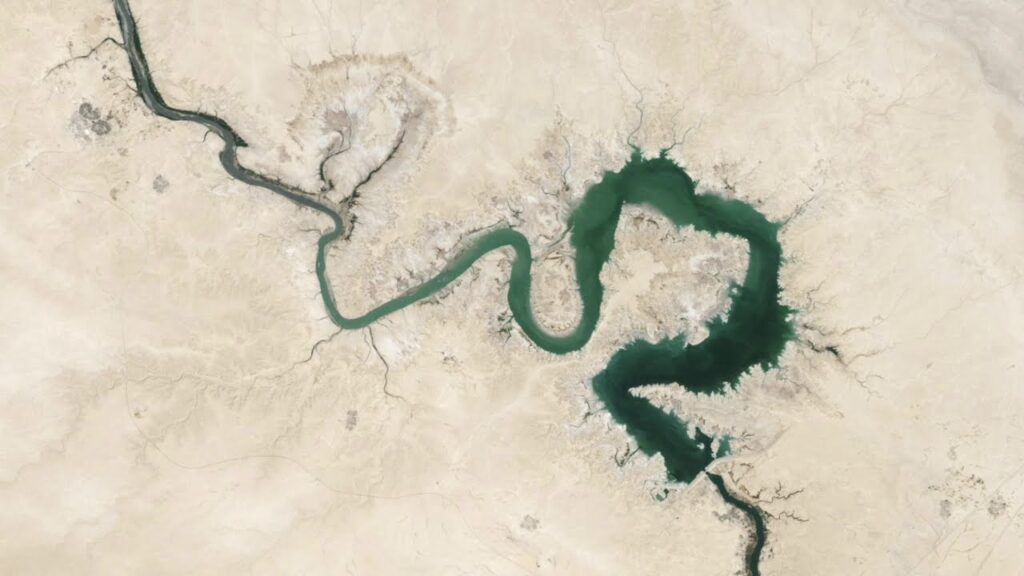
The Euphrates River, mentioned in the Bible as one of the harbingers of Armageddon, is indeed drying up. And NASA satellite images confirm it. But this isn’t about “bowls of God’s wrath” — it’s about entirely earthly matters: the climate is changing, dams are being built upstream, and groundwater is being pumped without any control. Events that are seen as signs of the end times usually have entirely measurable causes.
The Euphrates: Cradle of Civilization on the Brink of Disappearance
The Euphrates is one of the oldest and most significant rivers in Western Asia. The river originates in Turkey, flows through Syria and Iraq, and empties into the Persian Gulf, merging with the Tigris. It was between these two rivers that ancient Mesopotamia was born — a territory often called the “cradle of civilization.” The first agricultural societies, the first cities, and the first writing systems emerged here.
Historically, 85% of Syrian agriculture’s water needs were met by the Euphrates. For millennia, people used the river for drinking, field irrigation, and livestock farming. It’s no surprise that the Euphrates is mentioned numerous times in the Bible: as one of the rivers of the Garden of Eden and as a key element of the Book of Revelation.
What NASA Satellites Revealed About Water Loss in the Euphrates
Researchers observed the Tigris and Euphrates river basins — including territories of Turkey, Syria, Iraq, and Iran — and discovered that from 2003 to 2009, the region lost 144 cubic kilometers of freshwater. That’s roughly equal to the volume of the Dead Sea — an entire sea simply disappeared in six years.
The data was obtained through the GRACE satellite mission (Gravity Recovery and Climate Experiment) — a pair of spacecraft that measure changes in Earth’s gravity and help track freshwater reserves. When water increases or decreases in a region, the mass changes, and consequently, the gravitational pull changes. From these fluctuations, scientists reconstruct the picture of the planet’s water reserves.
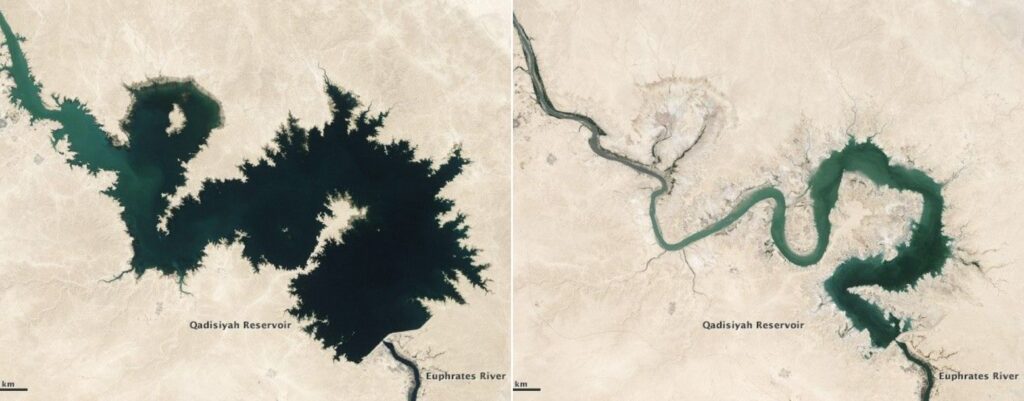
Two images were taken by the Landsat 5 satellite between September 7, 2006 and September 15, 2009, showing how the volume of the Qadisiyah Reservoir on the Euphrates River decreased.
Hydrologist Jay Famiglietti from the University of California, Irvine, noted that “the Tigris and Euphrates basins show an alarming rate of decline in total water storage” and rank second in the world in the rate of groundwater loss — after India. About 60% of all losses were attributed by researchers to the pumping of groundwater from underground reservoirs.
Imagine groundwater as a savings account: you can withdraw money when you need it, but if you never replenish it — sooner or later there will be nothing left. That’s exactly the comparison used by one of the study’s co-authors, Matt Rodell from NASA’s Goddard Center.
Climate, Dams, and War: Three Causes of the Euphrates Catastrophe
Water pumping is not the only reason the Euphrates is drying up. Climate change is hitting the region harder and harder. Temperatures in northeastern Syria have risen by 1°C compared to a century ago, and average precipitation has decreased by 18 millimeters per month over the same period. Higher temperatures increase evaporation, and droughts are becoming longer, which is why rivers and lakes are disappearing all over the world.
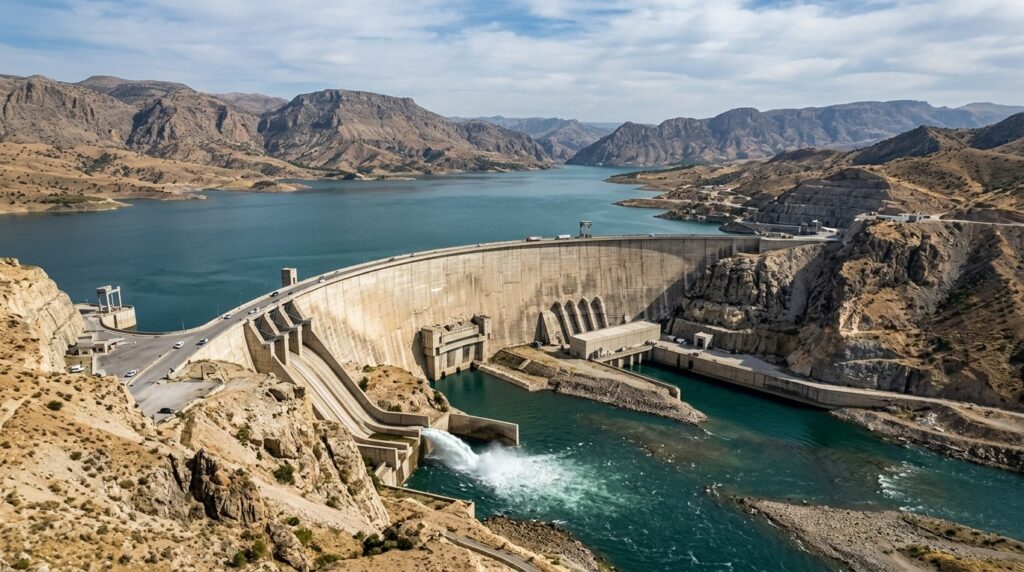
A major dam on a river in southeastern Turkey — part of the ambitious GAP project
Turkey’s GAP project is another powerful factor. The Southeastern Anatolia Project (GAP) envisions the construction of 22 dams and 19 hydroelectric power plants on the Tigris and Euphrates. Although the project promises economic benefits for Turkey, its impact on downstream countries is enormous and highly controversial. The Atatürk Dam alone and its associated irrigation projects have already reduced the Euphrates flow by roughly a third.
And the Syrian civil war destroyed water supply infrastructure and made normal water resource management in the region impossible.
Could the Euphrates Completely Dry Up by 2040?
Iraq’s Ministry of Water Resources has warned that the river could completely dry up by 2040. The consequences are already being felt. In Iraq’s Fallujah district, some farmers have experienced a 90% loss of their wheat harvest due to water shortages. In Syria, wheat yields have dropped by 75% since 2011, leaving rural populations in a state of acute food shortage.
Beyond agriculture, people’s health is also suffering. Freshwater shortages are quickly turning into a sanitary crisis: the cholera outbreak in Syria in late 2022 was directly linked to poor access to clean water and the use of contaminated river sources.
What Do the Bible, Armageddon, and the Drying of the Euphrates Have in Common?
In the 16th chapter of the Book of Revelation by John the Theologian, the Euphrates plays an important role in the last days of Earth’s existence. Angels begin pouring out seven bowls of God’s wrath upon the Earth — this is one of the final events preceding the ultimate battle between Good and Evil. According to the text, the sixth angel pours his bowl of God’s wrath upon the great river Euphrates, and it dries up, clearing the way for the kings from the East.
If we look at this rationally and through the lens of centuries, what do we see? Why was the drying of this particular river so frightening to the author of Revelation? In the 1st century BCE, the Euphrates became the border between the Roman and Parthian empires in the Middle East, and it remained so until the 3rd century CE. During the Roman period, the river served as an actual defensive frontier, especially after the defeat of Crassus at the Battle of Carrhae in 53 BCE. The drying up of the river would have meant the disappearance of this barrier — and an invasion from the East. So essentially, the fear of the Euphrates drying up was primarily a fear of a real military invasion, wrapped in religious imagery.
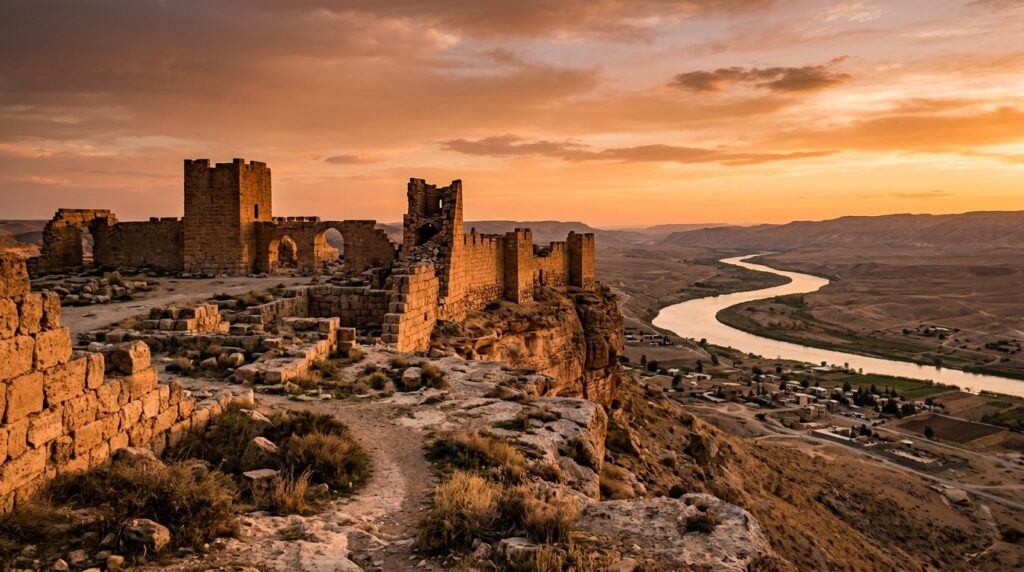
Ruins of ancient Roman fortifications on the banks of the Euphrates — the river once served as the border of the empire
And one more important detail: in the same passage of Revelation, it describes how seas turn to blood, all sea creatures perish, people are scorched by the sun, and hail weighing as much as a child falls upon the earth. Nothing like that has been observed so far. Wait a moment — isn’t something like that happening? After all, words and events can be interpreted in different ways: one can cite scientific arguments to refute it, or one can draw parallels. Even Isaac Newton tried to calculate the end of the world based on biblical texts.
The drying of the Euphrates can be considered a mystical omen or the consequence of entirely understandable and measurable processes. In any case, about 60 million people depend on the Euphrates alone, making the river critically important for the stability of the entire region. And Iraq’s water needs amount to 53 billion cubic meters per year — and the deficit could grow to 80%.
And this is a model of what awaits dozens of other rivers around the world. As hydrologist Famiglietti noted, the Middle East doesn’t have large water reserves to begin with, and climate change is only making the situation worse.