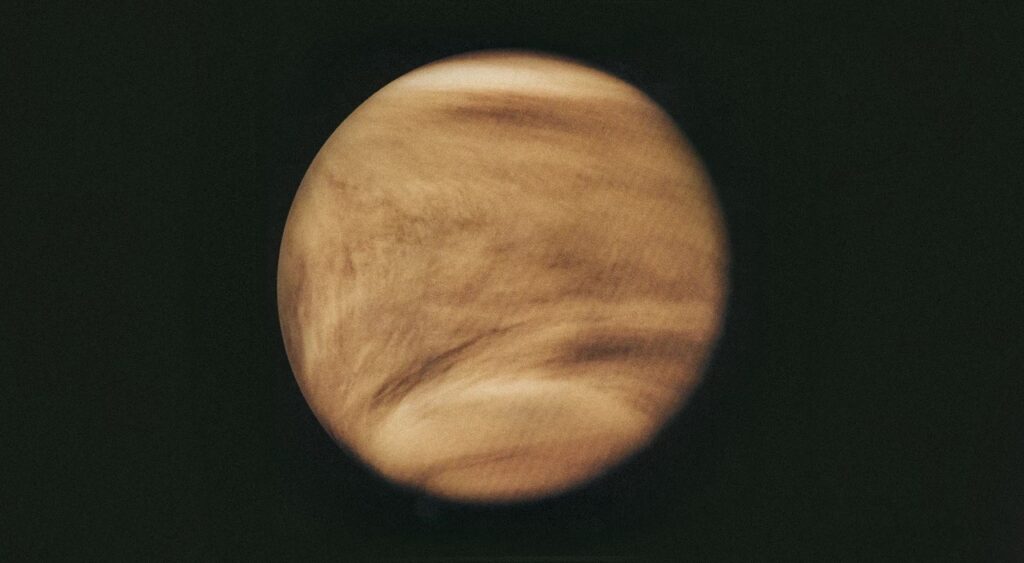
This image, taken in ultraviolet light, shows cloud structures covering Venus. Image source: cen.acs.org
According to scientists, if there is life on Venus, it could have come from Earth. A new study shows that over the past billion years, asteroid impacts could have ejected enough material from our planet’s surface to deliver billions of potentially viable cells into Venus’s atmosphere. This is not proof of life on Venus, but for the first time scientists have calculated how likely such a transfer could be. And in the near future, they plan to find out for certain.
What Is Panspermia and How Does It Transfer Life
The idea that life can travel between planets is called panspermia. Its essence is simple: when a large asteroid strikes a planet, it ejects chunks of rock into space. If microorganisms happen to be inside these fragments, they could theoretically survive the journey and reach another planet. Panspermia does not explain how life first originated — it only describes the mechanism of its dispersal.
For a long time, scientists discussed panspermia mainly in the context of Earth and Mars. Hundreds of meteorites of Martian origin have been found on our planet, and experiments have shown that some bacteria are indeed capable of surviving an interplanetary flight inside rock. But until recently, Venus was almost absent from these discussions — a planet with lead-melting surface temperatures was not considered a candidate for habitability.
Why the Possibility of Life on Venus Is Being Discussed Again
The situation changed in 2020 when a group of astronomers from Cardiff University announced the detection of phosphine (PH₃) in the clouds of Venus. On Earth, this gas is mainly produced by living organisms — anaerobic bacteria. Its appearance on Venus, where the oxidizing atmosphere quickly destroys such molecules, looked like an intriguing mystery.
However, the discovery immediately sparked heated debates. Some subsequent observations did not confirm the presence of phosphine, and calibration errors were found in the original data. Nevertheless, later observations with the ALMA telescope again detected traces of the molecule, and the debates continue. In any case, the discussion itself seriously brought Venus back into the field of view of astrobiologists and raised the question: if life in Venus’s clouds is possible, where could it have come from?
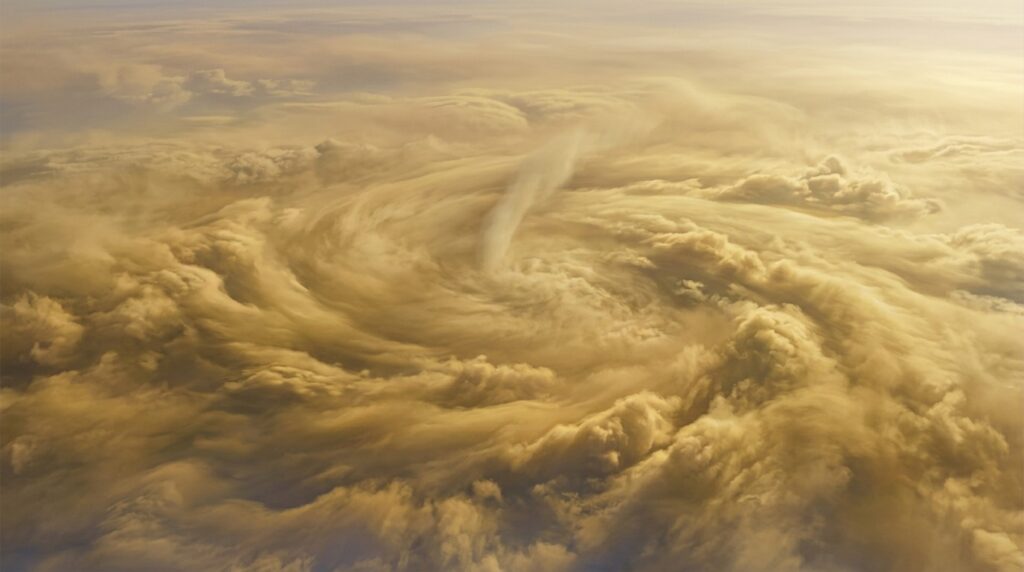
Venus’s dense clouds are the only place on the planet where conditions could theoretically allow life to exist
The key point: although Venus’s surface is a true hell with temperatures around 460 °C and pressure of 90 Earth atmospheres, at an altitude of 48–60 km the situation is entirely different. There, temperatures drop to 0–60 °C, and pressure is comparable to Earth’s. It is precisely this cloud layer that scientists consider as a potential refuge for life in Venus’s clouds.
How the Probability of Life on Venus Is Being Assessed Today
The new study was presented at the 57th Lunar and Planetary Science Conference (LPSC), which took place in March 2026 in Texas. A team from the Johns Hopkins University Applied Physics Laboratory (JHUAPL) and Sandia National Laboratories used a mathematical tool called the “Venus Life Equation” (VLE).
VLE was proposed by Noam Izenberg and colleagues in 2021 and works on the same principle as the famous Drake Equation for estimating the number of extraterrestrial civilizations. Only instead of civilizations, it estimates the probability of life existing on Venus right now.
The formula looks like this: L = O × R × C, where L is the probability of life, O is the chance that life once arose or was introduced, R is biosphere resilience, and C is the continuity of habitable conditions up to the present day.
Each parameter is rated from 0 (impossible) to 1 (certain). By multiplying the factors, scientists obtain a final estimate. The authors of the original VLE honestly acknowledge: this is not a precise calculation but rather a framework for systematically thinking about the problem — much like the Drake Equation helps structure the question of extraterrestrial civilizations but does not give a definitive answer.
How Rocks From Earth Could Reach Venus’s Clouds
The researchers focused on a specific scenario: what happens to fragments of Earth rock that enter Venus’s atmosphere. For their calculations, they used the so-called “pancake model” — a semi-analytical method describing how a bolide (a large fiery meteorite) breaks apart as it passes through the atmosphere.
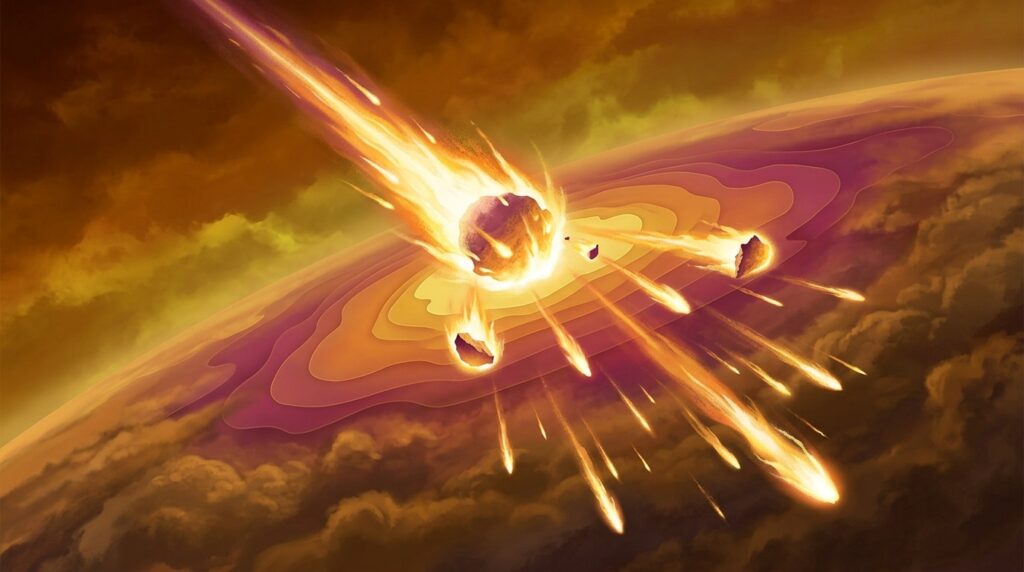
A bolide breaks apart in Venus’s atmosphere, and its fragments scatter across the cloud layer
It happens roughly like this: the bolide enters Venus’s dense atmosphere, heats up, and then explodes — this is called an airburst. Aerodynamic drag spreads the debris horizontally, forming a “pancake” of dispersed material. Individual fragments are small enough to float in the clouds. If living cells were inside them — they get a chance to end up in exactly that atmospheric layer where conditions are tolerable for life.
It is important to understand: to travel from Earth to Venus, organic material needs to survive the impact ejection, the transit through space (with its vacuum, radiation, and extreme temperatures), and atmospheric entry. Computer simulations and analysis of meteorites found on Earth show that organic matter can withstand all these stages — but this does not mean that living cells specifically survive. We are talking about probabilities, not guarantees.
How Many Earth Cells Could Have Reached Venus
The modeling results are impressive in scale but require cautious interpretation. According to the team’s calculations, over the past billion years, up to 20 billion cells could have been delivered from Earth to Venus, with the best estimate being about 100 cells per year dispersed in Venus’s clouds. The model also showed that hundreds of billions of cells could potentially have remained viable after the journey.
According to these calculations, life in Venus’s clouds could have existed for at least a few days per century — thanks to material ejected from Earth. This, of course, does not mean that Venus’s clouds are teeming with Earth bacteria. The model only shows that the delivery mechanism is physically possible and that the amount of potentially transferred material is non-zero.
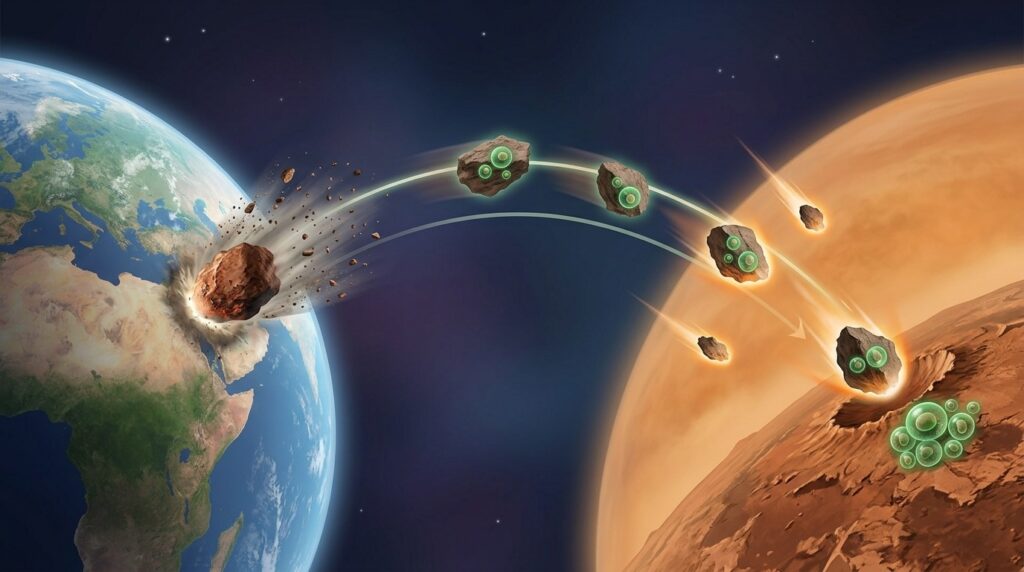
Diagram of material transfer from Earth to Venus as a result of asteroid impacts
The authors emphasize that each parameter of the model contains enormous uncertainty. The “pancake model” does not describe all the details of bolide interaction with the atmosphere, and the VLE equation itself is a tool for structuring the question rather than a final verdict. Nevertheless, the scientists’ conclusion is unambiguous: panspermia between Earth and Venus is physically possible.
What Panspermia Changes for Future Missions to Venus
The practical significance of this research could manifest within the next few years. If any of the upcoming missions to Venus — for example, the American DAVINCI mission, which is expected to pass through the planet’s atmosphere — discovers signs of life in the clouds, a key question will arise: did this life originate on Venus independently, or was it delivered from Earth?
The new study provides grounds to seriously consider the second option. And this is not merely an academic exercise. If hypothetical life on Venus turns out to be related to Earth life, it would be evidence of interplanetary transfer — one of the first real confirmations of panspermia in the Solar System. And if it turns out to be fundamentally different — that would be an even more sensational discovery, indicating an independent origin of life.