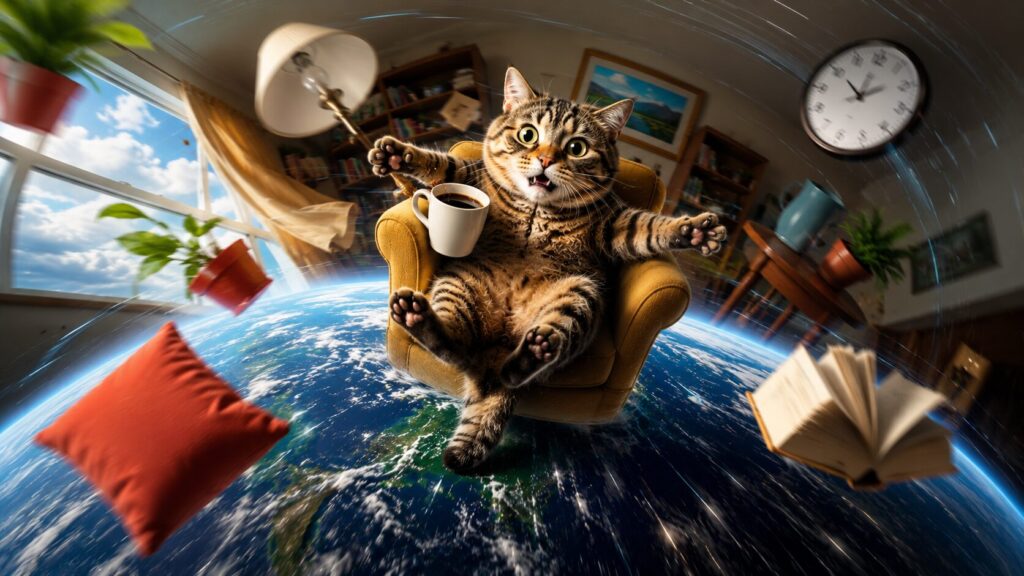
Why is Earth hurtling at enormous speed, yet we aren’t blown away or even shaken?
Right now, we are flying through space at tremendous speed. Doesn’t feel like it, does it? But it’s true: Earth rotates on its axis at a speed of about 1,600 km/h, orbits the Sun even faster, and together with the Solar System races through the Universe at cosmic speed. Yet we calmly sip our coffee, stand at bus stops, and don’t even feel the slightest swaying. If you think about it, this almost defies common sense. After all, on a carousel or in a car, sudden movement is felt instantly. So why is everything different with the planet?
Why Humans Don’t Feel Earth’s Rotation
The answer turns out to be both simple and very elegant from a physics perspective. The thing is, the human body barely perceives constant velocity. We only notice acceleration, deceleration, or sudden changes in movement. That’s why in an airplane, a few minutes after takeoff, it feels like you’re just sitting in a chair — even though you’re flying at nearly 900 km/h. And, by the way, you don’t arrive faster if you fly against Earth’s rotation.
When Earth rotates, absolutely everything moves with it: oceans, buildings, trees, the air, and you yourself. There is no separate “stationary” background against which you could feel the movement. It’s like riding in a very smooth train with no windows: if the car doesn’t shake, the brain quickly stops noticing the movement.
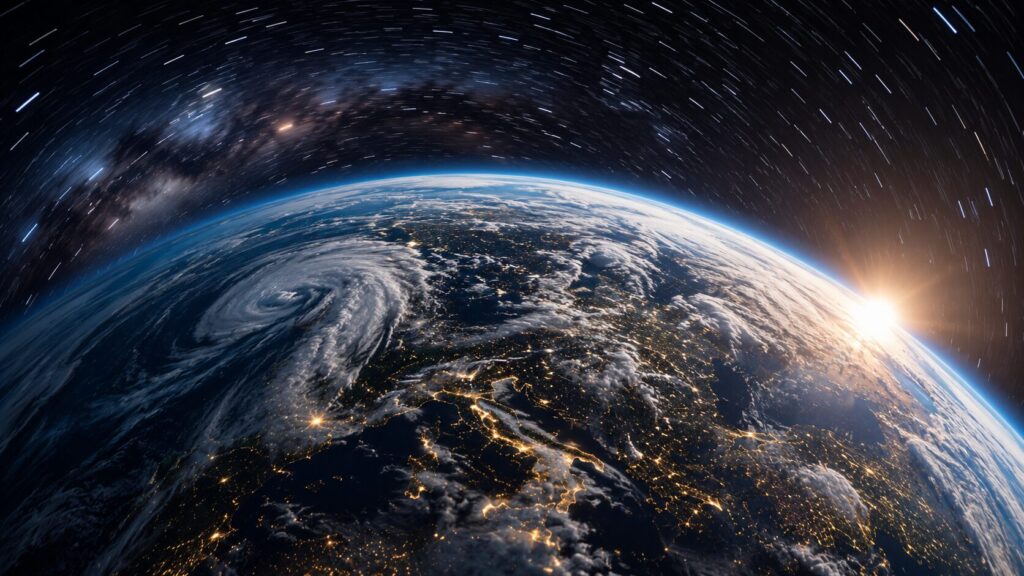
Earth completes one rotation on its axis every 24 hours and orbits the Sun at about 110,000 km/h, yet we don’t feel it.
That said, the effects of rotation do exist. For example, Earth is slightly wider at the equator precisely because of its rotation. And a person weighs slightly less there than closer to the poles. However, the difference is so small that an ordinary person would never feel it. And if it started spinning faster, it would affect not only weight but also the length of days, weather, and water levels at the equator.
Physicists explain it this way: gravity is far stronger than the effect of the planet’s rotation. Gravity literally “presses” us to the surface, and the planet’s rotation is essentially lost against that backdrop.
Why We Aren’t Blown Away by Earth’s Rotation

Have you ever noticed that your hair doesn’t blow around because of Earth’s rotation?
There’s another question that usually comes up right after the first one: if Earth rotates so fast, why isn’t there a constant wind blowing at hundreds of kilometers per hour?
The reason is the atmosphere. The air rotates together with the planet, so we move in sync with it. The same principle applies as in a car. As long as the windows are closed, the air inside seems motionless. But stick your hand outside — and the speed immediately becomes noticeable.
The most interesting thing is that Earth moves remarkably smoothly. If the planet suddenly stopped or slowed down even for a fraction of a second, humanity would feel it instantly. Scientists believe the consequences would be catastrophic: giant waves, destruction, and hurricanes would engulf the planet almost immediately.
And this is what’s truly frightening: we are so accustomed to Earth’s movement that we notice it in only one case — if something goes terribly wrong.