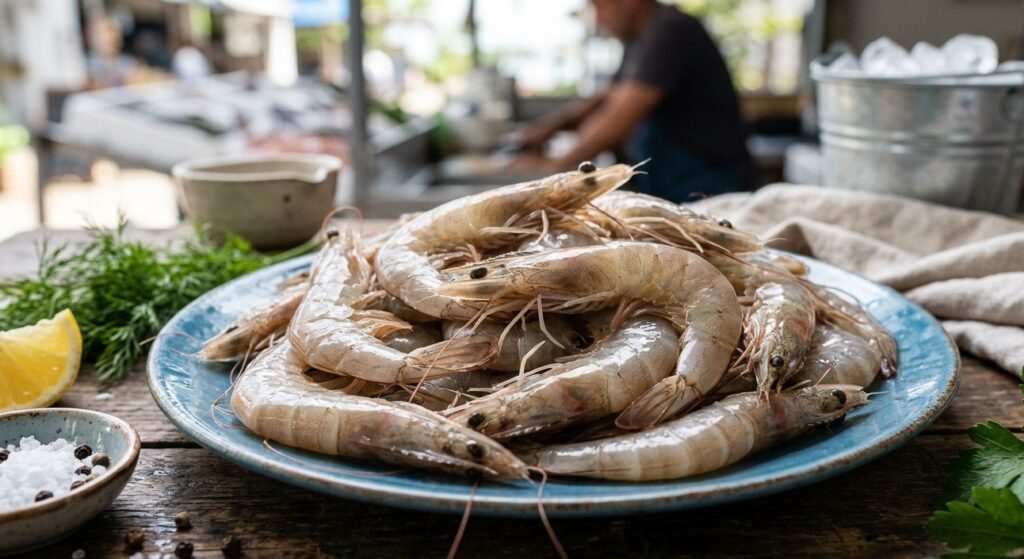
White-leg shrimp became the first known hosts of the mutated virus
A virus that previously affected only shrimp and fish has been detected in humans for the first time, causing severe chronic eye inflammation that can lead to blindness. Chinese scientists have determined that the cause behind the mysterious rise in eye diseases in the country is the covert mortality nodavirus (CMNV), well known in the aquaculture world. It seems it’s now worth thinking twice before buying shrimp.
What Is the Covert Mortality Nodavirus
The covert mortality nodavirus was first described in 2014. Until recently, it was considered exclusively an aquaculture problem because this virus was killing white-leg shrimp en masse. The name is no coincidence — infected shrimp die slowly, gradually sinking to the bottom, and farmers only notice the losses when the damage is already enormous.
Over the past ten years, this virus has caused serious economic damage to shrimp farms in China and Southeast Asia. Its range of hosts has constantly expanded: first shrimp, then crabs, fish, mollusks, and sea cucumbers. But no one suspected it could infect humans. And then ophthalmologists in China began noticing a strange trend.
People in China Are Going Blind After Eating Shrimp
According to Medical Xpress, starting around 2019, Chinese doctors recorded a growing number of patients with an unusual eye condition — persistent hypertensive viral anterior uveitis. This is an inflammation of the front part of the uveal tract of the eye, accompanied by a sharp increase in intraocular pressure. In its symptoms, it resembles glaucoma but with a pronounced viral and inflammatory component.
Anterior uveitis is usually caused by herpes viruses, varicella, or cytomegalovirus. But in the affected patients, standard tests for all these pathogens repeatedly came back negative. Meanwhile, microscopy of eye tissue from several patients revealed unknown viral particles that were suspiciously similar in size and shape to the covert mortality nodavirus.
The disease proved stubborn: according to the study, about 83% of patients experienced recurring episodes, and in half of them intraocular pressure exceeded 45 mmHg — an extremely high value. Repeated episodes lead to irreversible damage to the optic nerve, iris atrophy, and serious vision impairment.
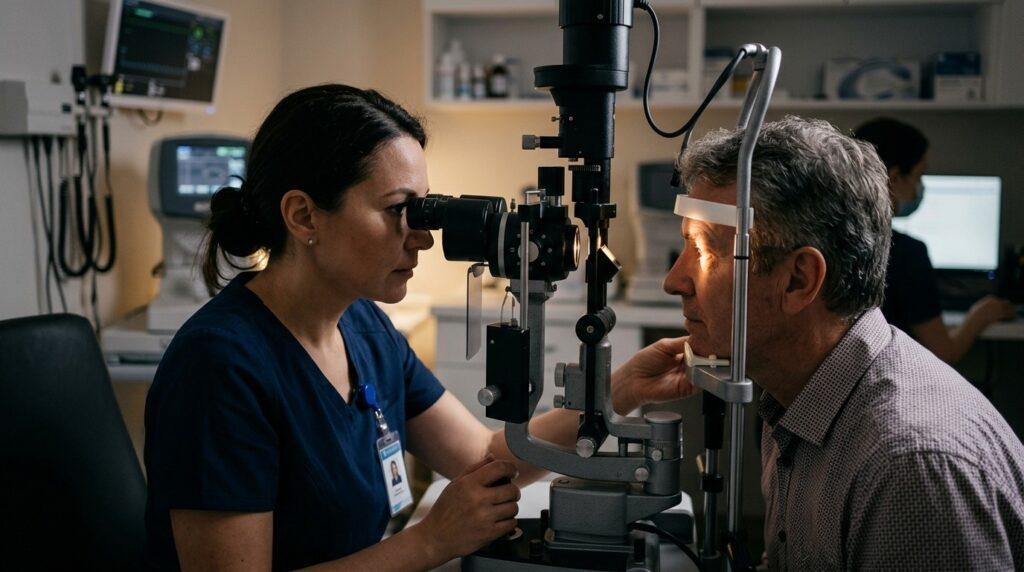
Eye examinations revealed traces of an unknown virus in patients
The Link Between the Shrimp Virus and Eye Disease in Humans
For a thorough investigation, Chinese researchers enrolled 70 patients diagnosed with persistent ocular hypertension between January 2022 and April 2025. A control group of healthy volunteers also participated in the study.
The evidence was built on several independent lines:
- When examining eye tissues removed during surgical treatment, electron microscopes revealed viral particles approximately 25 nanometers in size. Nothing similar was found in healthy individuals from the control group;
- For precise identification, scientists used special gold-labeled antibodies that bind only to CMNV, and obtained a positive result;
- Genetic sequencing confirmed that the virus from patients’ eyes matched the covert mortality nodavirus from marine animals by 98.96%;
- All 70 patients tested positive for antibodies to the covert mortality nodavirus, meaning their immune systems were actively responding to this virus.
To confirm that the virus actually causes the disease, scientists conducted experiments on mice. Infected animals developed the same symptoms as the patients: increased intraocular pressure and pathological changes in the cornea, iris, and retina. The covert mortality nodavirus also demonstrated the ability to infect human corneal cells in laboratory conditions, causing their death.
How the Virus Spreads From Shrimp to Humans
Researchers surveyed patients about their lifestyles, and the picture turned out to be quite telling. About 71% of those affected either regularly handled raw seafood without gloves or consumed raw marine animals. In other words, the main routes of infection are direct contact with raw meat of fish, shrimp, and other marine animals, as well as eating them without heat treatment.
Statistical analysis showed that the more frequent and intense the contact with raw seafood, the higher the risk of developing the eye disease. However, some patients had no apparent contact with raw seafood, leaving open the question of possible other transmission routes, including theoretical human-to-human transmission. At this point, this has not been confirmed.
Handling raw shrimp without gloves is one of the main risk factors identified in the study.
Are Shrimp Dangerous Outside of China
This is the first case where a virus from aquatic animals has been linked to a specific eye disease in humans. But the problem is potentially broader than China.
As part of the study, scientists conducted global monitoring of the disease’s spread. The virus was found in 49 species of marine animals: crabs, mollusks, shrimp, and fish, across Asia, Africa, Europe, the Americas, and even Antarctica. Genetic analysis suggests that the oldest lineage of the virus may be linked to Antarctic krill.
Additionally, the virus was detected in seafood samples from ordinary markets: in fish, crabs, and mollusks, with viral loads ranging from thousands to tens of thousands of copies per gram of tissue. This indicates a very real route of contact through products purchased by ordinary consumers.
An important caveat: so far we are talking about a relatively small number of cases, and the study’s authors explicitly urge against blowing the results into a panic alarm. Additional research is needed for definitive confirmation of the causal relationship. Current data also do not indicate mass spread of the infection or an epidemic scenario.
Nevertheless, the discovery itself changes our understanding of zoonotic infections — diseases transmitted from animals to humans. Until now, it was believed that the main zoonotic risks came from terrestrial animals: bats, birds, and rodents. The story of the covert mortality nodavirus shows that the ocean can also be a source of new infections, and that contact with raw seafood carries not only the usual bacterial risks but also unexplored viral ones.
For practical protection, the conclusion is simple for now: when handling raw seafood, it is worth using gloves, and consuming raw fish and mollusks is a conscious choice that carries certain risks. Further research will show how widespread this problem is and whether a revision of sanitary standards in aquaculture and the food industry will be necessary.