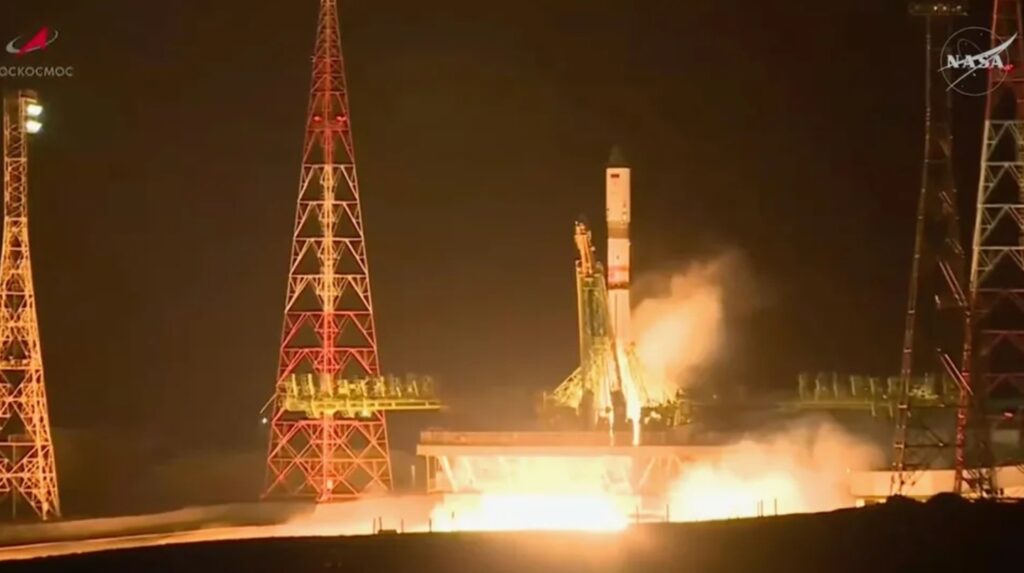
Launch of the Progress 95 spacecraft. Image source: space.com
The Progress 95 cargo spacecraft launched on April 25 from the Baikonur Cosmodrome in Kazakhstan and set course for the International Space Station. On board were nearly three tons of food, fuel, and equipment for the crew of Expedition 74. This is not just a package delivery: without such missions, life and work for people in orbit would be impossible.
Launch of the Progress 95 Spacecraft from Baikonur
According to Space.com, the Soyuz rocket lifted off at 3:21 AM local Baikonur time on April 26. The precision of timing here is not a whim: to dock with an object flying at an altitude of over 400 kilometers at a speed of about 28,000 km/h, even a few seconds of deviation can make rendezvous impossible.
The uncrewed Progress 95 delivered approximately three tons of cargo — food, fuel, and consumable materials for scientific experiments to the station. This is the second Progress mission in 2026: the previous spacecraft, Progress 94, reached the ISS in March, despite a technical issue with one of the docking antennas.
The Baikonur Cosmodrome is one of the oldest and most active launch sites in the world. All spacecraft of the Progress series over the program’s nearly half-century history have been launched from here.
Spacecraft Docking with the ISS
The spacecraft was scheduled to dock with the station on April 27. Over two days, Progress 95 performed a series of orbital maneuvers, gradually catching up with the ISS and aligning its speed and trajectory with the station.
Docking was carried out in automatic mode using the Kurs system — radar navigation that Russian spacecraft have used since the late 1980s. Manual control remains a backup option in case of malfunctions. The spacecraft occupied the aft port of the Zvezda service module, which was freed after the departure of Progress 93, which undocked from the station on April 20 and burned up in the atmosphere over the Pacific Ocean.
Currently aboard the station are seven people, the crew of Expedition 74: Commander Sergei Kud-Sverchkov (Roscosmos), flight engineers Sergei Mikayev and Andrei Fedyaev (Roscosmos), Jessica Meir and Jack Hathaway (NASA), Chris Williams (NASA), and Sophie Adenot (ESA).
How Progress Spacecraft Work
Progress is a single-use spacecraft. This is a fundamental difference from, for example, SpaceX’s Dragon capsule, which returns to Earth and can be reused. Progress has no heat shield, no parachutes, and no life support system — all of that would be unnecessary weight for a cargo vehicle.
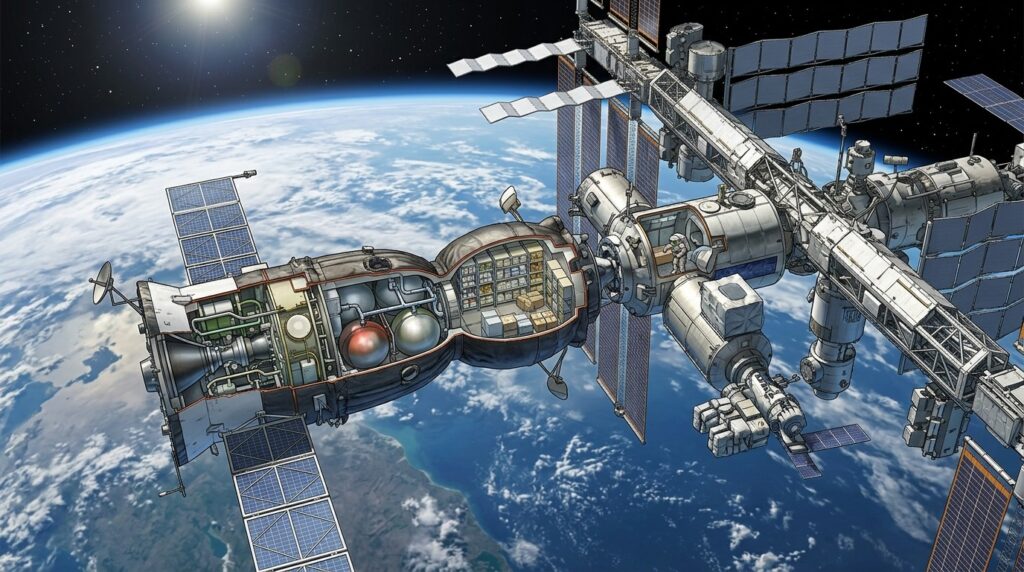
Schematic design of the Progress cargo spacecraft at the ISS
The absence of these systems allows for increased payload capacity — the spacecraft can deliver up to 2,350–3,200 kg of cargo depending on the modification. Progress 95 will remain at the station for about seven months. During that time, the crew will unload it and then fill it with spent materials and waste. After that, the spacecraft will undock and perform a controlled deorbit, burning up in the dense layers of the atmosphere over an uninhabited area of the ocean.
This approach solves two problems at once: the station gets rid of waste, and the orbit is not cluttered with debris. Since 1978, more than 185 launches of Progress series spacecraft have been carried out — first to the Salyut and Mir stations, and then to the ISS. The program’s success rate exceeds 98%.
Cargo Spacecraft for the ISS
The ISS does not depend on a single supplier but on an entire fleet. In addition to Russia’s Progress, cargo is delivered to the station by:
- Dragon (SpaceX) — the only spacecraft that can return cargo to Earth using parachute landing in the ocean. This allows retrieval of experiment results and equipment;
- Cygnus (Northrop Grumman) — an American cargo vehicle, including the new enlarged Cygnus XL version. Like Progress, it is single-use;
- HTV-X (JAXA) — a Japanese cargo spacecraft, the successor to the Kounotori series.
The combination of single-use and reusable spacecraft is not accidental but a strategy. Single-use systems are simpler and more reliable, while reusable ones save money in the long run and provide unique capabilities — such as cargo return. Just a week before the Progress 95 launch, the crew received the Cygnus XL spacecraft from Northrop Grumman, which delivered more than five tons of cargo.
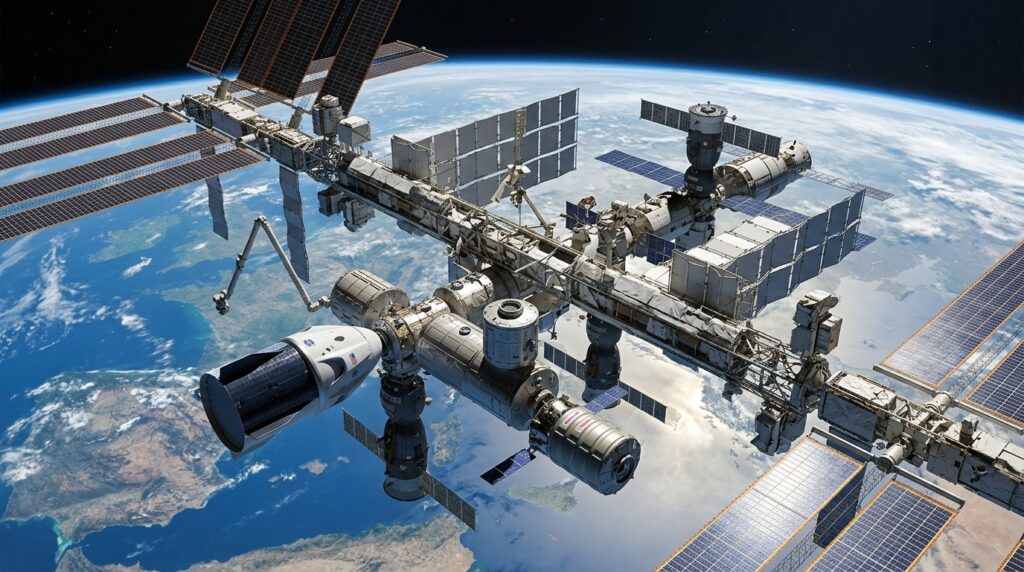
The ISS in orbit with several docked spacecraft
This diversity is also important as insurance. If one country or company experiences a launch delay, the station does not go without supplies because cargo arrives through other channels.
What Is Being Sent to the ISS: Scientific Equipment and Crew Resources
Every cargo mission is not just a “grocery delivery.” The supplies support the work of dozens of experiments that cannot be conducted on Earth. Microgravity allows growing protein crystals with clearer structures than in terrestrial laboratories, which is important for pharmaceuticals. On the station, they study bacterial behavior, the effects of cosmic radiation on the body, and even test ultraviolet surface disinfection for future long-duration missions.
Expedition 74, to which the current cargo is addressed, has been working on the ISS since December 2025. Part of the crew will return to Earth in the summer of 2026, and until then, regular deliveries are literally a matter of their health and safety.
The ISS remains the only permanently inhabited object beyond Earth. People have been living and working on it continuously for over 25 years. Every successful resupply mission is confirmation that international cooperation in space continues to work despite any terrestrial disagreements. And the experience in orbital logistics accumulated over decades of Progress, Dragon, and Cygnus missions will form the foundation for supplying future bases in lunar orbit and, possibly, on the way to Mars.