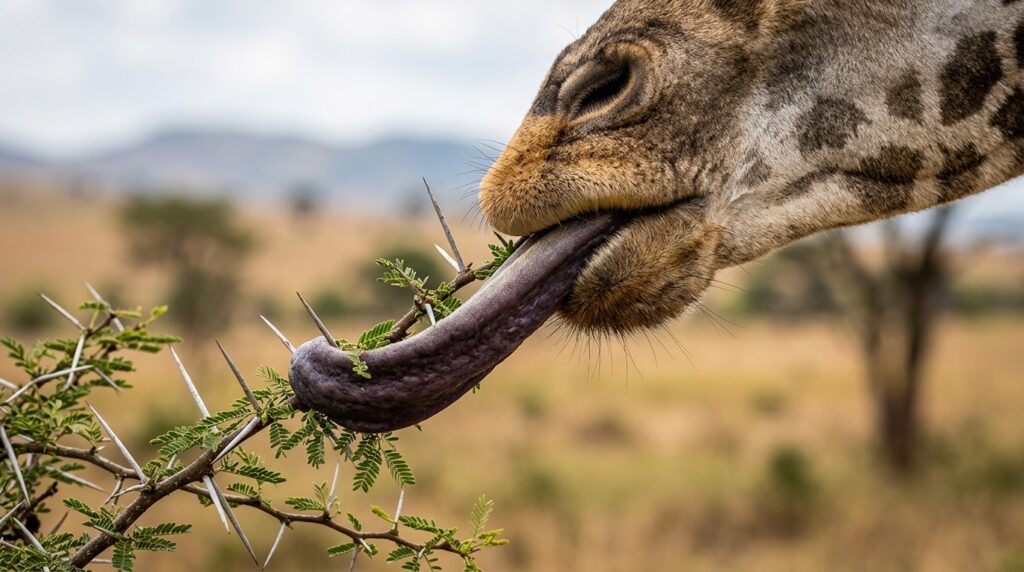
Scientists still cannot agree on why giraffes have a dark tongue
Giraffes have an incredibly long tongue, up to 50 centimeters, and it is dark purple, almost black in color. It is commonly believed that this is protection from sunburn, but reality turned out to be more interesting. Similar tongues are found in animals that live in completely different conditions. So yes, giraffes are fascinating beyond just their long legs and necks.
How Many Giraffe Species Exist
Today, scientists officially recognize four species of giraffes: Masai, northern, reticulated, and southern. They all live in Africa and spend up to 12 hours a day eating, stripping leaves, shoots, and flowers from tall trees. Giraffes’ favorite trees are acacias, mimosas, and wild apricots.
To reach leaves without getting impaled on thorns, giraffes use their main tool — a long and incredibly dexterous tongue measuring 45–50 centimeters. It can wrap around a branch and carefully strip leaves from it, avoiding thorns. The surface of the tongue is covered with thickened papillae that provide additional protection against mechanical damage.
But the most noticeable feature of this tongue is its color. It is dark purple, almost black in places. And this is where things get really interesting.
Why Do Giraffes Have a Black Tongue
The most common explanation for the purple color is a high concentration of the pigment eumelanin in the tongue’s skin. Eumelanin is a type of melanin, the same pigment responsible for the color of our skin, hair, and iris. The more melanin, the darker the tissue. This is according to the authors of the Green Matters website.
The logic is simple. As we know, a giraffe spends most of the day with its tongue out under the scorching African sun. Dark pigmentation protects the delicate mucous membrane from ultraviolet radiation, much like a tan protects our skin. In animals that lack this pigment or have very little of it, albinism or leucism occurs — they appear completely white or covered in white patches. The theory is elegant, logical, and… debatable.
The Giraffe’s Closest Relative
The main problem with the “sun” hypothesis is the okapi. This is the closest living relative of the giraffe, and it also has a dark purple tongue. However, the okapi lives not in the open savanna but in the dense tropical forests of the Democratic Republic of the Congo, under a thick canopy of trees.
If tongue color is exclusively sun protection, why would a forest animal need it? However, some researchers point out that okapi often feed in forest light gaps — places where direct sunlight penetrates through breaks in the canopy. So perhaps even the forest-dwelling okapi benefits from a sun-protective tongue. But there is no consensus on this issue, and scientists acknowledge that there may be something more behind this trait than just UV protection.
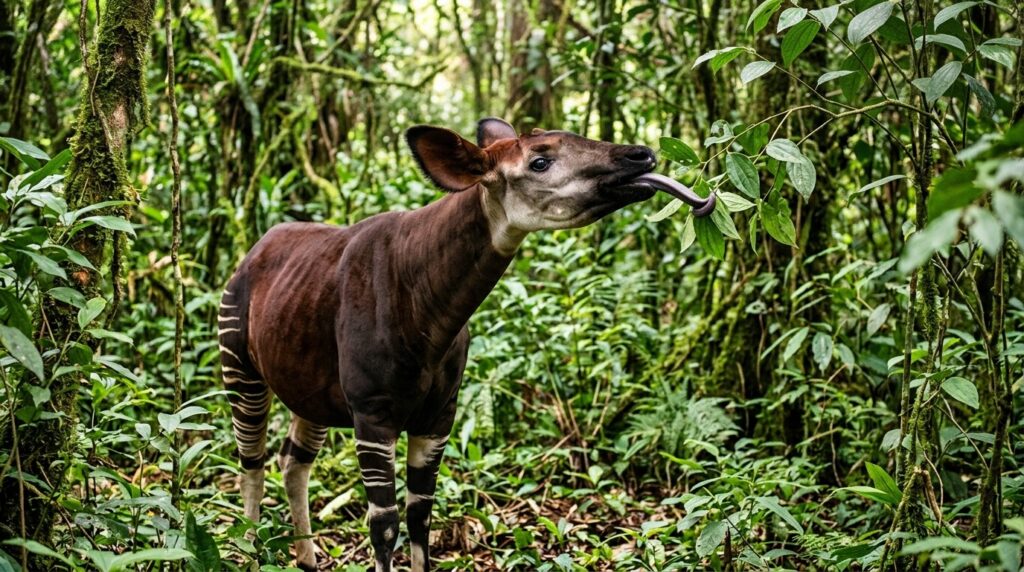
An okapi in a tropical forest — its tongue is just as dark as a giraffe’s
Other Animals with Black Tongues
Giraffes and okapi are not the only owners of unusually dark tongues. Polar bears are born with a pink tongue, but with age it gradually becomes dark blue or purple.
This is also related to melanin. The skin of a polar bear beneath its famous fur is black. The fur is not actually white but transparent — each hair is hollow and colorless, it simply scatters light so that it appears white. Black skin helps the bear absorb heat from the Arctic sun, and the dark tongue likely serves the same UV-protective function as in giraffes.
This creates a curious picture: animals from completely different climatic zones and with different lifestyles independently developed dark tongues. This hints that melanin pigmentation of the tongue is a fairly universal evolutionary solution, not a unique “feature” of giraffes.
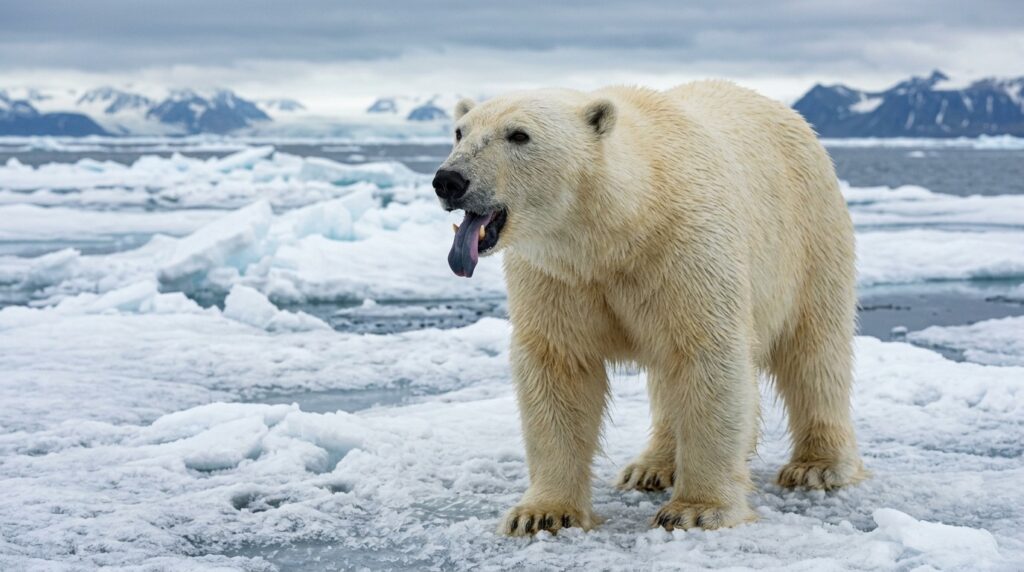
An adult polar bear’s tongue gradually darkens with age
Blue Tongue as a Weapon
But not all animals need a dark tongue for sun protection. According to PubMed, blue-tongued skinks of the species Tiliqua scincoides, found in Australia and Southeast Asia, use their bright blue tongue for an entirely different purpose. When the skink senses a threat, it opens its mouth wide and displays its contrasting tongue.
Scientists have not yet reached a consensus on whether the skink’s blue tongue serves as a predator deterrent or as a signal to other members of its species over long distances. Research published in the scientific literature points to both possible functions, but a definitive answer has not yet been found.
This example clearly shows that tongue color in the animal kingdom is multifunctional. The same external trait can solve different tasks in different species: from sun protection to communication and intimidation.
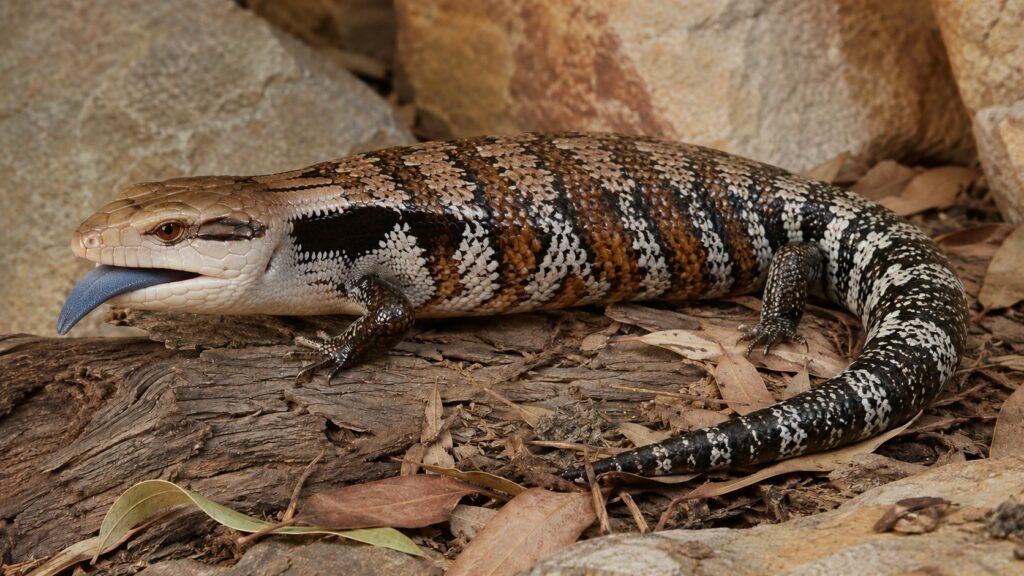
A blue-tongued skink
What Scientists Know About Giraffe Tongue Color
Let’s sum up. One thing is known for certain: the dark color of the giraffe’s tongue comes from a high concentration of eumelanin. The same pigment colors the skin of polar bears and is found in many other animals. And yes, melanin does indeed absorb ultraviolet light, shielding cells from damage.
What remains a subject of debate is the exact reason why this trait became established specifically in giraffes and okapi. The sun protection hypothesis is the most popular, but the case of the okapi shows that it may not be the only explanation. It is possible that dark tongue pigmentation is an inherited trait from a common ancestor that has been preserved in both species simply because it did not hinder survival, even if the forest-dwelling okapi has no direct need for it.
In evolution, this happens all the time: a trait can persist for millions of years not because it is critically important, but because it causes no harm. And yet, when the same trick appears in such different creatures — a giraffe in the savanna, a bear in the ice, a lizard in Australia — you can’t help but marvel at how inventive and yet economical natural selection can be.