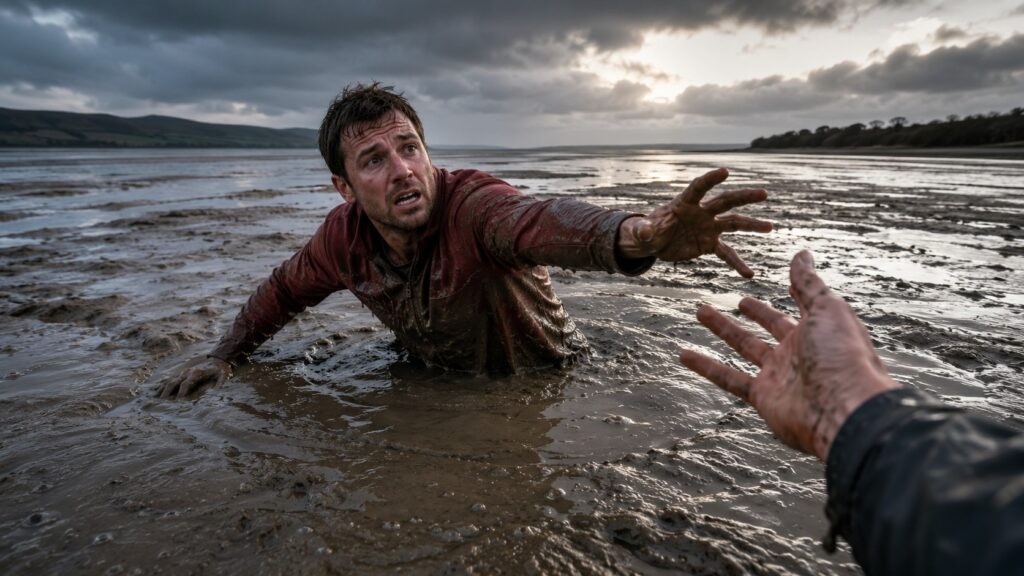
Quicksand is dangerous, but not the way it’s shown in movies
Quicksand can be called one of the most overrated dangers in nature, thanks to adventure movies. In films, a person steps on sand, sinks headfirst, and disappears within a minute. We’ve all watched quicksand in movies, and as children, we even thought we’d inevitably end up in such a situation someday. But how does quicksand actually work?
What Is Quicksand and How Does It Form
According to National Geographic, there is no special type of sand involved. Quicksand is ordinary sand, silt, or fine soil that is oversaturated with water. When water fills the gaps between particles, they stop holding on to each other. The surface looks solid, but the moment you step on it, your foot sinks in.
To make it clearer, imagine wet sand on a beach. Normally it’s firm and pleasant to walk on. Now imagine there’s too much water in it — so much that the grains are literally floating. On top, it may look like a flat, dry surface with a slight crust, but underneath is a liquid mush.
The physics here is simple. As long as the sand is undisturbed, it can support weight. But when a person steps on it, its structure breaks down, the water and sand redistribute, and a dense mass forms around the foot — something like a cement plug. That’s why a person doesn’t necessarily sink deep, but pulling the foot back out becomes very difficult. The harder you pull, the tighter it holds.
Where Quicksand Is Most Commonly Found
In movies, quicksand usually awaits heroes in the middle of a desert. However, in reality, you should look for it not in sand dunes but near water. Typical locations:
- tidal flats and intertidal zones;
- river mouths and estuaries;
- riverbanks after flooding;
- sandbars and silty areas of lakes;
- swampy terrain;
- quarries and washouts;
- stream beds in canyons;
- areas where groundwater is close to the surface.
One of the most well-known dangerous places is Morecambe Bay in the United Kingdom. It combines fast tides, quicksand, and constantly shifting channels. Local authorities explicitly warn that the bay is dangerous and that venturing onto the flats without preparation is not allowed.
Another example is Arches National Park in Utah, USA. Park documents mention that in some canyons, tourists have to navigate around areas of quicksand.
Does Quicksand Exist in Russia
Yes, quicksand exists in Russia as well. Potentially dangerous areas include river flats after spring flooding, reservoir shores, sand quarries, silty beaches, and areas near streams and washouts. Particularly treacherous are spots where a dry crust has formed on top, with a wet, loose layer underneath.
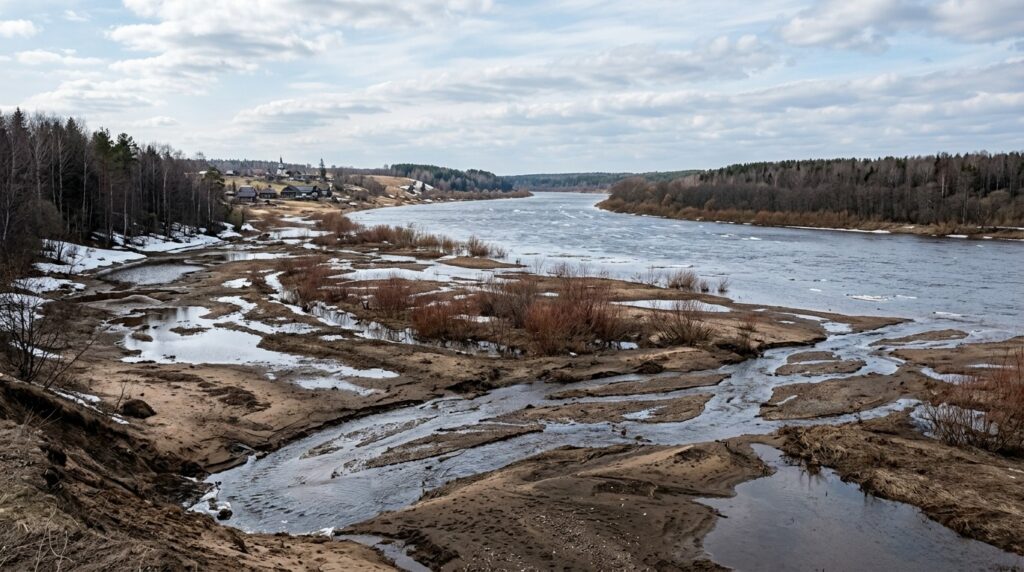
A river floodplain after flooding — a typical place where quicksand can be found in Russia
Quicksand in Russia is not uncommon; it’s just that Russia doesn’t have tides as powerful as Britain’s, so they’re not as dangerous. But getting stuck knee-deep in the silty bank of a river or quarry is a perfectly real scenario, especially if you’re alone and without a phone.
Can Quicksand Really Swallow a Person Whole
Short answer: no, it can’t. The density of quicksand is about 2 g/ml, while the density of the human body is about 1 g/ml. This means that a person in quicksand behaves roughly like a float — they sink but not all the way. Typically, a person sinks to about waist level and then stops, because the sand is simply too dense to let the body pass further down.
So the Hollywood scene where the hero slowly disappears beneath the surface with a dramatic expression on their face is pure fiction.
Why Quicksand Is Dangerous
The main threat of quicksand is not that it will swallow you, but that it will literally take you prisoner. And then circumstances take over:
- Tide. If you’re stuck on a tidal flat, the water can rise faster than you think;
- Hypothermia. Cold water or nighttime temperatures while immobilized pose a serious danger;
- Dehydration and heatstroke. In hot climates, several hours without water and shade can become critical;
- Panic. Sudden movements compact the sand around your legs and make the situation worse;
- Remoteness. If there are no people nearby and no cell service, even shallow entrapment can become fatal.
The British Coast Guard warns that estuaries and muddy shores may conceal channels with fast currents. If a person is stuck, they need professional help — not a friend who fancies themselves a hero and wades in without equipment, only to get stuck alongside them.
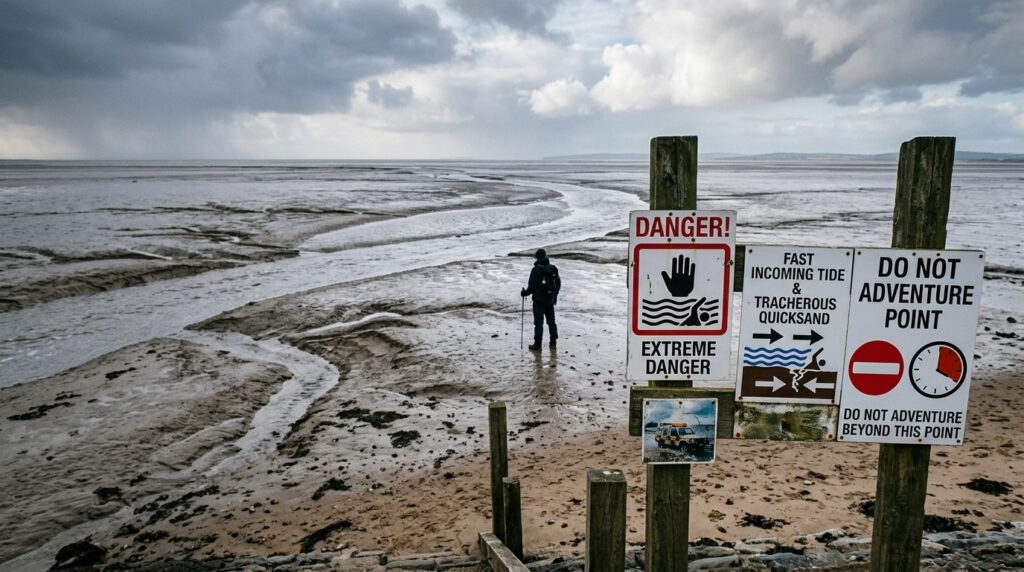
Morecambe Bay in the United Kingdom — one of the most well-known places with quicksand and fast tides
Real Cases of People Dying in Quicksand
The most well-known tragedy occurred in 2004 in Morecambe Bay. According to The Guardian, 23 Chinese workers collecting cockles on the flats died due to an incoming tide. They were killed by the flat tidal area, a rapidly rising tide, quicksand, and poor work organization. The workers were unable to leave the flats in time and became trapped.
In 2024, in the Solway Firth area (also in the United Kingdom), a 74-year-old woman became stuck in quicksand. She managed to call rescue services, but a fast-rising tide complicated the operation. According to The New York Times, her body was found the following day.
There are also cases with happy endings. In 2025, an experienced hiker in Arches National Park became stuck in quicksand in a canyon and sent an SOS distress signal. Rescuers searched for him with a drone and pulled him out using boards and shovels. He survived, but the risk was serious: cold, immobility, and remoteness from other people.
How to Tell If You’re Looking at Quicksand
There are several warning signs to watch for:
- A flat, wet tidal area where you can’t see the bottom;
- Water bubbles rising from the sand;
- A trembling or “jelly-like” surface;
- Sticky silt;
- A sudden transition from firm sand to soft;
- Washouts, areas near streams and drains;
- Places that were recently underwater — after flooding or a tide.
To quickly check whether you’re dealing with quicksand, push a stick into it. If it easily sinks deep and comes out with a characteristic squelching sound, you’re looking at a potentially dangerous area. In tidal zones, an additional risk factor is not knowing the tide schedule. If you’re walking across a wide, wet flat and don’t know when the water will return, that’s already a dangerous situation — even without quicksand.
What to Do If You Fall Into Quicksand
If this happens, the most important thing is not to panic and not to thrash around. Here is a step-by-step guide based on rescue service recommendations:
- Don’t make sudden movements. Jerking compacts the sand around your legs and makes things worse. Stop struggling — this is the first and most important step;
- Call for help immediately. Call 112 (in Russia) or 999 (in the UK). Say: “A person is stuck in sand or mud, there is a risk of water.” Your phone should be on you, not in a backpack three meters away;
- Distribute your weight. If you’re standing, try to slowly shift your weight backward, sit down, lie on your back or side. The greater the surface area of support, the less pressure on the ground and the slower you sink;
- Free your legs slowly. Don’t pull your leg straight up — this creates a vacuum and requires enormous force. Gently wiggle your toes, rotate your foot, and rock your leg with small movements. If there’s water nearby, pour it toward your stuck foot — this liquefies the sand around the foot and helps break down what feels like cement;
- Crawl your way out. Once your foot is free, don’t stand up to full height right away. Crawl backward along your own tracks or roll toward firmer ground.
And a few more important “don’ts.” Don’t run forward through a suspicious area. Don’t jump. Don’t let your friends come toward you without a board, rope, or understanding of what’s happening.