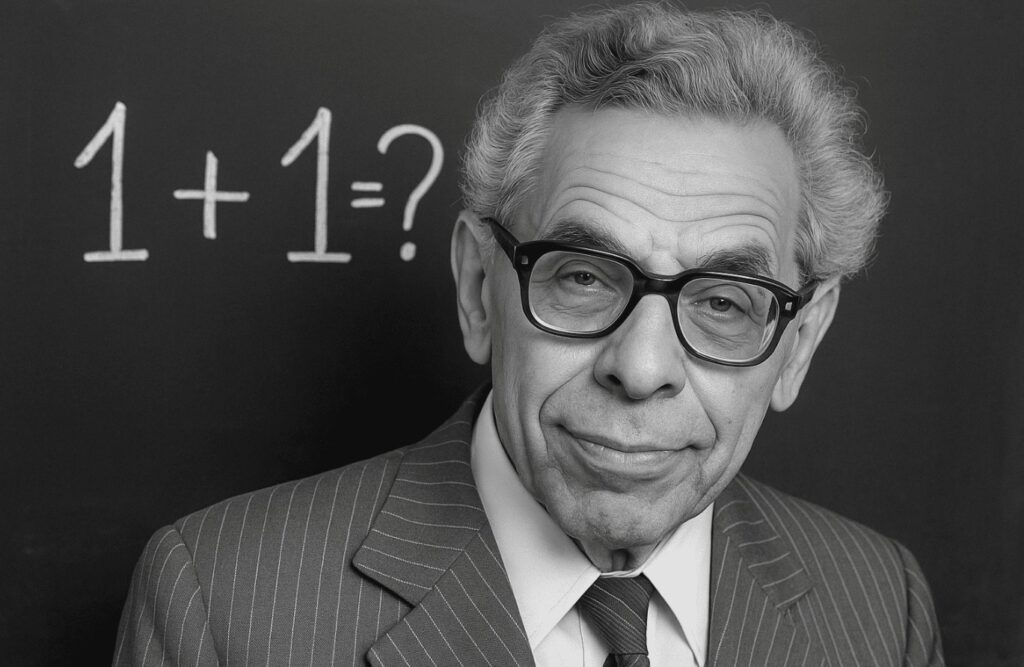
A neural network solved one of Paul Erdős’s most difficult problems
Recently, a 23-year-old guy with no mathematical education asked ChatGPT to solve a problem that the world’s best mathematicians had been struggling with for decades. The neural network managed it in 80 minutes, finding an approach that no human had ever thought of. The result has already been confirmed by one of the most famous mathematicians on the planet, Fields Medal laureate Terence Tao.
The Most Difficult Problem in Mathematics
Paul Erdős was a legendary 20th-century Hungarian mathematician who left behind hundreds of unsolved problems during his lifetime. Many of them are recorded on the special website erdosproblems.com, and they still serve as a challenge for mathematicians.
The problem in question is number 1196. It is related to so-called primitive sets — these are sets of integers in which no number can be evenly divided by another. A simple example: all prime numbers (2, 3, 5, 7, 11…) automatically form such a set because prime numbers are not divisible by anything other than themselves and one.
Erdős devised a special formula, the Erdős sum, to evaluate such sets with a single number — a kind of score. Back in the 1960s, he and his colleagues conjectured that if the numbers in the set are very large, then this score would tend toward exactly one. It sounds simple, but nobody could prove it.
In 2022, Stanford mathematician Jared Duker Lichtman proved another Erdős conjecture — that among all primitive sets, prime numbers give the maximum score (approximately 1.64). But problem number 1196, about the behavior of the score for very large numbers, still remained unanswered. Lichtman himself tried to solve it but got stuck, just like everyone before him.
ChatGPT for Solving Mathematical Problems
Liam Price is a 23-year-old Briton without a serious mathematical education. He has a ChatGPT Pro subscription, which gives access to the GPT-5.4 model — the most powerful version from OpenAI to date.
One Monday, Price simply entered the problem’s conditions into the chat. He didn’t even know how difficult it was.
I had no idea what this problem was. I just sometimes take Erdős problems and feed them to AI to see what happens, — he said.
ChatGPT thought for 80 minutes and produced something resembling a proof. Price sent the result to his acquaintance, Kevin Barreto, a second-year mathematics student at Cambridge. Barreto immediately realized he was looking at something important and contacted professional mathematicians.
Interestingly, Price and Barreto were already known in the mathematical community. At the end of 2025, they started feeding unsolved Erdős problems into the free version of ChatGPT, just for fun. Their approach was dubbed “vibe maths” — intuitive mathematics through trial and error with the help of AI. One AI researcher even gifted them both paid subscriptions to support their experiments.

Price received the ChatGPT answer after a single query; the model thought for 80 minutes
How ChatGPT Solved the Most Difficult Mathematical Problem
The key part of this story is not just the fact that it was solved, but how exactly the neural network found the solution.
Terence Tao, one of the most respected mathematicians in the world, explained that everyone who had previously tackled the problem started the same way. There was a standard set of techniques, and everyone followed the same route. But ChatGPT chose a completely different path and used a formula that is well known in adjacent areas of mathematics but that no one had thought to apply to problems of this type before.
According to Tao, all previous researchers collectively took a wrong turn at the very first step. And the neural network, unfamiliar with the tradition of solving such problems, simply didn’t have that limitation.
However, the raw proof produced by ChatGPT was far from ideal. Lichtman says directly: the result was rough, and a specialist had to work through it. But the key idea turned out to be viable. Tao and Lichtman trimmed and polished the proof, isolating the main line of reasoning.

AI found a path to a solution that professional mathematicians couldn’t see
Can a Neural Network Replace Mathematicians
AI solutions to Erdős problems are not new. Since the fall of 2025, neural networks have helped close about a hundred such problems. But most of them were essentially the result of smart searching: models found already published works that people simply didn’t know about and assembled an answer from existing pieces.
Problem 1196 is a different case. First, it was genuinely difficult — prominent mathematicians had worked on it and failed. Second, the neural network didn’t simply find a ready-made answer in the literature but proposed an approach that didn’t exist — a connection between different branches of mathematics that no one had noticed before.
Terence Tao emphasized that they discovered a new way of thinking about large numbers and their structure. And Lichtman added that the new method confirms his long-held intuition that an entire group of unsolved problems is interconnected and can be solved with one common approach.
At the same time, experts are cautious in their assessments. Tao says directly that this is a good achievement, but it’s too early to talk about its long-term significance. The point is not that AI has learned to do mathematics on its own, but that it can suggest directions that humans miss.
How Artificial Intelligence Is Changing Mathematics
This story is about changing the very process of scientific discovery. A person without specialized education, armed with a ChatGPT subscription, obtained a result that was inaccessible to professionals with decades of experience. Not because he is smarter, but because AI doesn’t have professional blinders — habitual thinking patterns that sometimes prevent seeing unconventional solutions.

The future of mathematics is the synergy between amateur curiosity, AI power, and professional expertise
But don’t think that now anyone with a laptop can advance science by pressing a single button. ChatGPT’s result required expert verification and refinement. Without Tao and Lichtman, it would have just been a strange text in a chat. The working model looks like a chain: an amateur asks AI a question, AI generates an idea, and a professional verifies and refines it.
The most valuable thing in this story is not the solution to one problem itself, but what came after it. Tao and Lichtman already see how to apply the approach found by AI to other unsolved problems in number theory. If this works, one ChatGPT query from a bored twenty-three-year-old could turn out to be the beginning of an entire series of discoveries. However, for now this is a prospect, not a guarantee.
Source: Scientific American