A piece of ancient Moon found in Africa: evidence of a forgotten cosmic cataclysm
A piece of the Moon that fell to Earth as a meteorite preserved the memory of a collision that occurred about 3.5 billion years ago and literally melted part of the lunar surface. The most interesting thing isn’t the impact itself, but that almost at the same geological time, powerful collisions also occurred on two other bodies of the Solar System — on Earth and on the giant asteroid Vesta. Scientists consider this coincidence a rare stroke of luck. Let’s find out why.
How a lunar rock ended up in an African desert
It sounds almost like science fiction, but pieces of other celestial bodies regularly arrive on their own. When a large asteroid slams into the Moon, some of the ejected material accelerates so much that it overcomes lunar gravity and flies off into space. After thousands or millions of years, some of these fragments cross Earth’s orbit and fall to the surface as meteorites.
That’s exactly the kind of lunar meteorite that was found in Africa. Desert regions are a real paradise for meteorite hunters: dark rocks are easily visible against light sand, and the dry climate prevents them from breaking down quickly. Compositional analysis showed that this sample indeed came from the Moon, and it preserved information about an ancient cataclysm.
How an ancient impact melted the Moon’s surface
When a large object slams into a solid surface at cosmic speed, kinetic energy is instantly converted into heat. In a powerful impact, rock literally melts, turning into a scorching mass that then solidifies again.
This solidification works like a natural clock. In the melted mineral, radioactive elements begin to decay at a known rate, and by measuring their ratios, scientists can calculate how much time has passed since the rock was last liquid. This is how researchers determined the age of the event — about 3.5 billion years.
Three impacts on the Moon, Earth, and Mars almost simultaneously
The most unexpected part of this story isn’t the meteorite’s age, but the company it finds itself in. The impact on the Moon occurred at roughly the same time as major collisions on two other bodies: our Earth and Vesta — the second largest asteroid in the Solar System.
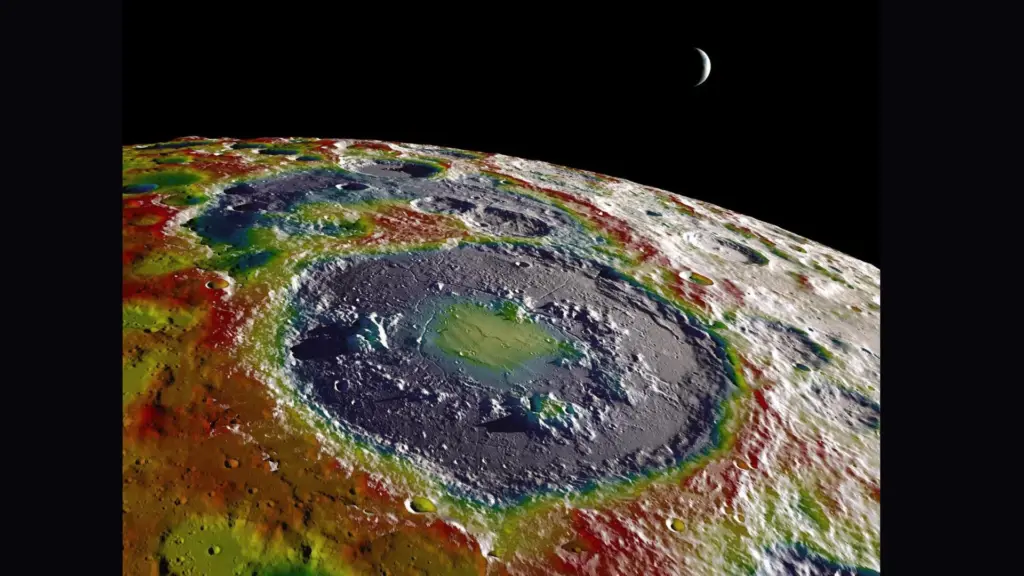
A large asteroid impact can melt rock and eject debris into space
Finding three such traces on three different worlds is extremely rare. Erosion, volcanism, tectonic plate movement, and other geological processes gradually erase nearly all scars of the past. On Earth, for example, ancient craters heal particularly quickly. That’s why the coincidence, where three impact records “line up” in time, is called an exceptional case by researchers.
This isn’t a very common occurrence, which is why we’re so excited. It’s quite rare for all three records to align like this, — noted one of the study’s participants named Crow.
What the lunar meteorite tells us about the early Solar System
Three nearly simultaneous impacts hint that 3.5 billion years ago, the neighborhood of the young Solar System was a far more turbulent place than it is today. During that era, there were many more asteroids flying around, and collisions occurred much more frequently.
Gradually, the number of “wandering” fragments decreased: some fell onto planets and moons, while others were ejected beyond the boundaries of the system. The team expects that a more detailed comparison of these three impacts will help understand exactly how the Solar System changed during that period — and how quickly it calmed down.
It’s fascinating how science can extract such stories from rocks: sometimes a single unremarkable sample completely overturns the picture of the past.
Why this meteorite matters for lunar research
Lunar meteorites are valuable because they come to us for free and can originate from the most diverse corners of the Moon — including places where neither humans nor robotic landers have ever visited. Samples brought back by Apollo missions were taken from only a few surface locations, while meteorites provide a much broader sampling.
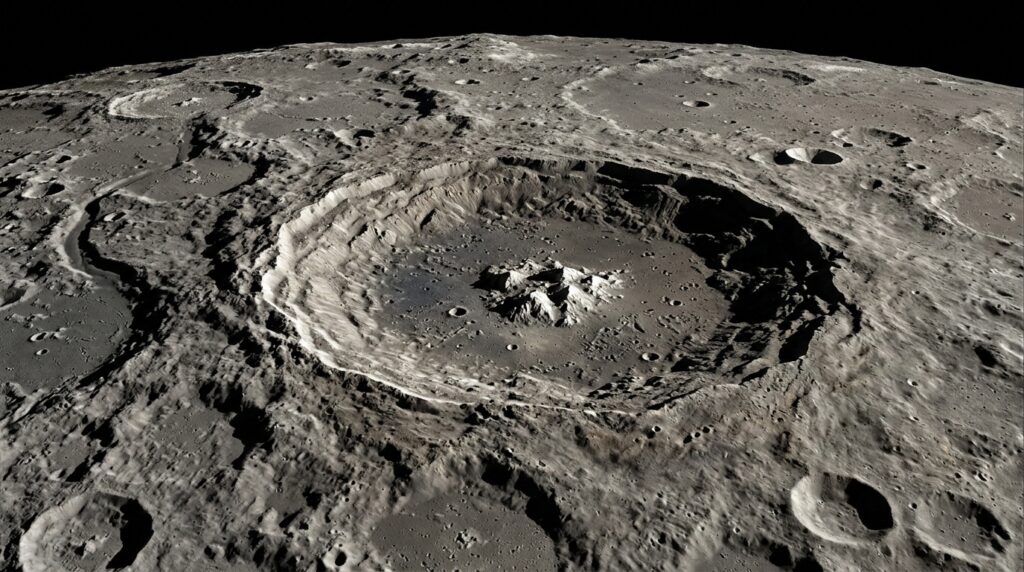
A large lunar crater photographed by a NASA orbiter
Each such rock is a chronicle of impacts recorded in minerals that shaped the Moon’s surface billions of years ago. The more such samples that can be dated, the more accurate the “schedule” of bombardments becomes — bombardments that young planets, including our own, endured.
For us, this isn’t abstract astronomy: those same collisions once reshaped the face of early Earth. By understanding how often and how forcefully asteroids struck billions of years ago, scientists can better reconstruct the conditions under which our planet formed and life originated. And a single rock from an African desert turned out to be yet another page in this ancient history, with comparisons to Earth and Vesta impacts ahead that could reveal much more.